Stock Market & Financial Terms Glossary India — A to Z
The stock market has its own language. And honestly, it can feel a bit overwhelming at first. Terms like Grey Market Premium, P/E ratio, F&O, CAGR, NAV — they're thrown around everywhere, but rarely explained clearly. We put this glossary together so you don't have to Google every word mid-conversation with your broker.
At Finoda, we believe financial literacy is step one of smart investing. This isn't a dictionary — it's a working reference. Whether you're opening your first demat account or trying to understand what sensex live data actually means, you'll find simple, honest answers here. And if you want to go beyond reading and actually start investing, open your free demat account with Finoda — no paperwork, no jargon.
Table of Contents
A — Asset Allocation, AMC, AMFI
Asset Allocation is how you divide your money across different types of investments — stocks, bonds, fixed deposits, gold, and so on. There's no one-size-fits-all formula here. Your allocation depends on your age, goals, and how comfortable you are with short-term losses. A 25-year-old building wealth might hold 80% in equities. Someone nearing retirement would likely flip that.
AMC (Asset Management Company) is the firm that manages your mutual fund money. When you invest in a SIP or mutual fund, an AMC like HDFC AMC, SBI MF, or Nippon India is the one making the actual investment calls on your behalf. They charge a fee — called the expense ratio — for doing this.
AMFI (Association of Mutual Funds in India) is the industry body that regulates and promotes mutual funds in India. It works alongside SEBI to set standards for fund houses and ensure investors are protected. If you're unsure whether your mutual fund advisor is legitimate, AMFI's ARN verification tool is the right place to check.
B — Broker, Bull Market, Beta
Broker is the intermediary between you and the stock exchange. You can't directly walk up to NSE or BSE and buy shares — you need a registered broker. At Finoda, we help our clients access NSE and BSE through a fully regulated trading platform, with real people available for guidance. Not just an app and an FAQ page.
Bull Market means prices are rising — and sentiment is positive. Technically, it's a 20% rise from recent lows. But in everyday conversation, it just means the market is on a roll. India's markets have seen multiple bull runs, and in our experience, new investors tend to enter during peak bull phases. That's usually not the best time. Knowing the difference between momentum and genuine value matters.
Beta measures how volatile a stock is compared to the broader market. A beta of 1 means the stock moves exactly in line with Nifty. A beta above 1 means it swings more — higher risk, potentially higher reward. A beta below 1 means it's more stable. For long-term investors, low-beta stocks tend to be more suitable during uncertain times.
C — CAGR, CDSL, Call Option
CAGR (Compound Annual Growth Rate) tells you how much an investment has grown per year, on average, over a given period. If a fund turned ₹1 lakh into ₹2 lakh in 5 years, the CAGR is about 14.87%. It's one of the most honest ways to compare investment performance — better than just saying "it doubled."
CDSL (Central Depository Services India Limited) is one of India's two depositories. When you open a demat account, your shares are held electronically — either with CDSL or NSDL. Your shares don't disappear when your broker shuts down, because they're held at the depository level, not with the broker. This is an important safety net most new investors don't think about.
Call Option is a contract that gives the buyer the right — but not the obligation — to purchase a stock at a fixed price before a set date. Options are part of the F&O (Futures and Options) segment. They're powerful instruments but come with real risk. We'd strongly recommend learning derivatives basics before trading them.
D — Demat Account, Dividend, Derivatives
Demat Account stands for Dematerialised Account. It's the digital locker where your shares, bonds, and mutual fund units are stored in electronic form. Before demat accounts existed, investors held physical share certificates — which could be lost, stolen, or forged. Today, the whole process is paperless and instant. Opening a demat account is the first step to investing in stocks or IPOs.
Dividend is a company's way of sharing its profits with shareholders. Not all companies pay dividends — many prefer to reinvest profits back into growth. But consistent dividend-paying companies, especially PSU stocks and FMCG majors in India, are popular among income-seeking investors. The dividend yield — dividend per share divided by share price — is a useful metric to compare.
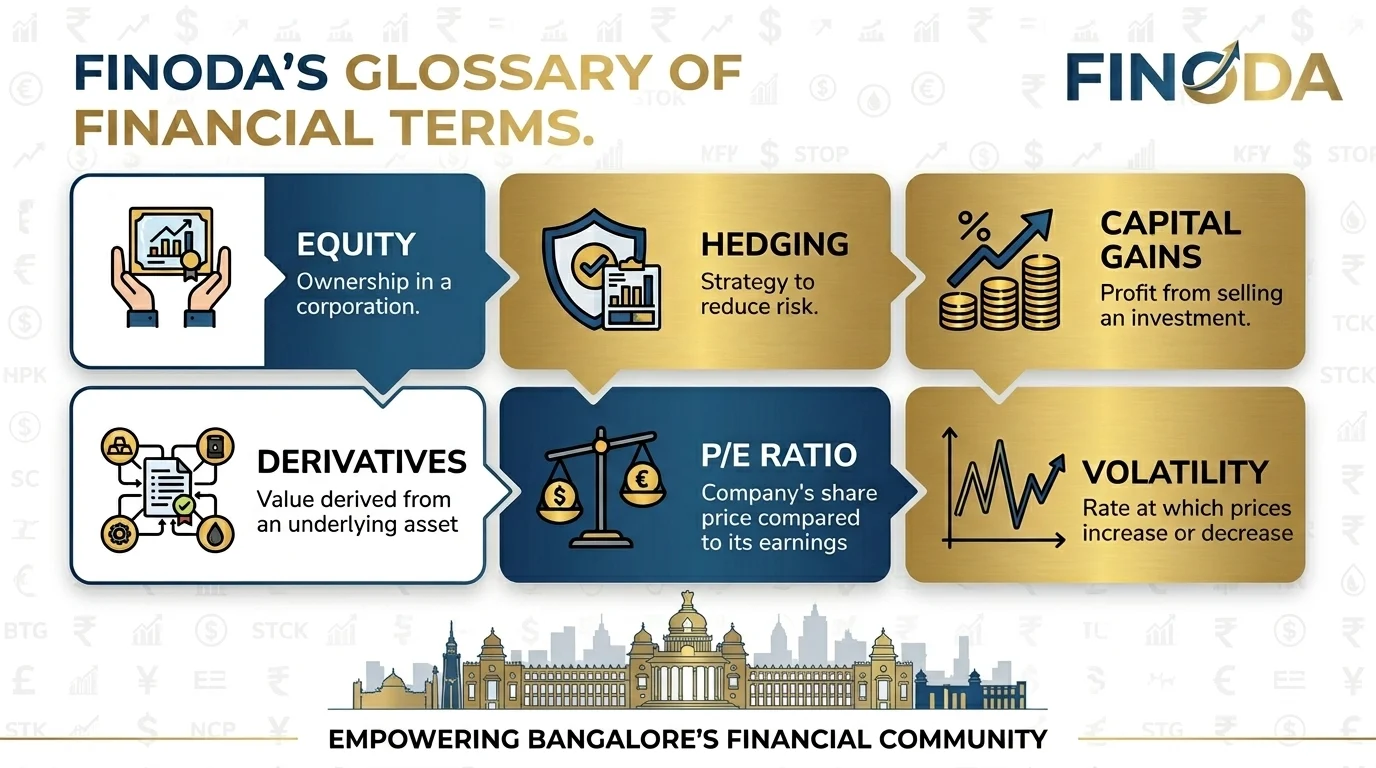
Derivatives are financial contracts whose value is derived from an underlying asset — a stock, commodity, index, or currency. Futures and options are the two main types. They're used for hedging risk or for speculation. Derivatives trading on NSE is one of the most active in the world by volume, but it's not something beginners should rush into.
E — Equity, ELSS, Exchange
Equity means ownership. When you buy shares, you're buying a small equity stake in that business. Equity investors benefit when the company grows — through rising share prices and dividends. However, equity also means last in line during liquidation if the company goes bankrupt. That's the risk. Over long periods, Indian equities have historically delivered 12–15% CAGR, well above inflation.
ELSS (Equity Linked Savings Scheme) is a type of mutual fund that gives you a tax deduction of up to ₹1.5 lakh per year under Section 80C. It has a mandatory 3-year lock-in, which is actually the shortest among all 80C investments. And because it's equity-heavy, returns have generally beaten FDs and PPF over longer periods. We've found ELSS to be one of the most underused tax-saving tools among our first-time clients.
Exchange — India has two main stock exchanges: NSE (National Stock Exchange) and BSE (Bombay Stock Exchange). NSE is larger by trading volume, especially in derivatives. BSE is older, established in 1875. Most listed companies trade on both. The nse bse share price for a given stock is usually identical or very close, thanks to arbitrage.
F — F&O, Fixed Deposit, Fund Manager
F&O (Futures and Options) is the derivatives segment of the stock market. Futures are contracts to buy or sell at a set price on a future date. Options give you the right — not obligation — to do so. SEBI's 2024 data showed that ~90% of individual F&O traders in India reported losses. So the question isn't whether you can trade F&O — it's whether you should, right now, without proper guidance.
Fixed Deposit (FD) is one of India's most trusted investment instruments. You park money for a fixed tenure, earn a guaranteed interest rate, and get your principal back at maturity. FD rates in India currently range from about 6.5% to 9% depending on the bank and tenure. They're not exciting, but they're predictable. We offer competitive FD options through our Fixed Deposit investment page.
Fund Manager is the professional who decides where your mutual fund money gets invested. Their track record, investment philosophy, and experience matter. A fund manager change is often a signal to review your holdings — even if the fund name stays the same.
G — GMP, Growth Fund, Gilt Fund
GMP (Grey Market Premium) is the unofficial price at which IPO shares trade before they are officially listed. It's not regulated and not guaranteed. But it's widely watched as an early indicator of listing sentiment. A high grey market premium IPO doesn't always list at a premium — and a low GMP doesn't mean bad listing. We've seen both scenarios. Treat it as one data point, not a buying signal.
Growth Fund focuses on companies expected to grow faster than the market average — typically mid-cap and small-cap businesses. They're more volatile but can deliver higher returns over 5–10 years. Suitable for investors who can stay invested through corrections.
Gilt Fund invests in government securities. Since the Indian government doesn't default on domestic debt, these are low credit-risk funds. However, they're sensitive to interest rate movements. When rates rise, gilt fund NAVs typically fall. Useful for conservative investors who still want to avoid the volatility of equities.
Market Cap, NAV, Nifty 50, NSE
Market Cap (Market Capitalisation) is the total value of all a company's outstanding shares. It's calculated by multiplying share price by total shares. Companies are classified as large-cap (top 100 by market cap), mid-cap (101–250), and small-cap (251 and beyond). Large-caps are more stable. Small-caps carry more risk — and more potential reward.
NAV (Net Asset Value) is the per-unit price of a mutual fund. It's calculated at the end of each trading day. A higher NAV doesn't mean a more expensive or better fund — it just means the fund is older or has grown more. Comparing two funds purely on NAV is one of the most common mistakes new investors make.
Nifty 50 is the benchmark index of NSE, tracking 50 large Indian companies across 13 sectors. It's the go-to reference for Indian market performance. When people say "the market is up 1% today," they usually mean Nifty 50 moved 1%. Nifty 50 stocks list changes periodically as companies are added or removed based on market cap and liquidity.
NSE (National Stock Exchange) was set up in 1992 and started trading in 1994. Today it's one of the world's largest exchanges by derivatives volume. The NSE website at nseindia.com has extensive data tools for investors and traders. Most brokers, including the platform we work with, are registered with NSE.
P — P/E Ratio, Premium, Portfolio
P/E Ratio (Price-to-Earnings Ratio) compares a company's current share price to its earnings per share. A P/E of 20 means you're paying ₹20 for every ₹1 the company earns annually. High P/E can mean investors expect strong future growth — or it can mean the stock is overvalued. Context matters. The p e ratio of a sector leader is usually higher than a value stock. Neither is automatically better.
Premium has multiple meanings in finance. In options, it's the price you pay to buy an options contract. In insurance, it's the amount you pay to keep your policy active. In IPOs, it refers to the grey market premium — how much above issue price the shares are trading informally before listing.
Portfolio is the total collection of investments you hold — stocks, mutual funds, FDs, gold, bonds, real estate. A well-built portfolio isn't just about having many things — it's about having the right things in the right proportions. Diversification reduces risk. But over-diversification dilutes returns. Finding that balance is where proper financial guidance helps.
S — SEBI, SIP, Sensex, STT
SEBI (Securities and Exchange Board of India) is the regulatory authority that oversees India's capital markets. It protects investor interests, regulates brokers and fund houses, and sets rules for IPOs, trading, and disclosures. All brokers and advisors operating in India's markets function under SEBI's guidelines and regulatory framework. You can check any broker's registration at sebi.gov.in.
SIP (Systematic Investment Plan) is the most popular way Indians invest in mutual funds today. You invest a fixed amount — say ₹500 or ₹5,000 — every month, automatically. SIP works through rupee cost averaging: you buy more units when prices are low, fewer when prices are high. Over time, this smooths out market volatility. We've found that clients who run SIPs without trying to time the market consistently outperform those who stop and start.
Sensex is the flagship index of BSE, tracking 30 financially sound, large-cap companies. When people check "sensex live," they're checking the real-time value of this index. It was launched in 1986 with a base value of 100. As of early 2025, it crossed the 75,000 mark. That journey tells you a lot about the long-term power of Indian equities.
STT (Securities Transaction Tax) is a direct tax levied on every stock transaction in India. It's collected at source by stock exchanges. For equity delivery trades, STT is 0.1% on both buy and sell. For intraday trades, it's lower. STT is non-refundable and should be factored into your cost of trading.
Complete Index of Financial Terms — Quick Reference A to Z
Can't find what you're looking for in the sections above? Here's a quick reference of more commonly used financial terms across Indian markets:
| Term | Quick Definition |
|---|---|
| ASBA | Application Supported by Blocked Amount — IPO application method where funds are blocked, not debited, until allotment |
| Blue Chip | Large, stable, financially sound companies with a long track record — e.g., TCS, HDFC Bank, Reliance |
| Commodity | Physical goods traded on exchanges — gold, silver, crude oil, natural gas, agricultural products |
| Circuit Breaker | SEBI-mandated halt in trading if a stock or index moves beyond a preset percentage limit |
| DRHP | Draft Red Herring Prospectus — the document a company files before an IPO, containing all material details |
| EPS | Earnings Per Share — net profit divided by total shares outstanding |
| ETF | Exchange Traded Fund — a basket of securities traded like a stock on an exchange |
| Face Value | The nominal value of a share as stated in the company's books — often ₹1, ₹2, or ₹10 |
| Hedging | Taking a position to reduce risk on an existing investment |
| Index Fund | A mutual fund that passively tracks a benchmark like Nifty 50 |
| KYC | Know Your Customer — mandatory identity verification before investing |
| Leverage | Using borrowed capital to amplify potential returns — and potential losses |
| Limit Order | An order to buy or sell only at a specified price or better |
| Liquidity | How easily an asset can be converted to cash without affecting its price |
| LTCG | Long Term Capital Gains — tax on profits from assets held over a defined period |
| Market Order | An order to buy or sell at the current market price, executed immediately |
| NSDL | National Securities Depository Limited — one of India's two depositories |
| NPS | National Pension System — government-backed retirement savings scheme |
| OPEX / CAPEX | Operating Expenditure vs. Capital Expenditure — used in fundamental analysis |
| PMS | Portfolio Management Service — customised investment management for HNIs |
| ROE | Return on Equity — how efficiently a company uses shareholder capital to generate profit |
| STCG | Short Term Capital Gains — tax on profits from assets sold before the long-term holding threshold |
| Stop Loss | An order placed to sell a security when it reaches a certain price, limiting loss |
| Swing Trading | Holding stocks for days to weeks to capture short-term price moves |
| Ticker Symbol | The abbreviated code that identifies a stock on an exchange — e.g., RELIANCE, INFY, HDFCBANK |
| ULIP | Unit Linked Insurance Plan — combines investment and insurance in one product |
| Volume | Total number of shares traded in a given period — a measure of market activity |
| Yield | Income generated by an investment, expressed as a percentage of cost or current price |
| 52-Week High/Low | The highest and lowest prices at which a stock has traded in the past 52 weeks |
→ Still have questions? Book a free consultation with the Finoda team
Frequently Asked Questions About Financial Terms
It's a reference guide that explains the technical words used in stock markets, mutual funds, insurance, and investing. You need it because financial jargon is one of the main reasons people avoid investing — and avoiding investing is expensive in the long run.
NSE stands for National Stock Exchange and BSE stands for Bombay Stock Exchange. Both are India's primary stock exchanges where companies list their shares and investors buy and sell them. Most stocks are available on both exchanges, and prices are usually similar.
Sensex live refers to the real-time value of BSE's benchmark index — the S&P BSE Sensex. It tracks 30 large, financially sound companies. The calculation uses free-float market capitalisation: the total market value of only those shares that are actively tradable by the public.
SEBI — Securities and Exchange Board of India — is the statutory regulator for India's securities markets. It licenses brokers, regulates IPOs, penalises market manipulation, and ensures investor protection. Every broker, advisor, and fund house in India operates under SEBI's regulatory framework.
Grey market premium is the price at which IPO shares trade unofficially before the official listing date. It's an informal, unregulated market. A high GMP suggests positive listing sentiment, but it's not a guarantee. We've seen high-GMP IPOs list below issue price and vice versa.
Fixed deposit interest rates in India currently range from about 6.5% to 9% per annum depending on the bank, tenure, and whether you're a senior citizen. Small finance banks typically offer the highest rates. Finoda can help you compare and choose the right FD option — check our FD page.
Market cap is the total value of a company's outstanding shares — price multiplied by share count. It tells you the size of a company. Large-cap companies (₹20,000 crore+) are generally more stable. Mid-caps and small-caps offer higher growth potential with more volatility. Most portfolio strategies use a mix.
P/E ratio is the price you pay per rupee of earnings. A P/E of 15–20 is generally considered reasonable for Indian large-caps, but sector context matters. IT and FMCG companies tend to trade at higher P/E. PSU banks often trade at lower P/E. There's no universal "good" number — you compare within the same sector.
Nifty 50 is a basket of 50 large-cap companies listed on NSE, representing 13 sectors. NSE reviews the composition semi-annually. A stock gets added when it meets liquidity, market cap, and trading frequency criteria. Stocks that no longer meet the criteria get replaced. The nifty 50 stocks list is publicly available on NSE's website.
CAGR stands for Compound Annual Growth Rate. Formula: [(Ending Value / Beginning Value) ^ (1 / Number of Years)] – 1. For example, ₹1 lakh growing to ₹2 lakh in 5 years = CAGR of 14.87%. It's the most reliable way to measure and compare investment growth across different time periods.
Both are Indian stock exchanges where shares are bought and sold. NSE was established in 1992 and is larger by derivatives volume. BSE, established in 1875, is Asia's oldest exchange. Most Indian stocks trade on both. NSE uses the Nifty 50 index; BSE uses the Sensex.
A Demat (Dematerialised) account stores your shares electronically — like a bank account for securities. You can't buy or sell stocks without one. It's held with a depository (CDSL or NSDL), not with your broker. This means your shares are safe even if your broker changes. Open your free demat account here.
SIP — Systematic Investment Plan — lets you invest a fixed amount in a mutual fund every month. It builds discipline, removes the need to time the market, and benefits from rupee cost averaging over time. You can start a SIP for as low as ₹500/month.
Before trading F&O, understand: Lot Size (minimum quantity per contract), Premium (price of an options contract), Strike Price (the agreed price in the contract), Expiry Date (when the contract expires), OTM/ATM/ITM (Out / At / In the Money), and Open Interest. F&O involves significant risk — read the risk disclosure first.
ELSS — Equity Linked Savings Scheme — offers a ₹1.5 lakh deduction under Section 80C. It has a 3-year lock-in (shortest among 80C options) and equity-driven returns that have historically beaten PPF over longer horizons. PPF offers guaranteed, tax-free returns but has a 15-year tenure. ELSS suits aggressive investors; PPF suits conservative ones. Learn more about ELSS.