
Is Forex Trading Legal in India? Yes — But Only Through NSE Currency Derivatives
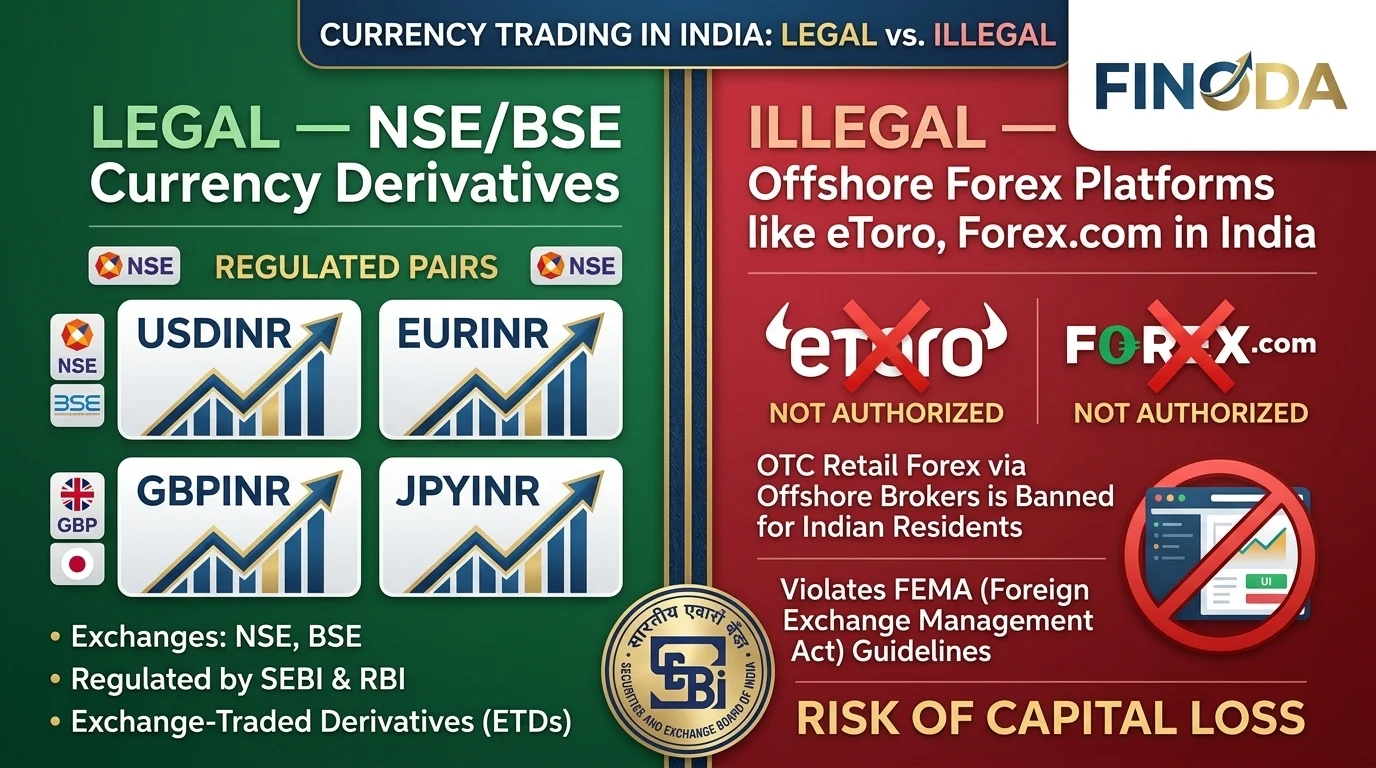
Yes, forex trading is legal in India — but it comes with one very clear condition. You can only trade through NSE or BSE's currency derivatives segment, using brokers who operate under SEBI guidelines. That's it. Any offshore platform, any app promising you EUR/USD trading from your phone through a foreign broker — that's illegal under FEMA and the RBI rules. We've seen a lot of confusion around this, so let's clear it up for good.
At Finoda, we help traders and investors across India navigate the currency markets the right way. Whether you're hedging dollar income, speculating on the rupee, or simply exploring a new asset class — this is the complete guide to legal currency trading in India.
What Is Legal Currency Trading in India? — RBI & SEBI Framework
India's currency market runs on a strict rulebook. The Foreign Exchange Management Act (FEMA), 1999 is the base law. It decides what Indian residents can and can't do when it comes to foreign currency. On top of that, RBI sets the policy — which pairs are allowed, which exchanges can offer these products, and what transactions are permitted. SEBI, meanwhile, regulates the brokers and exchanges that give retail traders access to currency derivatives.
So when you trade currency legally in India, here's what that actually looks like: You open a trading account with a broker operating under SEBI guidelines. Your trades go through NSE or BSE's currency derivatives segment. You buy or sell futures or options contracts on permitted INR-based currency pairs. Everything is exchange-regulated, transparent, and settled in Indian rupees.
What's not legal? Signing up on an international platform — an eToro, a Forex.com, or any foreign broker — and trading EUR/USD or GBP/USD with your INR. Under FEMA, sending money abroad to fund speculative forex accounts is prohibited for Indian residents. The penalty can go up to three times the transaction amount, plus asset confiscation in serious cases. It's not worth the risk when the legal route works just as well.
We always tell our clients: the NSE currency market is not a compromise — it's a genuinely liquid, well-regulated market. Daily volumes on USD/INR alone run into billions of rupees. You don't need an offshore platform to trade currencies seriously in India.
Currency Pairs Available on NSE — USD, EUR, GBP, JPY vs INR
NSE lists four main INR-based currency pairs for futures and options trading. These are the only pairs Indian residents can legally speculate on. Additionally, NSE offers cross-currency contracts on EUR/USD, GBP/USD, and USD/JPY — but again, only as exchange-listed derivatives, not spot forex. Here's a breakdown of each pair:
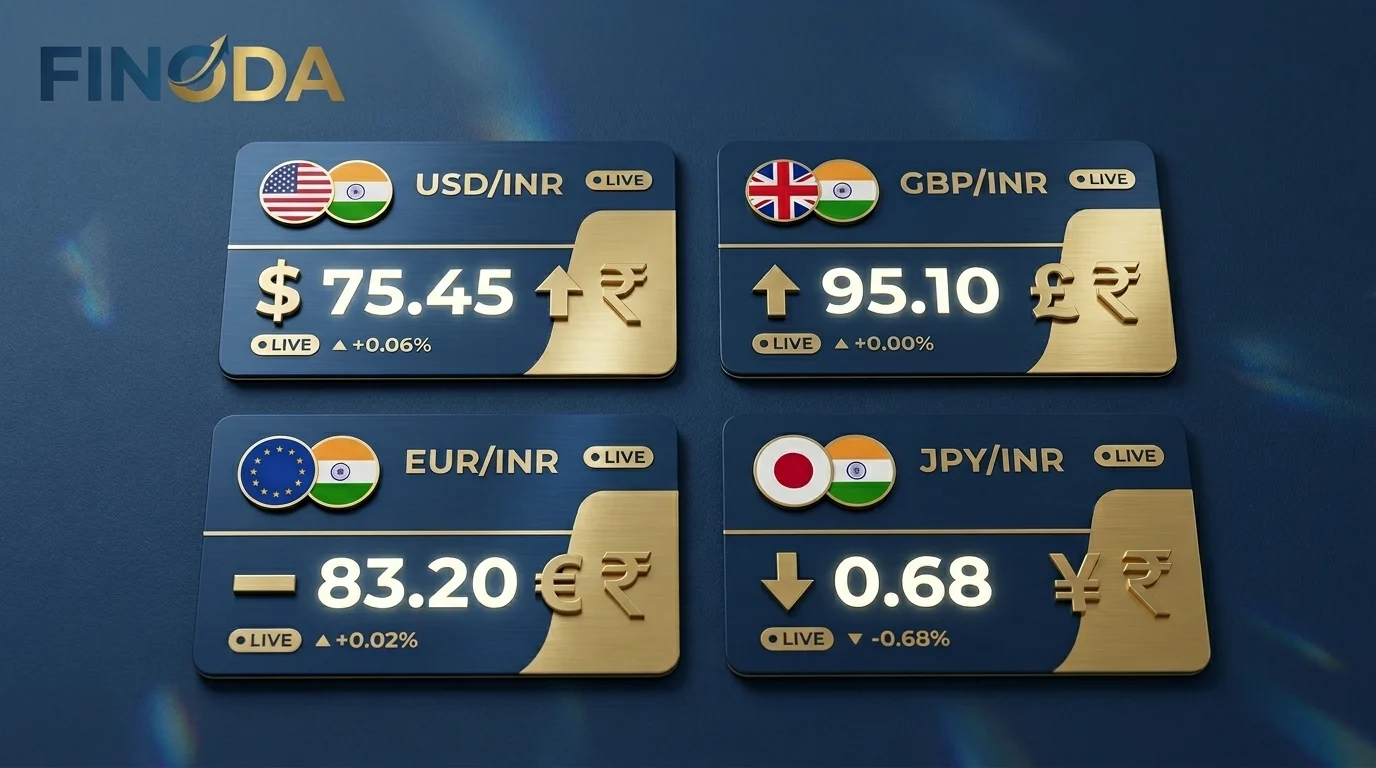
USD/INR — India's Most Traded Currency Pair
USD/INR is, by a wide margin, the most active currency pair on NSE. The dollar-rupee pair attracts traders ranging from large corporates hedging import/export exposure to retail traders speculating on RBI policy and US Fed decisions. Contract lot size is 1,000 USD, and margins are typically in the range of 1.5–3% of the contract value. In our experience, USD/INR is the best starting point for anyone new to currency trading in India — good liquidity, tight spreads, and a clear macroeconomic story to follow.
EUR/INR — Second Most Active Pair
EUR/INR gets over 500,000 searches per month in India — it's one of the most looked-up currency terms on Google. And it's easy to see why. Euro exposure is relevant for businesses dealing with European clients, IT professionals working on European projects, and students and families sending money to EU countries. The pair trades with reasonable liquidity on NSE and follows ECB policy decisions, EU economic data, and INR movements. It's a solid pair for traders who follow global macro news.
GBP/INR & JPY/INR — Useful Pairs for Specific Needs
GBP/INR matters a lot for traders and businesses with UK ties — especially post-Brexit movements have made the pound genuinely volatile and interesting to trade. JPY/INR, on the other hand, is often used by traders who track the Bank of Japan's yield curve policy and the yen's role as a global safe-haven currency. Both pairs are available as futures and options on NSE. Liquidity is lower than USD/INR, but these pairs can offer good opportunities during specific macro events. We'd generally recommend these pairs for traders who already have some experience with USD/INR.
Currency Trading Hours in India — NSE/BSE Schedule
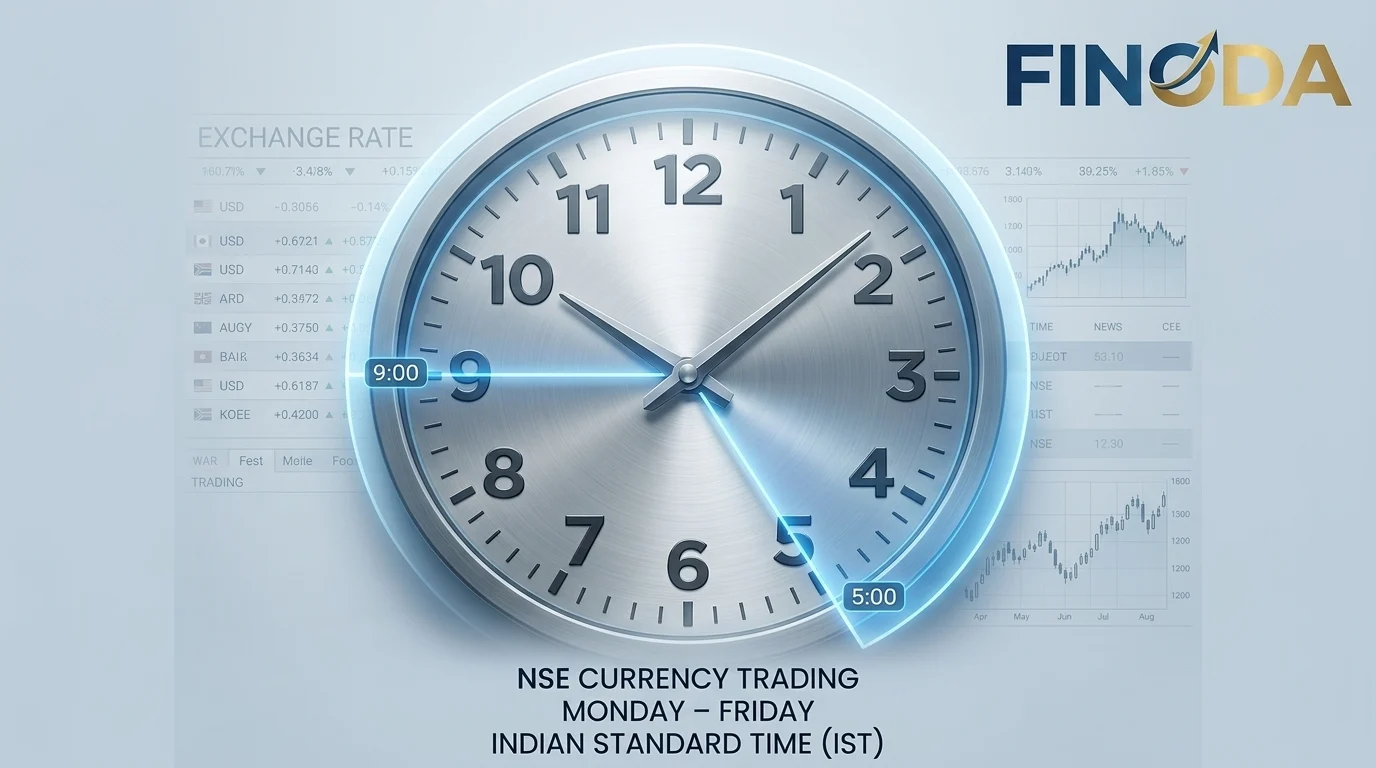
NSE currency derivatives trade from 9:00 AM to 5:00 PM IST, Monday to Friday, on all Indian stock market trading days. That's it — no 24-hour access, no weekend sessions. This is quite different from the global forex market, which runs around the clock. But for most Indian traders, those eight hours are more than enough. The bulk of USD/INR price action happens during Indian market hours anyway, especially around the RBI's daily reference rate fixing at around 12:30 PM.
One thing to keep in mind: NSE currency hours extend beyond normal equity hours (equity closes at 3:30 PM, currency stays open until 5:00 PM). That extra window — 3:30 PM to 5:00 PM — often sees interesting moves tied to global news coming in from European markets and the US pre-market. Smart traders use that window carefully.
And if you're a global currency watcher wondering about the London or New York sessions — those aren't accessible through NSE legally. But frankly, for INR-based pairs, the action is right here in Indian hours.
| Session | Time (IST) | Notes |
|---|---|---|
| Opening | 9:00 AM | Aligns with equity market open |
| RBI Reference Rate | ~12:30 PM | Key daily event for USD/INR |
| Equity Close | 3:30 PM | Currency segment continues |
| Currency Close | 5:00 PM | Final settlement for the day |
| Days | Mon–Fri | Closed on NSE holidays |
Who Should Actually Trade Currency in India?
Currency trading isn't just for speculators. In our experience, there are three types of people who genuinely benefit from the NSE currency derivatives market — and only one of them is a pure trader.
Exporters and importers use USD/INR futures to lock in exchange rates. If you run a business that invoices in dollars and you're worried the rupee might strengthen before your payment comes in — a short USD/INR futures position hedges that risk. Same logic applies to importers paying in euros or pounds. This is legitimate, structured hedging. It's not speculation; it's risk management.
Then there are IT professionals and freelancers earning in dollars. If your monthly salary or client payments come in USD, and you want to protect yourself from rupee appreciation eating into your earnings, currency futures give you a clean tool for that. Even a small hedge on anticipated dollar income can make a real difference over a year.
And finally, active traders who follow macro economics — RBI policy, US inflation data, global risk events — often find currency futures more predictable than individual stocks during certain market conditions. The currency market is deep, transparent, and driven by clear macro fundamentals rather than quarterly earnings surprises.
Not sure which category fits you? Talk to one of our advisors — we'll help you figure out whether currency trading makes sense for your situation before you put a single rupee at risk.
How to Start Currency Trading on NSE Through Finoda
Starting is simpler than most people expect. Here's how we walk clients through it:
- Open a free demat and trading account — Start here. You'll need your PAN card, Aadhaar, bank details, and a selfie. KYC takes about 15 minutes.
- Activate the currency segment — Once your account is open, request activation of the NSE currency derivatives segment. We handle this for you.
- Add margin funds — Transfer funds from your bank to your trading account through standard banking channels. Your funds stay in your name throughout.
- Pick your pair — USD/INR is the right starting point for most beginners. You can also trade EUR/INR, GBP/INR, or JPY/INR based on your exposure or view.
- Place your trade — Buy or sell currency futures or options between 9 AM and 5 PM IST, Monday to Friday. Set stop-losses from day one — always.
We're based in Bangalore, but we serve clients across India. Most of our onboarding is fully digital. However, if you prefer sitting down with someone and understanding the market first — our team is available at our Kodihalli office or over a phone call at 9035294343.
Also worth reading: Derivatives F&O at Finoda | Commodity Trading | Complete Demat Account Guide | Stock Market Basics Hub
Legal vs Illegal Forex Trading in India — Quick Reference
| ✅ Legal in India | ❌ Illegal in India |
|---|---|
| Trading USD/INR, EUR/INR, GBP/INR, JPY/INR on NSE/BSE | Trading EUR/USD, GBP/JPY or other non-INR pairs via offshore brokers |
| Using a broker operating under SEBI guidelines | Using unregistered foreign brokers or apps |
| Currency futures and options on NSE | Spot forex or CFDs through overseas platforms |
| Exchange-listed cross-currency contracts (EUR/USD, GBP/USD, USD/JPY) on NSE | Sending money abroad via e-wallets or crypto to fund forex accounts |
| Hedging business FX exposure through NSE currency derivatives | Binary options trading on offshore platforms |
Source: NSE Currency Derivatives | RBI FEMA Regulations | SEBI Currency Circulars
Currency Trading Charges at Finoda — What You Actually Pay
Transparency matters to us. So here's what currency trading actually costs in India through a regulated broker. Note that charges are set by SEBI/NSE and are standard across brokers — what differs is the brokerage itself.
| Charge Type | Rate | Notes |
|---|---|---|
| Brokerage | As per your plan | Contact us for current rates |
| STT (Securities Transaction Tax) | 0.01% on sell side (futures) | Options: 0.05% on premium |
| Exchange Transaction Charges | ~0.0009% (NSE) | Standard exchange fee |
| GST | 18% on brokerage + charges | Standard across India |
| SEBI Fees | ₹10 per crore of turnover | Regulatory charge |
| Stamp Duty | 0.002% on buy side | As per state rules |
Currency trading charges are among the lowest of any segment in Indian markets. This is one reason why currency derivatives are popular for short-term and intraday strategies. Even a small margin gives you meaningful exposure, and the cost of transacting is minimal.
Want a detailed charge breakdown before you start? Get in touch with us — we'll walk you through the exact cost structure for your trading style.
Frequently Asked Questions — Currency Trading in India
Real questions from real traders. Here's what we hear most often:
1. Is forex trading legal in India?
Yes — currency trading is legal in India, but only through NSE or BSE's currency derivatives segment using brokers operating under SEBI guidelines. Trading on offshore platforms like eToro or international forex brokers using INR is illegal under FEMA regulations. The key point: you're trading derivatives of currency pairs, not buying and holding foreign currency directly.
2. Which currency pairs can I trade legally in India?
On NSE and BSE, you can legally trade USD/INR, EUR/INR, GBP/INR, and JPY/INR as currency futures and options. NSE also lists EUR/USD, GBP/USD, and USD/JPY as cross-currency contracts — but only as exchange-listed derivatives through a SEBI-regulated broker.
3. What are the currency trading hours in India?
NSE and BSE currency derivatives trade from 9:00 AM to 5:00 PM IST, Monday to Friday, on all Indian market trading days. There's no 24-hour access — this is a key difference from the global forex market.
4. Can I use leverage in currency trading in India?
Yes. Currency derivatives on NSE/BSE are margin-based instruments — you only put up a fraction of the full contract value. SEBI regulates the margin requirements, which vary by pair and contract type. Leverage amplifies both gains and losses, so use it carefully.
5. Why is trading on international forex platforms illegal in India?
Under FEMA and RBI regulations, Indian residents can't remit money to overseas forex platforms for speculative trading. If you send money abroad to fund a foreign forex account, that's a direct FEMA violation. Penalties can reach three times the transaction amount. Only SEBI-regulated NSE/BSE currency derivatives are the right way to go.
6. What is the minimum amount to start currency trading in India?
USD/INR futures have a lot size of 1,000 USD. With current margins (typically 1.5–3% of contract value), you can start with a relatively small amount. But we always recommend having enough buffer to manage drawdowns — don't put in more than you're comfortable losing entirely.
7. How is currency trading income taxed in India?
Currency derivative gains are taxed as business income in India. You report them under "Income from Business and Profession" in your ITR. Losses can be set off against business income. We recommend working with a tax advisor — and our Income Tax Filing service can help if needed.
8. What is EUR/INR and why do so many people search for it?
EUR/INR is the Euro to Indian Rupee pair, actively traded on NSE. It gets over 500,000 Google searches every month in India — making it one of the most searched currency terms in the country. It matters to businesses, students going to Europe, IT companies with Euro contracts, and traders following ECB policy.
9. Can NRIs trade currency derivatives in India?
NRIs can participate in Indian currency derivatives markets in certain circumstances, subject to RBI and FEMA guidelines. The specifics depend on your NRI status, account type, and purpose. Talk to us directly — we'll check your eligibility before you proceed.
10. What's the difference between currency futures and currency options?
Futures commit you to buy or sell a currency pair at a fixed price on a set date — it's an obligation. Options give you the right, but not the obligation, to do so. Options cost a premium upfront but limit your maximum loss to that premium. Both are traded on NSE. Beginners often find futures simpler to start with.
11. What is FEMA and why does it matter for forex trading in India?
FEMA — the Foreign Exchange Management Act, 1999 — is the main law governing foreign exchange in India. It replaced the older, stricter FERA. FEMA sets the rules for what Indian residents can do with foreign currency. For traders, the most important rule: you can only trade currency derivatives on SEBI-regulated exchanges. Violating FEMA can lead to fines of up to three times the amount involved in the transaction.
12. Is USD/INR trading profitable in India?
USD/INR is highly liquid, has tight spreads, and is driven by clear macro factors — RBI policy, US Fed decisions, oil prices, India's trade deficit. Many traders find it more "readable" than individual stocks. Profitability depends on your strategy, discipline, and risk management — not just the pair. We'd recommend paper trading for a few weeks before going live.
13. Can I trade forex 24 hours in India legally?
No. Legal currency trading in India through NSE/BSE runs only from 9 AM to 5 PM IST, Monday to Friday. There is no legal 24-hour forex trading option for Indian residents through domestic exchanges. International platforms offering 24-hour access are illegal for Indian residents under FEMA.
Ready to Trade Currency Legally? Start With Finoda.
We've helped thousands of traders and investors across India set up their currency trading accounts, understand the market, and get started the right way. No offshore platforms. No FEMA risk. Just clean, exchange-traded currency derivatives on NSE — with a team that actually answers when you call.