
Loan Against Securities (LAS) India — Pledge Shares, Get Instant Liquidity
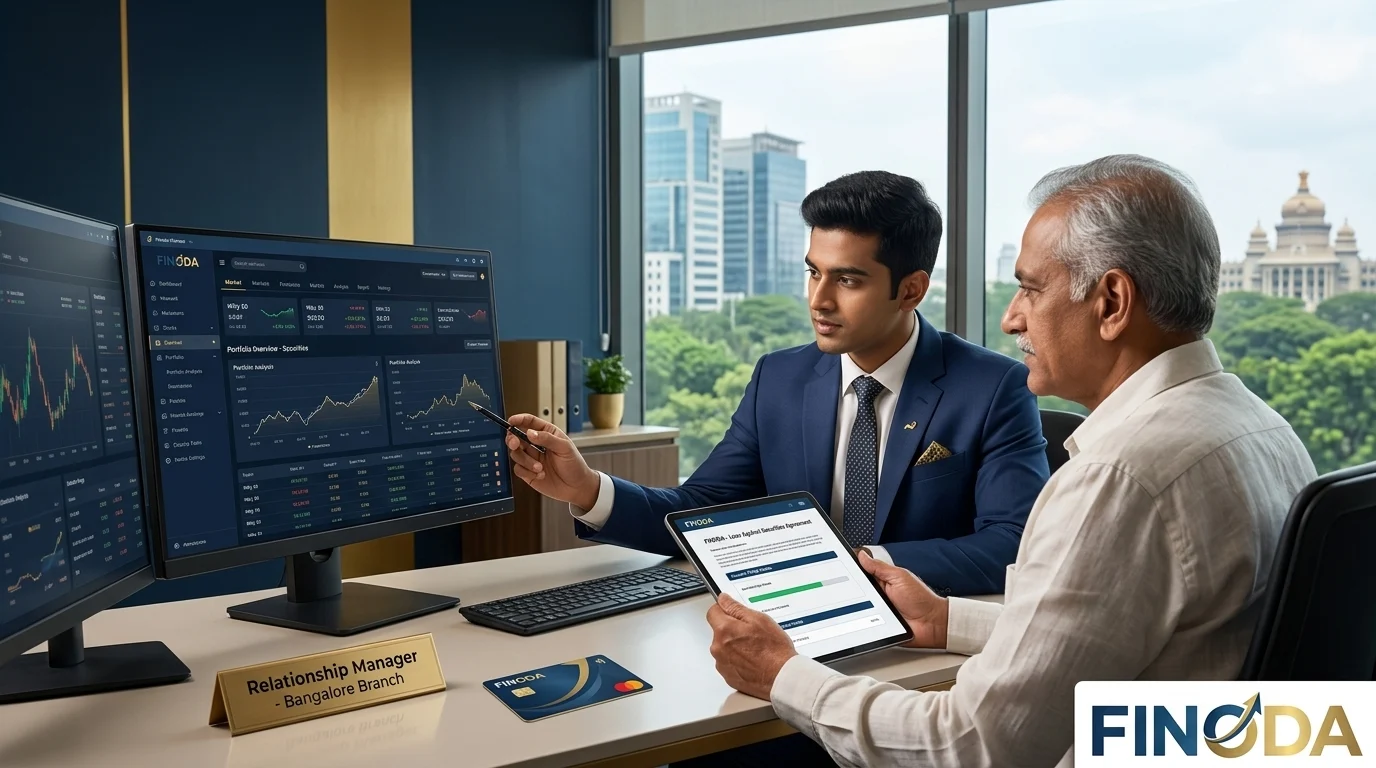
You've built a solid portfolio — shares in demat, a few good mutual funds, maybe some bonds. And then comes a moment where you need cash. Could be a business opportunity, a medical bill, a property deal, or just a short-term gap. Most people panic and sell their investments. But here's the thing — you don't have to.
At Finoda, we help you pledge your securities and access funds immediately, without disturbing your portfolio. You keep the investments. They keep growing. And you handle what you need to.
Table of Contents
- What is Loan Against Securities (LAS)?
- How Does Loan Against Securities Work?
- LAS Interest Rate in India — 9–12% vs 18–24% Personal Loan
- Eligible Securities for LAS — Shares, Mutual Funds, Bonds
- LAS vs Personal Loan — Why LAS Wins Every Time
- Why Work with Finoda for Loan Against Securities?
- Loan Against Securities FAQs
- 1. What is Loan Against Securities (LAS)?
- 2. Which securities are eligible for LAS in India?
- 3. What is the interest rate on a Loan Against Securities?
- 4. How much loan can I get against my shares or mutual funds?
- 5. Do I lose ownership of my securities when I pledge them?
- 6. Can I pledge mutual funds for a loan against securities?
- 7. What happens if the value of my pledged securities drops?
- 8. Is there a minimum and maximum loan amount for LAS?
- 9. Can NRIs apply for Loan Against Securities in India?
- 10. How long does it take to get funds through LAS?
- 11. What documents are required to apply for LAS?
- 12. Is LAS the same as a loan against shares?
- 13. Can I prepay or foreclose a Loan Against Securities early?
- 14. What is the minimum age to apply for LAS in India?
- 15. Is LAS better than a personal loan for short-term needs?
What is Loan Against Securities (LAS)?
A Loan Against Securities — commonly called LAS — is a secured credit facility where you use your financial assets as collateral instead of selling them. Think of it as putting your portfolio to work twice: once for the returns it earns, and again for the liquidity it unlocks.
You pledge eligible securities — like demat shares, equity or debt mutual funds, bonds, or even insurance policies — and in return, you get access to a credit line or overdraft facility. The moment you repay, the pledge is released and full control of your assets returns to you.
In our experience working with investors across Bangalore, this option doesn't get nearly as much attention as it deserves. Most people hear "pledge your shares" and immediately assume it's complicated or risky. But honestly? It's one of the most straightforward financing options available — and when used right, it's significantly smarter than going to a personal loan.
The concept is simple: your investments have value today. LAS lets you access that value without exiting your position.
How Does Loan Against Securities Work?
The process is more straightforward than most people expect. Here's how it flows:
Step 1 — Pledge Your Securities
You choose which securities you want to pledge. These need to be on the lender's approved list. Your shares stay in your demat account, but a lien is placed on them.
Step 2 — Valuation & Credit Limit
The lender calculates the current market value of your pledged assets. Based on that, they assign a Loan-to-Value (LTV) ratio. For equity shares and equity mutual funds, LTV is typically around 50%. For debt mutual funds, it can go up to 80%.
So if you pledge equity shares worth ₹10 lakh, you'd typically get access to up to ₹5 lakh.
Step 3 — Overdraft Facility Activated
Your loan isn't disbursed as a lump sum. Instead, you get an overdraft account. You draw only what you need, when you need it. And you pay interest only on the amount you actually withdraw — not the full sanctioned limit.
Step 4 — Repay & Unpledge
Once you repay, the lien is lifted. Your investments return to normal. No lock-in, no exit penalty in most cases.
We've found that the overdraft structure is one of the most underappreciated features of LAS. Unlike a term loan where you're paying interest on the full amount from day one, here you control what you borrow and what you pay.
LAS Interest Rate in India — 9–12% vs 18–24% Personal Loan
This is where LAS makes the most compelling case for itself.
A personal loan typically comes with interest rates anywhere between 18% and 24% per annum — sometimes more, depending on your credit score and the lender. A credit card outstanding can hit 36–42% annually if you're not careful.
With LAS, because your investments are backing the loan, the lender's risk drops significantly. That lower risk gets passed on to you as a borrower. Interest rates on LAS generally range from 9% to 13% per annum, depending on the type of securities pledged and the lending institution.
And remember — you only pay interest on what you actually use. If you've got a ₹5 lakh overdraft limit but only draw ₹1.5 lakh for three weeks, you pay interest on ₹1.5 lakh for those three weeks. That's it.
Other charges to be aware of:
- Processing fee: Usually up to 1–2% of the loan amount (one-time)
- Account maintenance charges: Varies by lender
- Pledge creation/closure charges: Charged by the depository participant
Compare this to a personal loan where you pay interest on the full disbursal from day one, and the math becomes very clear. For short-to-medium-term liquidity needs, LAS almost always works out cheaper.
Eligible Securities for LAS — Shares, Mutual Funds, Bonds
Not every investment qualifies. Lenders maintain an approved list of eligible securities, and the LTV ratio also varies by asset type. Here's a general breakdown:
Equity Shares (Demat form only)
Listed, approved shares from NSE/BSE. LTV typically 50%. Physical share certificates are not accepted — they need to be in demat form first.
Equity Mutual Funds
AMFI-registered equity MF units registered with CAMS or KFintech. LTV around 50% of NAV. Units continue earning market returns while pledged.
Debt Mutual Funds
Considered lower-risk. LTV can be higher — often up to 80%.
ETFs (Exchange Traded Funds)
Eligible in most cases, subject to lender's approved list.
Bonds and Debentures
Government securities, corporate bonds, sovereign gold bonds (SGBs). LTV varies.
Insurance Policies
Endowment plans, money-back policies, ULIPs — surrender value used as basis for LTV.
One thing we always tell clients: check the approved securities list before assuming your portfolio qualifies. Not every stock or fund makes the cut. Some smaller-cap stocks may be excluded due to liquidity concerns.
LAS vs Personal Loan — Why LAS Wins Every Time
Let's be direct about this. If you have a meaningful investment portfolio and you need funds for 6–18 months, LAS is almost always the better call. Here's why:
| Factor | Loan Against Securities | Personal Loan |
|---|---|---|
| Interest Rate | 9–13% p.a. | 18–24% p.a. |
| Collateral Needed | Yes (your investments) | No |
| Processing Time | Fast (often same day digitally) | 1–7 days typically |
| Interest Charged On | Only amount withdrawn | Full loan amount |
| Impact on Portfolio | None — assets stay invested | Not applicable |
| Prepayment Charges | Usually nil or minimal | Often 2–5% |
| Credit Score Impact | Lower, since secured | Higher risk to lender |
There's one scenario where a personal loan still makes sense — if you genuinely don't have enough securities to pledge, or if your portfolio is tied up in asset types that don't qualify. Otherwise, paying nearly double the interest rate when you have investments sitting in your demat account is hard to justify.
And here's something not many people consider: your pledged mutual funds keep earning returns. So even as you're paying 10% interest on a loan, your equity fund might be delivering 12–14% annual returns. In that scenario, you're actually coming out ahead.
Why Work with Finoda for Loan Against Securities?
We're a Bangalore-based financial services platform operating under SEBI guidelines. Over 10,000+ investors have worked with us across equity, mutual funds, insurance, and loans. And we've seen enough loan stories — good and bad — to know that getting the right guidance before you pledge matters.
Here's what we bring to the table:
We Help You Choose What to Pledge
Not all securities give you equal value. We look at your portfolio and help identify which assets to pledge so you protect your long-term positions while meeting your short-term need.
We Don't Push You Into the Wrong Product
If LAS doesn't make sense for your situation, we'll tell you. We've guided people toward personal loans, FD-backed loans, or even portfolio rebalancing when that was the better answer. We're not here to sell — we're here to advise.
We Cover the Full Financial Picture
From your trading account to your tax filing, insurance and loans — everything sits under one roof at Finoda. That means we understand your finances holistically, not just in fragments.
You Get a Real Person, Not Just a Form
Our team in Bangalore is reachable at 9035294343 or info@finoda.in. Walk into our office at VGV Towers, 100 Feet Ring Rd, Jayanagara 9th Block, Bengaluru — or just call us.
Loan Against Securities FAQs
1. What is Loan Against Securities (LAS)?
LAS is a secured credit facility where you pledge financial assets — shares, mutual funds, bonds — as collateral to access funds without selling them. You get an overdraft limit based on your portfolio's value and pay interest only on what you withdraw. Once you repay, the pledge is cleared and your assets are fully yours again.
2. Which securities are eligible for LAS in India?
Eligible securities typically include listed demat shares (from approved NSE/BSE lists), equity and debt mutual funds registered with CAMS or KFintech, ETFs, bonds, sovereign gold bonds, and certain insurance policies. Physical share certificates are not accepted — they must be dematerialised first.
3. What is the interest rate on a Loan Against Securities?
LAS interest rates in India generally range from 9% to 13% per annum, depending on the lender, type of security pledged, and loan amount. This is significantly lower than personal loans, which typically charge 18–24% p.a.
4. How much loan can I get against my shares or mutual funds?
The loan amount depends on the Loan-to-Value (LTV) ratio set by the lender. For equity shares and equity mutual funds, LTV is typically 50% of the market value. For debt mutual funds, it can be up to 80%. So if your shares are worth ₹10 lakh, you could access up to ₹5 lakh.
5. Do I lose ownership of my securities when I pledge them?
No. You retain ownership of your securities throughout the loan tenure. A lien is placed on them, which means you can't sell or transfer them while the pledge is active — but dividends, bonuses, and market appreciation all still accrue to you.
6. Can I pledge mutual funds for a loan against securities?
Yes. Both equity and debt mutual funds are accepted, provided they are in the lender's approved list and are registered with CAMS or KFintech. Units in both demat and non-demat form can be pledged, depending on the lender's process.
7. What happens if the value of my pledged securities drops?
If the market value of your pledged assets falls significantly, the lender may issue a margin call — asking you to either repay part of the loan or pledge additional securities to maintain the required LTV ratio. This is a key risk to keep in mind with equity-backed LAS.
8. Is there a minimum and maximum loan amount for LAS?
Minimum and maximum amounts vary by lender. Typically, the minimum is around ₹50,000 and the maximum can range from ₹20 lakh (for retail customers at banks) up to several crores at NBFCs for HNI portfolios.
9. Can NRIs apply for Loan Against Securities in India?
Yes. Non-Resident Indians (NRIs) can apply for LAS in India, provided they meet the eligibility criteria and submit documentation as per Indian financial regulations. NRI-specific conditions may apply.
10. How long does it take to get funds through LAS?
The process is significantly faster than a traditional loan. With a digital application and existing demat account, funds can be available in as little as 24–48 hours. The pledge creation itself is electronic — no paperwork shuffling.
11. What documents are required to apply for LAS?
Documents typically required include: Identity proof (Aadhaar, PAN, Passport), Address proof, Demat account statement or MF folio statement showing your holdings. For companies or firms: IT returns and audited financial statements for the past two years.
12. Is LAS the same as a loan against shares?
Yes, broadly. "Loan against shares" is a subset of LAS — it specifically refers to pledging listed equity shares. LAS is the umbrella term covering all eligible financial securities including MFs, bonds, ETFs, and insurance policies.
13. Can I prepay or foreclose a Loan Against Securities early?
In most cases, yes — and often without prepayment charges. However, terms vary by lender. It's important to confirm the prepayment terms before signing up. At Finoda, we always make sure you understand the fine print before you commit.
14. What is the minimum age to apply for LAS in India?
The minimum age is 18 years. Most lenders accept applications up to age 70 for individual borrowers. Corporates, HUFs, LLPs, partnership firms, and trusts can also apply for LAS.
15. Is LAS better than a personal loan for short-term needs?
For most investors with a sizeable portfolio, yes. LAS interest rates are nearly half of personal loan rates. You pay interest only on what you draw. Your investments keep working for you. And repayment is flexible. Unless you don't have eligible securities, LAS is almost always the smarter short-term option.
Ready to Unlock Your Portfolio's Liquidity?
Talk to the Finoda team today. We'll look at your portfolio, explain exactly what you can pledge, and walk you through every step — no jargon, no pressure.
Email: info@finoda.in
Visit: VGV Towers, Unit 101, 100 Feet Ring Rd, Jayanagara 9th Block, Bengaluru — 560041