
Equity Trading in India — Buy & Sell Stocks on NSE & BSE | Finoda
We've helped 10,000+ investors buy and sell stocks on India's two biggest exchanges. Whether you're starting with ₹5,000 or ₹50 lakh, we give you the same expert guidance every step of the way.
📋 Table of Contents
- What is Equity Trading? — Simple Explanation for Beginners
- Delivery Trading vs Intraday Trading — Which is Right for You?
- How to Start Equity Trading with Finoda — Step by Step
- Nifty 50 & Sensex — How India's Benchmark Indices Work
- Equity Trading Charges at Finoda
- Why Trade Equity with Finoda? — Expert-Guided Stock Investing
- Frequently Asked Questions — Equity Trading
What is Equity Trading? — Simple Explanation for Beginners
Equity trading simply means buying and selling shares of companies listed on NSE (National Stock Exchange) or BSE (Bombay Stock Exchange). When you buy one share of Reliance, Infosys, or HDFC Bank, you own a tiny piece of that company. As the company grows, your share's value usually goes up. That's the core idea.
In our experience, most people overcomplicate this. At its heart, equity is ownership. You're not lending money — you're buying into a business. Returns come in two ways: price appreciation (your share goes up in value) or dividends (the company shares some profits with you).
India's stock market has grown significantly. As of March 2026, over 16 crore demat accounts have been opened across the country — a number that's tripled since 2020. More Indians are investing in equities than ever before. And honestly, the tools have never been better or more accessible.
However, equity trading isn't just clicking "buy" on an app. You need to understand the two main types — delivery trading and intraday trading — before putting a single rupee in. Let's look at both.
Want to understand the full landscape first? Visit our Stock Market Basics Hub — it's a free resource we've built for first-time investors.
Delivery Trading vs Intraday Trading — Which is Right for You?
This is probably the most common question new investors ask us. And it's a fair one — the two styles are fundamentally different in terms of risk, holding time, capital requirement, and tax treatment. Let's break both down clearly.
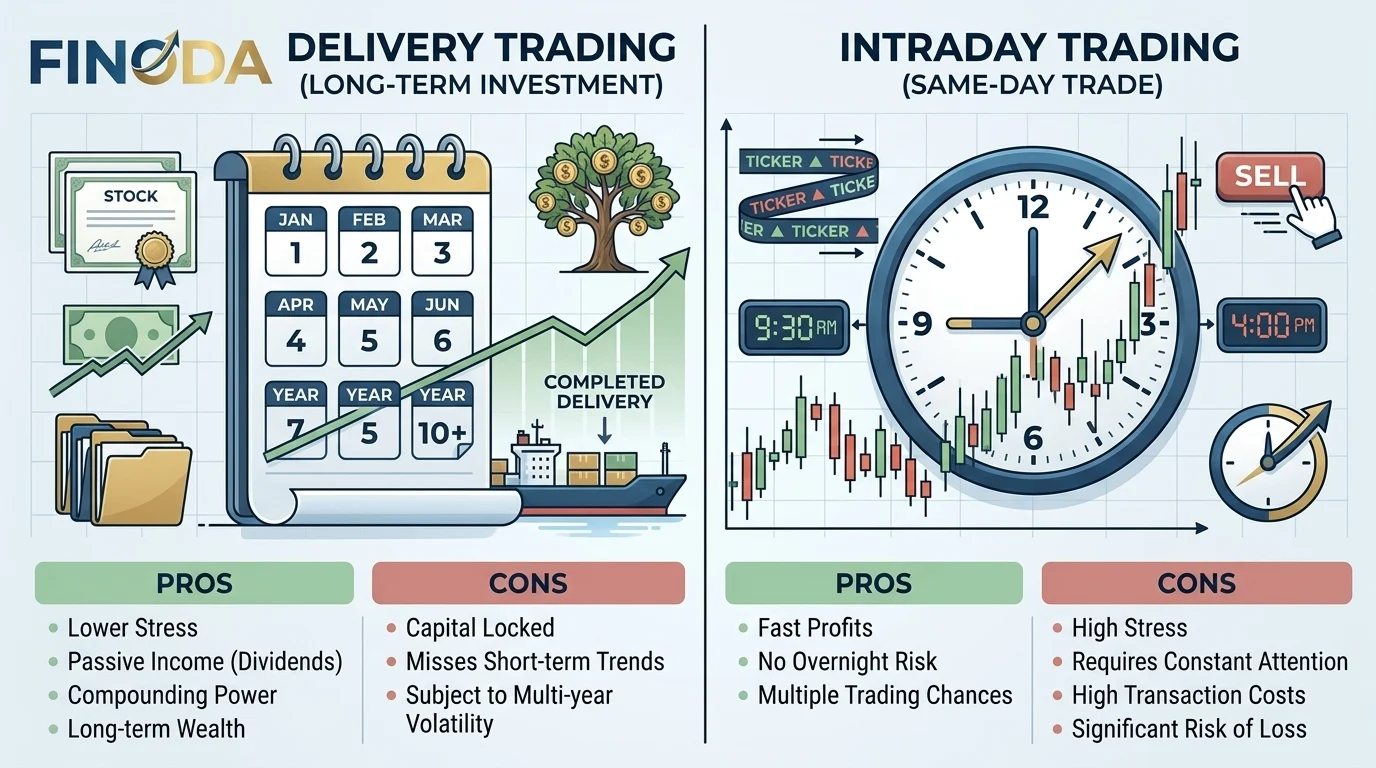
| Feature | Delivery Trading | Intraday Trading |
|---|---|---|
| Holding Period | More than 1 trading day (can be months or years) | Same trading day — position must close by 3:30 PM |
| Best For | Wealth building, long-term investors | Experienced traders seeking short-term gains |
| Capital Needed | Full share price (no margin for delivery) | Can trade with leverage (margin up to 5x typically) |
| STT (Tax) | 0.1% on both buy & sell | 0.025% on sell side only |
| Capital Gains Tax | STCG 20% (<12 months) / LTCG 12.5% (>12 months) | Speculative business income — taxed at slab rate |
| Risk Level | Lower (time smooths volatility) | Higher (gaps, news, and volatility hit hard) |
| Settlement | T+1 — shares in demat next day | Same day — no physical settlement |
Delivery Trading (Long-Term Investing)
Delivery trading is the closest thing to actual investing. You buy shares, they sit in your demat account, and you hold them — for days, months, or years. There's no pressure to sell by end of day. Moreover, you benefit from compounding if the company keeps growing.
In our experience, this suits most first-time investors best. You're not scrambling to track price movements every minute. Also, you can invest via SIP-style stock investing — buying a fixed amount of a stock every month, much like a mutual fund SIP. That approach removes the stress of timing the market.
We usually recommend starting with Nifty 50 blue-chip stocks for delivery — companies like Reliance, TCS, Infosys, HDFC Bank, or Bajaj Finance. These are well-researched, liquid, and fundamentally strong. For more details on this approach, check our page on Cash Equity Trading.
Intraday Trading (Same-Day Buying & Selling)
Intraday trading means you buy and sell the same stock within one market session — between 9:15 AM and 3:30 PM. If you don't exit, most brokers auto-square-off your position near close. So you never actually take delivery of the shares.
The appeal is obvious — you can potentially make gains on the same day without needing large capital, because brokers offer leverage. But here's the honest truth: intraday trading is hard. Volatility works both ways. Most beginners who jump straight into intraday end up losing money in the first few months.
That said, it's a legitimate style — and with the right setup, technical analysis skills, and risk management, some traders do very well. But we'd suggest mastering delivery trading first. When you're ready to explore intraday, our Intraday Trading page covers everything in detail.
How to Start Equity Trading with Finoda — Step by Step
A lot of people think starting to trade stocks involves paperwork, phone calls, and waiting for a week. Not anymore. The process has changed completely. Here's how it works at Finoda — from zero to your first trade.
-
1Open a Free Demat & Trading Account
Visit finoda.in/open-demat-account. Fill in your basic details — PAN, Aadhaar, and bank account info. The whole thing takes about 10 minutes online. You don't need to visit any branch.
-
2Complete Your KYC
Upload your PAN card and Aadhaar. Our team handles the in-person verification (IPV) step digitally. Once approved, your account is live — usually within 24–48 hours.
-
3Add Funds via Net Banking or UPI
Transfer money from your savings account into your trading account. There's no minimum deposit. Start with whatever amount you're comfortable putting into the market today.
-
4Search for a Stock by Symbol
Log into the trading platform, type the stock name or NSE/BSE symbol (e.g., RELIANCE, HDFCBANK, WIPRO), and check its live price. You'll see the real-time NSE BSE share price, charts, and key data.
-
5Place Your Buy Order
Enter the quantity and choose market order (buy at current price) or limit order (buy at your chosen price). Hit confirm. Your order gets executed on NSE or BSE within seconds. Under T+1 settlement, shares land in your demat account the next business day.
-
6Track and Manage with Advisory Support
This is where Finoda is genuinely different. We don't just give you the app and leave you to figure it out. Our advisors review your portfolio regularly and flag opportunities — or risks — as the market evolves. Not sure whether to hold or sell? Call us at 9035294343.
Worried about reading stock charts? We've got you. Check our How to Read Stock Charts guide — it's written for people who've never looked at a candlestick before. Also, our Demat Account Guide answers the most common account-related questions in plain language.
Nifty 50 & Sensex — How India's Benchmark Indices Work
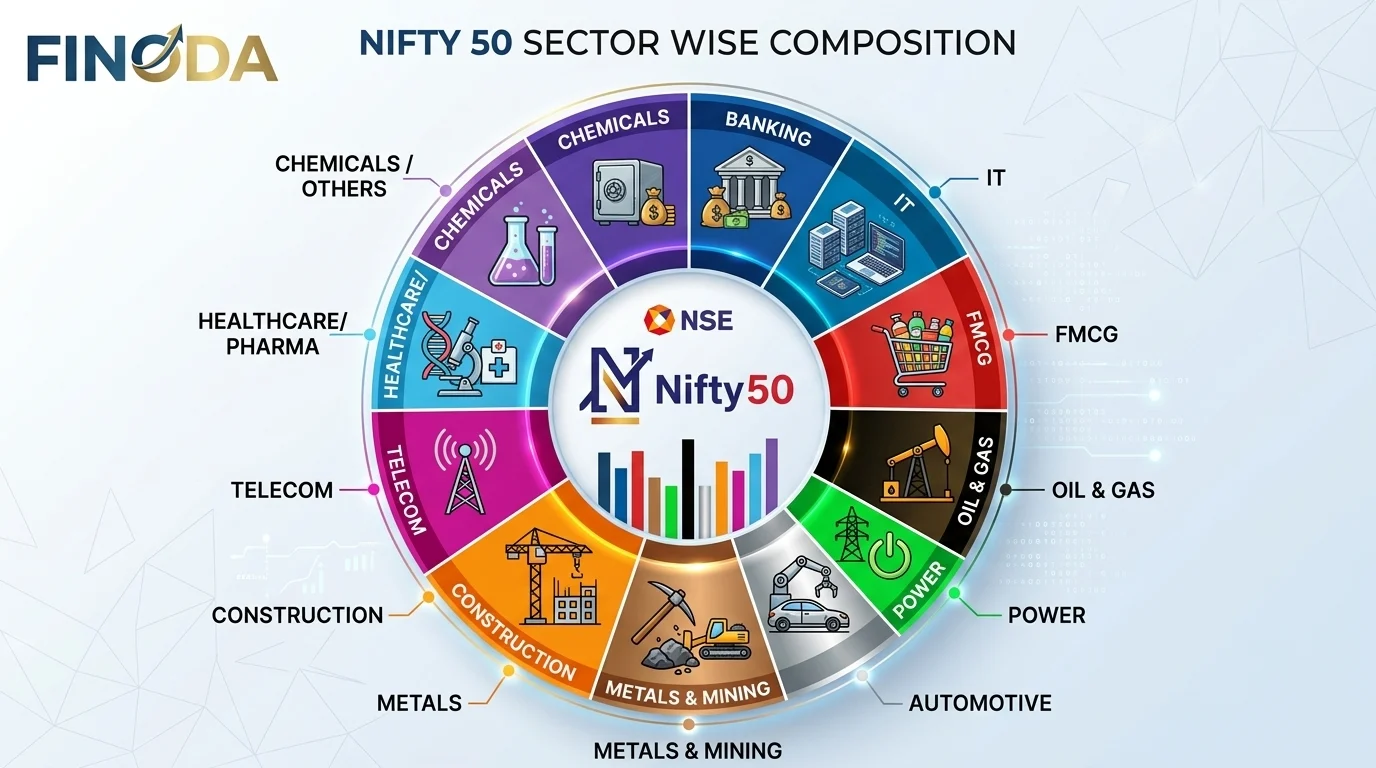
You'll hear "Nifty" and "Sensex" constantly if you follow Indian markets. Both are indices — essentially a basket of top stocks that together tell you how the overall market is doing.
Nifty 50 is the flagship index of the National Stock Exchange. It tracks 50 large-cap companies across 13 sectors — banking, IT, FMCG, pharmaceuticals, energy, automobiles, and more. The Nifty 50 was launched on 22 April 1996, with a base value of 1,000. Today it trades at many multiples of that. When people say "the market is up 200 points today," they usually mean the Nifty.
Sensex is BSE's equivalent — 30 of India's most established companies. It's been around longer and is often quoted in traditional media. Both indices move together most of the time. However, sector weightings differ slightly, so they can diverge on days with strong sector-specific news.
Why does this matter for your equity trades? Because the Nifty 50 and Sensex act as market mood indicators. When the broader market tanks, most stocks follow — and vice versa. Moreover, many passive investors simply buy Nifty 50 ETFs or index funds rather than picking individual stocks. We cover that angle in detail on our Long-Term Investing page.
For live NSE and BSE data, you can check NSE Market Data or BSE Market Data directly. We also share daily market insights with our clients.
For regulatory information on how equity trading works in India, the SEBI official site is the authoritative source.
Equity Trading Charges at Finoda
One thing we're firm about at Finoda — no hidden charges. So here's a complete breakdown of what you'll pay when you trade equities on NSE or BSE. These are the standard statutory charges applied to all Indian equity trades.
| Charge Type | Delivery Trading | Intraday Trading |
|---|---|---|
| STT (Securities Transaction Tax) | 0.1% on buy + 0.1% on sell | 0.025% on sell side only |
| Exchange Transaction Charges | ~0.00335% (NSE) / ~0.00375% (BSE) | ~0.00335% (NSE) / ~0.00375% (BSE) |
| SEBI Turnover Fee | ₹10 per crore of turnover | ₹10 per crore of turnover |
| GST | 18% on brokerage + transaction charges | 18% on brokerage + transaction charges |
| Stamp Duty | 0.015% on buy side only | 0.003% on buy side only |
| DP Charges (CDSL/NSDL) | ₹13.5 per scrip per day (on sell) | Not applicable (no demat delivery) |
A quick word on DP charges — many first-time investors miss these. When you sell delivery shares, ₹13.5 per stock is deducted as a Depository Participant charge regardless of quantity. So if you sell three different stocks in one day, ₹40.5 is charged (3 × ₹13.5). Small amounts, but worth knowing.
Also note that SEBI tightened F&O eligibility in 2025. For equity delivery trades, there's no change — STT remains 0.1%. For beginners especially, we recommend sticking to delivery equity trades for the first year. Derivatives and F&O comes later.
Why Trade Equity with Finoda? — Expert-Guided Stock Investing
Finoda isn't just another trading app. We're a Bangalore-based advisory-first firm. Our team actually talks to you, understands your financial goals, and helps you build a portfolio that matches your risk appetite. Not all clients want the same thing — and we've built our approach around that reality.
In our experience, investors who trade with advisory support consistently outperform those who go it alone in the first two to three years. Not because the market is mysterious, but because human emotion messes with decision-making. When markets fall 8% in a week, most retail investors panic-sell. Our advisors have seen several market cycles and know when to hold.
Furthermore, all client securities are held in your own CDSL or NSDL demat account. We don't hold your money — your bank and your depository do. That's a key regulatory safeguard, and we think it's worth saying explicitly.

Daily Market Research
Our advisors share sector analysis, stock picks, and market commentary every trading day — no extra charge.
Risk-First Approach
We always discuss stop-loss levels before recommending any trade. Protecting your capital comes first — gains come second.
Modern Trading Platform
Access a fast, intuitive trading interface on mobile and desktop with real-time NSE BSE data, charts, and order management.
One Account, All Markets
Trade equities, derivatives, commodities, and currencies — plus invest in mutual funds and SIPs — all from one account.
Dedicated Relationship Manager
You get a real person to call. Not a chatbot. Not a ticket system. Just a direct line to someone who knows your portfolio.
Physically Present in Bangalore
Our office is at VGV Towers, HAL Old Airport Road — near Leela Palace. Walk in any time for a face-to-face consultation.
Not sure how equity compares to Mutual Funds or SIP Investment? Both have their place. Frankly, many of our clients do both — some equity for higher potential return, some SIPs for disciplined long-term growth. We can help you figure out the right mix for your situation.
Frequently Asked Questions — Equity Trading
Equity trading means buying and selling shares of companies listed on NSE or BSE. When you buy a share, you hold a fractional ownership in that company. Returns come through price appreciation or dividends. India's equity market now has over 16 crore active demat accounts as of early 2026.
Delivery trading means you buy shares and hold them for at least one day — perfect for long-term wealth building. Intraday trading means you buy and sell the same stock within the same trading session. Delivery carries lower risk and favourable long-term capital gains tax, while intraday offers leverage but higher risk.
There's no fixed minimum. You can buy just one share of any NSE or BSE listed company. For practical purposes, starting with ₹5,000–₹10,000 lets you buy 3–5 different stocks for basic diversification. A demat and trading account is mandatory — open yours free with Finoda at finoda.in/open-demat-account.
T+1 means trades settle one business day after the transaction date. India moved to T+1 settlement in 2023. So if you buy shares on Monday, they appear in your demat account on Tuesday. Sell proceeds also reach your bank account one day after the sale.
Open a free demat and trading account at Finoda, add funds from your bank, search the stock by NSE/BSE symbol, and place a buy order — market or limit. The whole process from account opening to first trade can be done in under 24 hours. Our advisors guide every step.
For delivery trades, STT is 0.1% on both buy and sell. Other charges include exchange transaction fees (~0.00335% NSE), SEBI turnover fee (₹10/crore), 18% GST on brokerage, stamp duty (0.015% on buy), and DP charges of ₹13.5 per scrip per day on sell side.
The Nifty 50 index tracks 50 of India's largest companies listed on NSE across 13 sectors. It's the primary benchmark for the Indian equity market. Beginners are often advised to start with Nifty 50 stocks because they're highly liquid, well-researched, and less prone to manipulation than smaller stocks.
Yes. One demat and trading account through Finoda gives you access to both NSE and BSE. Most blue-chip stocks are listed on both exchanges. Your trading platform shows live prices on both, and you can place orders on whichever offers a slightly better price at that moment.
Both NSE and BSE equity markets operate Monday to Friday, 9:15 AM to 3:30 PM IST. A pre-open session runs from 9:00 to 9:15 AM for price discovery. Both exchanges are closed on public holidays — you can find the NSE BSE trading holiday calendar for 2026 on the official NSE and BSE websites.
You need your PAN card, Aadhaar (linked to your mobile number for OTP verification), a cancelled cheque or recent bank statement, and a passport-sized photo. The entire process is fully online and typically completes within 24–48 hours.
STT stands for Securities Transaction Tax — a mandatory government tax on all stock market transactions. For equity delivery trades, STT is 0.1% on both buy and sell. For intraday trades, it's 0.025% only on the sell side. This is automatically deducted by the exchange; you don't calculate it separately.
Equity trading always carries market risk — prices move up and down. However, with a disciplined approach, starting with well-known Nifty 50 stocks, using a long-term horizon, and working with an advisor, most beginners manage risk effectively. Finoda's advisory support specifically helps new investors avoid the most common and costly mistakes.