

Company Audit Services in Bangalore — Statutory, Tax & Internal Audit by Experienced CAs
We work with private limited companies, LLPs, startups, and SMEs across Bangalore to handle every audit obligation — cleanly, on time, and without last-minute panic. Statutory audit, tax audit under Section 44AB, internal audit, and secretarial audit — our ICAI-registered Chartered Accountant partners manage the full process, from engagement letter to final UDIN-verified report. Transparent fees. No hidden surprises. And your ROC filings stay on track, every financial year.
📄 Table of Contents Map
- Types of Company Audits in India — Which Does Your Business Need?
- ROC Filing and Annual Compliance — Companies Act Deadlines
- Our Audit Process — From Engagement to Final Report
- Audit Fees in Bangalore — Transparent Pricing by Company Type
- Company Audit FAQs — CA Expert Answers
- Why Companies in Bangalore Choose Finoda for Audit
Types of Company Audits in India — Which Does Your Business Need?
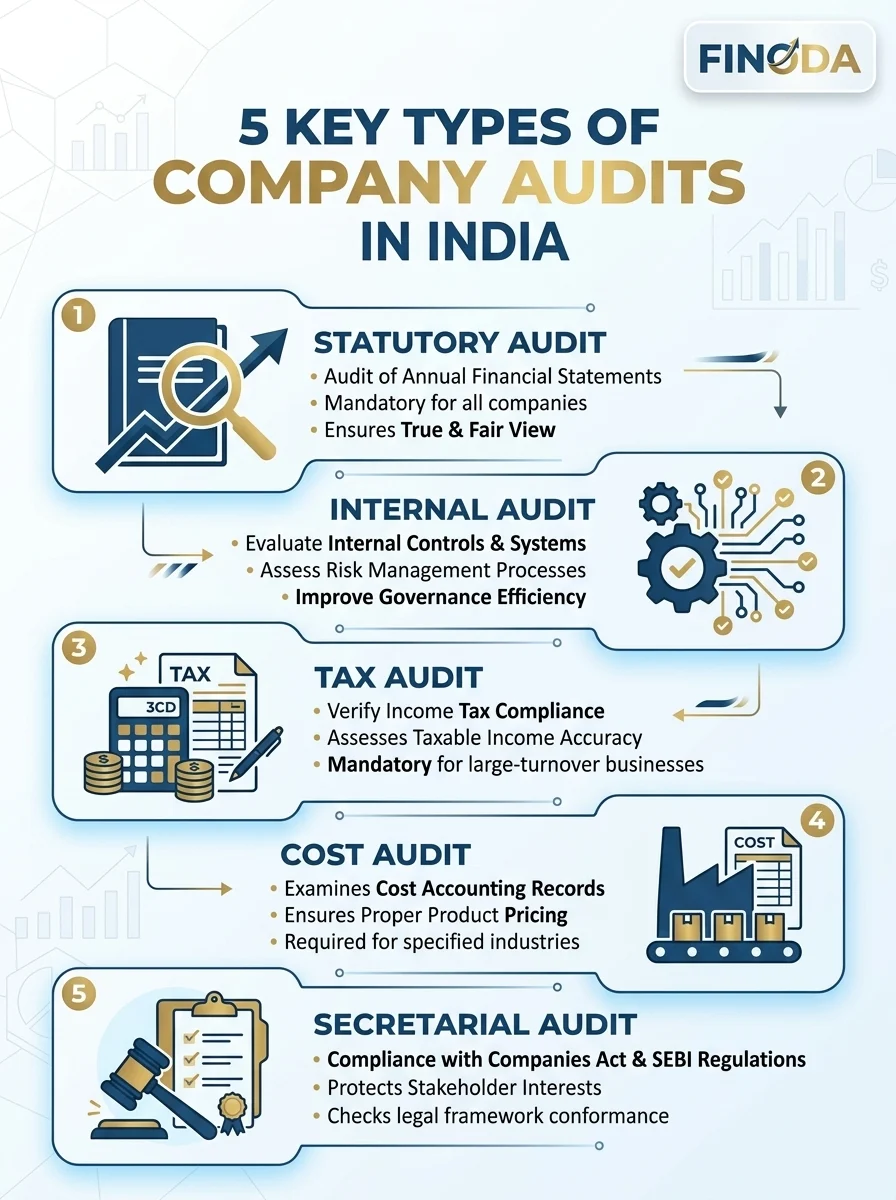
Running a company in India means dealing with more than one kind of audit — and the rules for each are different. In our experience, most business owners are clear on statutory audit but genuinely surprised when tax audit, secretarial audit, or internal audit requirements come up unexpectedly. So let's break it down simply.
There are five main types of company audits in India: Statutory Audit, Tax Audit, Internal Audit, Secretarial Audit, and Forensic Audit. Each one serves a different purpose, and each is triggered by different criteria. However, a private limited company almost always needs at least the first two — and often all five as it scales.
People Also Ask: What are the types of audit for companies in India?
See Finoda's Regulatory Disclosures →
Statutory Audit — Mandatory Under the Companies Act 2013
Every company registered in India — whether a brand-new startup or an established private limited firm — must get its accounts audited every single year. No turnover threshold. No exemption for zero revenue. This is the rule under the Companies Act 2013 and there's no way around it.
Under Section 139, every company must appoint an ICAI-registered Chartered Accountant as its statutory auditor. The first auditor must be appointed within 30 days of incorporation. Auditors rotate every five years for individuals and every ten years for firms, under the Companies Act rotation policy.
What does the auditor actually check? The financial statements, bank balances, asset registers, related-party transactions, and whether the company followed accounting standards (Ind AS / AS). At the end of the process, the auditor issues a report — which then gets attached to Form AOC-4 and filed with the MCA portal.
At Finoda, we coordinate directly with our CA partners so you don't have to chase anyone. We handle the engagement, the follow-ups, and the filing — you focus on running the business.
Tax Audit — Under Income Tax Act Section 44AB
Tax audit is separate from statutory audit. It's required under Section 44AB of the Income Tax Act when:
- Business turnover exceeds ₹1 crore (or ₹10 crore if 95%+ transactions are digital)
- Professional gross receipts exceed ₹50 lakh
- You've opted out of a presumptive taxation scheme or have F&O trading losses
Worth noting: ICAI now caps the number of tax audits a CA can conduct at 60 per year (effective April 2026). So securing your CA slot before peak season — October — is genuinely important.
Penalty for missing the tax audit? 0.5% of turnover or ₹1,50,000, whichever is lower, under Section 271B.
Internal Audit — Strengthen Operations and Risk Management
Internal audit isn't about ticking boxes for a regulator. It's genuinely useful — because it shows you where cash is leaking, where controls are weak, and where a bank or investor will push back during due diligence.
Under Section 138 of the Companies Act, internal audit is mandatory for companies that meet certain thresholds: turnover above ₹200 crore or borrowings above ₹100 crore. For smaller companies, it's voluntary — but banks specifically ask about internal audit practices when processing loan applications above ₹5 crore.
Our team conducts internal audits covering financial controls, procurement cycles, inventory management, fraud risk areas, and process efficiency. We deliver reports quarterly or annually — formatted for the Board and actionable for your finance team.
Secretarial Audit — Compliance for Listed and Large Companies
Secretarial audit checks whether your company is following all applicable laws — Companies Act, SEBI regulations, ROC filings, and more. It's conducted by a practising Company Secretary (CS), not a CA.
It becomes mandatory for:
- All listed companies
- Private companies with paid-up capital ≥ ₹10 crore or turnover ≥ ₹250 crore
Finoda coordinates your CA and CS requirements together, so statutory audit, ROC compliance, and secretarial audit all run in sync — one point of contact, zero coordination gaps.
ROC Filing and Annual Compliance — Companies Act Deadlines
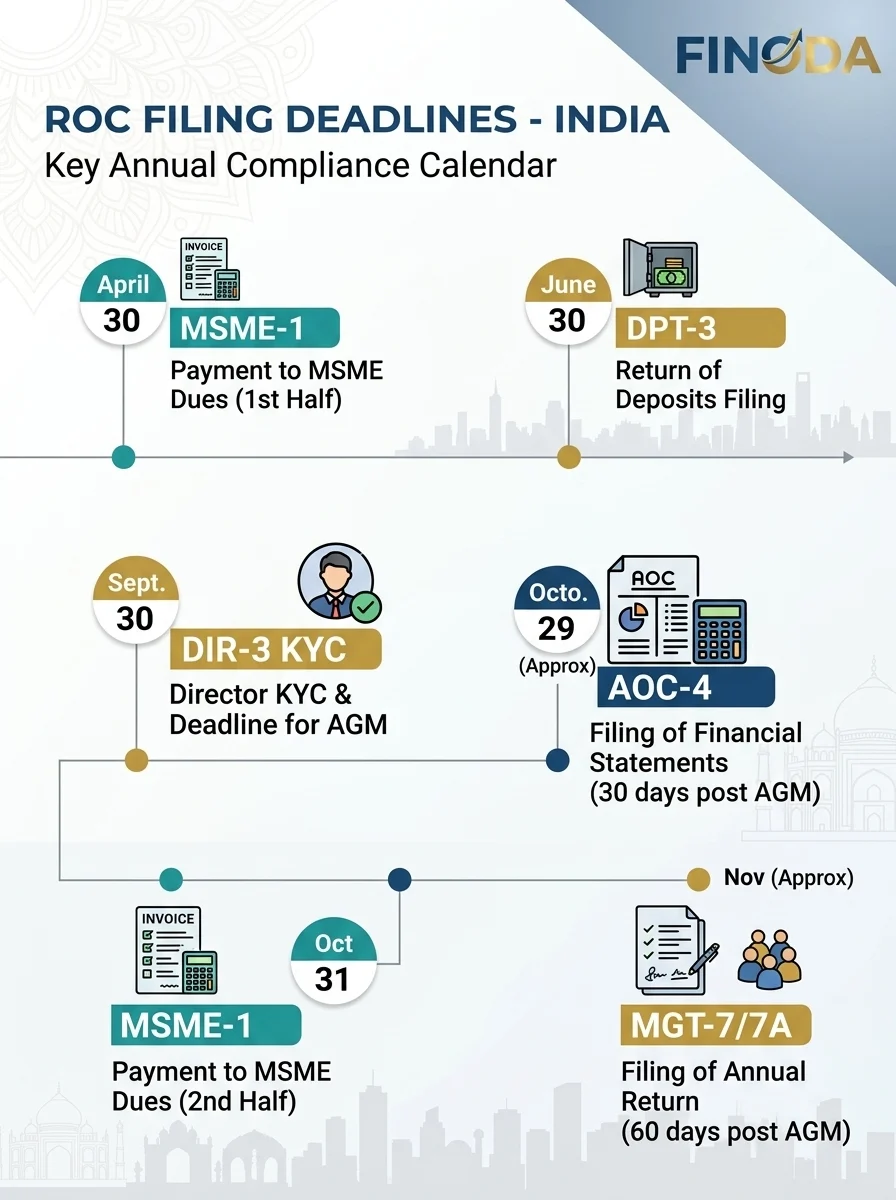
Audit is only one piece of the annual compliance puzzle. After the audit is done, three critical forms need to be filed with the MCA portal — and all three have strict deadlines.
| Form | Purpose | Due Date |
|---|---|---|
| ADT-1 | Auditor appointment | Within 15 days of AGM |
| AOC-4 | Financial statements | Within 30 days of AGM |
| MGT-7 | Annual return | Within 60 days of AGM |
For most companies with a March 31 financial year end, the AGM deadline is September 30. That means AOC-4 is due by October 30 and MGT-7 by November 29.
Miss these? Late filing fees are ₹200 per day per form, and they add up fast. Beyond fees, repeated defaults can lead to ROC notices, director disqualification, or even company strike-off.
We've found that companies which start their audit process in July — right after the financial year closes — consistently avoid the October crunch. That's the window we target for every audit client.
Our Audit Process — From Engagement to Final Report
Here's exactly how we work. No guesswork, no delays, no "we'll get back to you" loops.
For companies with turnover below ₹10 crore and well-maintained books, we target a 4–6 week turnaround.
₹ Audit Fees in Bangalore — Transparent Pricing by Company Type
We believe audit fees should be clear upfront — not a number you find out after two meetings. Here's our general pricing structure for companies in Bangalore:
| Company Type | Turnover | Statutory Audit Fees (Starting) |
|---|---|---|
| Early-stage startup | Below ₹1 crore | ₹25,000 + GST |
| Growing SME | ₹1 crore – ₹10 crore | ₹50,000 + GST |
| Mid-size company | ₹10 crore – ₹100 crore | ₹1,50,000 + GST |
| Large company | Above ₹100 crore | ₹5,00,000 + GST (custom) |
| Tax audit (Section 44AB) | As applicable | ₹15,000 – ₹75,000 + GST |
All fees include: audit report, management letter, UDIN registration, and coordination for ROC filing. Complex industries, prior-year backlogs, or multiple entity audits are quoted separately.
Get a free custom audit quote →
Also explore: Financial Planning Guide →
Company Audit FAQs — CA Expert Answers
FAQ 1: Is audit mandatory for private limited companies in India?
Yes. Statutory audit is mandatory for all companies registered under the Companies Act 2013 — including private limited companies — regardless of turnover or number of employees. The audit must be conducted by an ICAI-registered Chartered Accountant, and the audited financial statements must be submitted to the ROC every year.
FAQ 2: What is the difference between statutory audit and tax audit?
Statutory audit is conducted under the Companies Act 2013 and applies to every registered company without exception. Tax audit under Section 44AB of the Income Tax Act applies when business turnover exceeds ₹1 crore (or ₹10 crore if 95%+ transactions are digital), or professional receipts exceed ₹50 lakh. A company can be required to undergo both.
FAQ 3: What is the audit deadline for private limited companies?
Form AOC-4 (financial statements) must be filed with the MCA within 30 days of the AGM. The AGM must be held within 6 months of the financial year end. For FY ending March 31, the AGM deadline is September 30 — making the AOC-4 deadline October 30 and MGT-7 deadline November 29.
FAQ 4: What is UDIN in company audit?
UDIN stands for Unique Document Identification Number. It's a mandatory code generated on the ICAI UDIN portal for every audit report or certification signed by a practising CA. It allows any stakeholder to verify the genuineness of a CA-signed document. All Finoda audit reports carry a valid UDIN.
FAQ 5: What are the penalties for not getting a company audited?
Non-compliance with audit requirements under the Companies Act can attract penalties up to ₹5,00,000, prosecution of directors, and even ROC strike-off of the company. Late ROC filings additionally attract ₹200 per day per form. Internal audit non-compliance under Section 138/450 carries ₹10,000 plus ₹1,000 per day of continuing default.
FAQ 6: How long does a company audit take?
A typical statutory audit for an SME takes 4–8 weeks from engagement to final report. For companies with turnover below ₹10 crore and well-maintained accounts, Finoda's CA team targets a 4–6 week turnaround. Complex companies or those with backlogs may take longer.
FAQ 7: Does a startup or new company need an audit?
Yes. Even a newly incorporated private limited company requires a statutory audit from its first financial year — regardless of revenue or whether any transactions occurred. If the company had no activity, the auditor certifies nil transactions in the financial statements, which still need to be filed with the ROC.
FAQ 8: What is secretarial audit and when is it mandatory?
Secretarial audit is a compliance review conducted by a practising Company Secretary (CS). It verifies adherence to the Companies Act, SEBI regulations, FEMA, and other applicable laws. It is mandatory for listed companies and private limited companies with paid-up capital of ₹10 crore or more, or turnover of ₹250 crore or more.
FAQ 9: Can the same CA do both statutory audit and tax audit for a company?
Yes, the same CA or CA firm can conduct both the statutory audit under the Companies Act and the tax audit under Section 44AB — and in most cases it's more efficient because the CA already has all your financial records. However, the CA's total tax audit assignments cannot exceed 60 per year (ICAI limit from April 2026).
FAQ 10: What documents do I need to give the auditor?
Typically: bank statements for the full year, sales and purchase invoices, ledger extracts, GST returns (GSTR-1, GSTR-3B), TDS statements, fixed asset register and depreciation schedule, loan agreements, statutory registers, prior year ROC filings (AOC-4, MGT-7), and the previous year's audited financials. Our CA team provides a detailed checklist at engagement.
FAQ 11: What is the auditor rotation rule in India?
Under the Companies Act, individual auditors rotate every 5 years and audit firms rotate every 10 years. This applies to companies other than small companies and one-person companies. The intent is to ensure independence and bring fresh perspective to the audit process.
FAQ 12: What happens if my company has losses — do I still need an audit?
Absolutely yes. The statutory audit requirement has nothing to do with whether a company is profitable. A company incurring a loss, or even one with zero transactions, must still get its accounts audited and file with the ROC every year. Skipping the audit because "there's nothing to show" is a common and costly mistake.
FAQ 13: Is there a GST audit requirement for companies?
For businesses with turnover above ₹5 crore, a GSTR-9C (reconciliation statement) needs to be certified by a CA or CMA along with the annual GST return. This is effectively a GST audit. Finoda's CA team handles this alongside the statutory audit in the same engagement where possible.
Internal Link: GST Registration & Filing Services →
🏆 Why Companies in Bangalore Choose Finoda for Audit
Bangalore's startup ecosystem — Koramangala, Indiranagar, Whitefield, HSR Layout — produces thousands of new private limited companies every year. Most of them have the same early problem: finding a CA who understands their business, completes the audit on time, and doesn't disappear after March.
In our experience working with companies across sectors — tech, manufacturing, retail, professional services — the biggest audit failures aren't caused by bad intentions. They come from missed timelines, poor coordination between the company and the CA, and last-minute scrambles that lead to qualified opinions or penalty notices.
We've built Finoda's audit practice to fix exactly that. One point of contact. Structured document workflows. A CA team that's reachable. And pricing that's clear before you sign anything.
Whether you're a first-year startup filing your first ROC return or an SME with a decade of compliance history, we handle the audit so you can focus on what actually builds your business.