
F&O Trading India — Futures & Options Explained | NSE Derivatives | Finoda
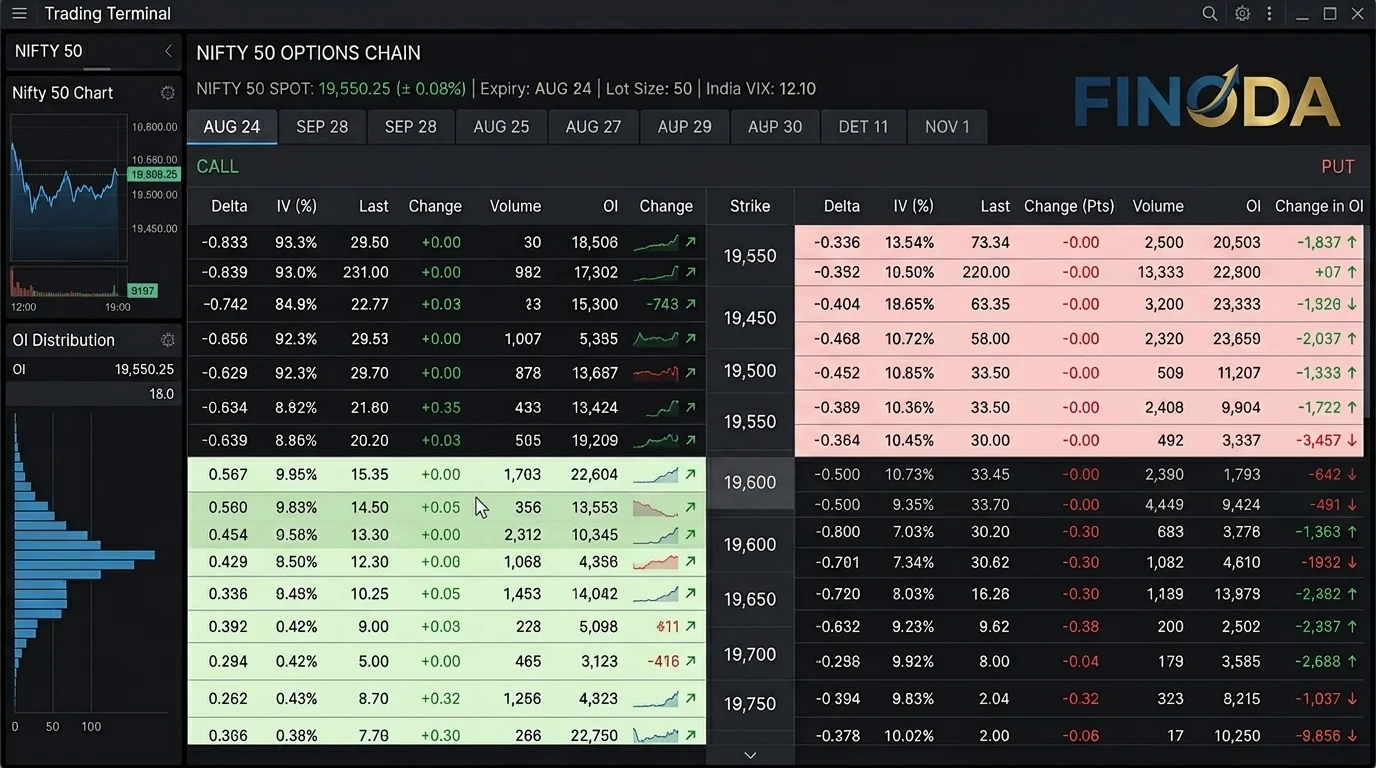
F&O trading — short for Futures and Options trading — is how millions of Indian investors trade derivative contracts on NSE and BSE Derivatives every single day. These contracts derive their value from an underlying asset, like the Nifty 50 index, Bank Nifty, or individual stocks. Unlike buying shares, you don't own the company here. Instead, you're trading an agreement tied to its price movement.
At Finoda, we've guided hundreds of clients through the F&O markets. And frankly, this is one segment where we always start with the same advice: learn before you leap. (Visit our Stock Market Basics Hub for beginner resources.) F&O can amplify your returns — but it can just as quickly amplify your losses. That's not a sales pitch. That's just what the data says.
- What is F&O (Futures & Options) Trading in India?
- Futures vs Options — Key Differences Explained
- How Nifty 50 Options Work — India's Most Traded F&O
- F&O Margin Requirements in India — SEBI Rules
- Risks of F&O Trading — Must Read Before Starting
- How to Trade F&O Through Finoda — Expert-Guided Derivatives
- F&O vs Equity Trading — Which One's Right for You?
- Tax on F&O Trading in India
- Frequently Asked Questions — F&O Trading India
What is F&O (Futures & Options) Trading in India?
Derivatives trading in India happens primarily on the National Stock Exchange (NSE). The F&O segment covers index contracts like Nifty 50 and Bank Nifty, plus selected stocks. All F&O trading operates under SEBI's regulatory framework, which has become significantly stricter over the last couple of years — and for good reason.
In simple terms: when you trade in the cash market, you buy or sell shares directly. In F&O, you're trading a contract. That contract has an expiry date. And it comes with leverage — meaning you can control a large position with relatively less capital. That leverage cuts both ways.
India's F&O segment is massive. NSE alone processes hundreds of millions of contracts daily. Most of that volume comes from retail traders — people just like our clients — which is exactly why SEBI has been tightening rules since 2023. More on that shortly.
Futures vs Options — Key Differences Explained
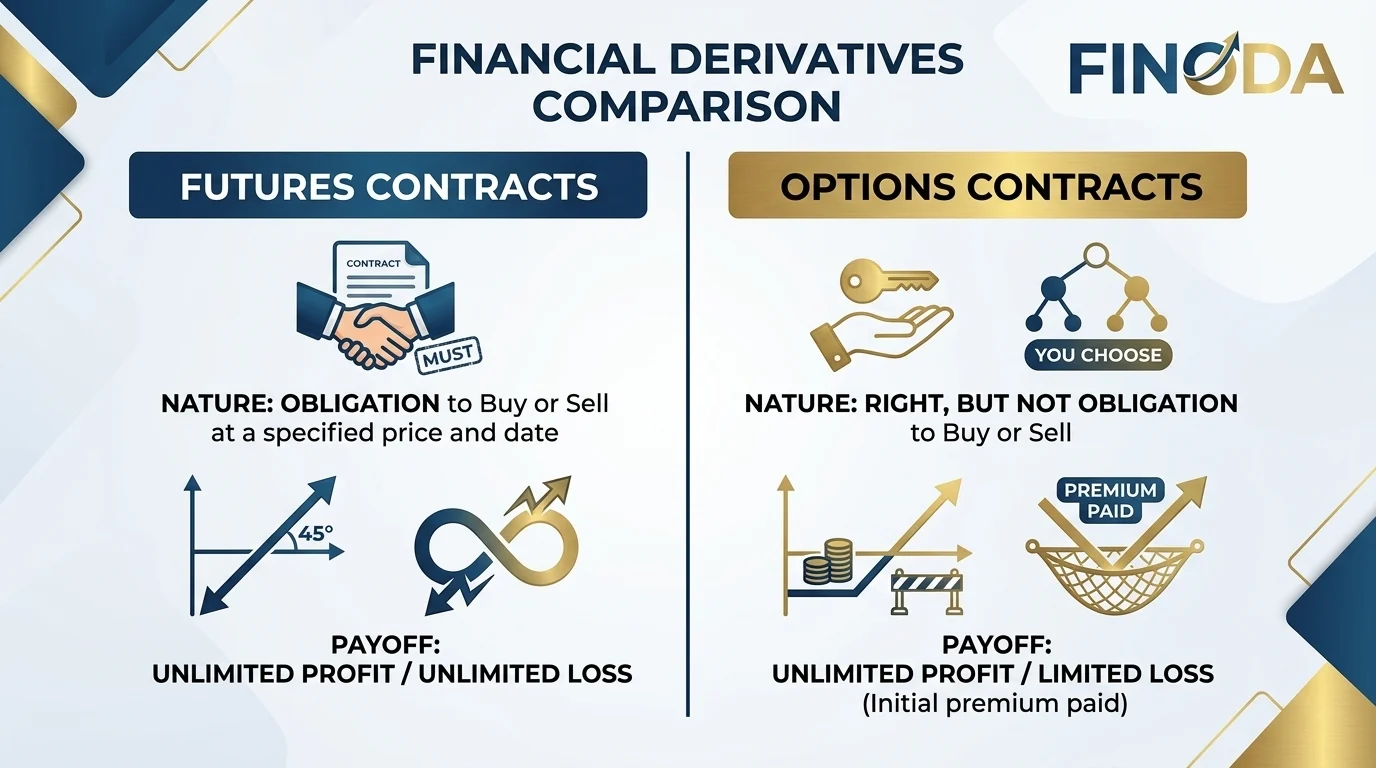
People often use 'futures' and 'options' interchangeably. They're related — but they work very differently. Here's the quick breakdown:
| FUTURES CONTRACTS | OPTIONS CONTRACTS |
|---|---|
| Obligation to buy or sell at expiry | Right (not obligation) to buy or sell |
| Both buyer and seller are bound | Only seller (writer) is obligated |
| Unlimited profit — and unlimited loss | Buyer's loss limited to premium paid |
| Requires SPAN + Exposure margin | Buyer pays only the premium upfront |
| Settled on last Tuesday (monthly) for Nifty | Weekly (Thursday) or monthly expiry |
| Better for hedging large positions | Better for limited-risk directional bets |
What are Futures Contracts?
A futures contract is a formal agreement to buy or sell an asset at a fixed price on a specific date. Both parties are legally bound. If you hold a Nifty futures contract to expiry, you settle at whatever price Nifty closes at — and the profit or loss lands directly in your trading account.
Key point: Nifty 50 futures currently have a minimum contract value of ₹15 lakhs per lot (post SEBI's October 2024 changes, the Nifty lot size moved to 75 units). This means futures aren't a casual bet — you need real capital and a solid understanding of margin.
Futures contracts on NSE are available for 3 monthly cycles. The near-month contract is the most liquid. Nifty 50 futures expire on the last Tuesday of the month.
What are Options Contracts?
An options contract gives the buyer the right — but not the obligation — to buy or sell at a certain price before expiry. You pay a premium for that right. If things don't go your way, the worst that happens is you lose the premium you paid.
There are two types. A call option profits when the underlying rises. A put option profits when it falls. Together, they give traders flexibility that futures simply don't offer.
In our experience, most retail traders start with options buying — specifically buying Nifty call or put options around key market events. It's one of the more accessible entry points into F&O, since your maximum loss is capped at the premium.
How Nifty 50 Options Work — India's Most Traded F&O
Nifty options are the most actively traded derivative contracts in India. The Nifty 50 index tracks India's 50 largest listed companies across sectors — and it represents roughly 65% of NSE's total market cap. That's why it's so liquid.
Here's what you need to know about Nifty options practically:
- Lot size: 75 units per contract (revised by SEBI in October 2024)
- Weekly expiry: Every Thursday for near-week contracts
- Monthly expiry: Last Tuesday of each calendar month for monthly Nifty futures; options have their own monthly cycle
- You can trade call (CE) and put (PE) options across dozens of strike prices
- ATM (at-the-money) options carry the highest time value — and decay fastest
Bank Nifty options are the other big one. They track India's top banking stocks and react sharply to RBI policy decisions. Monthly Bank Nifty options expire on the last Tuesday of the month.
One thing we've seen trip up new traders: theta decay. Options lose value as expiry approaches — even if the underlying price doesn't move. So even a 'right direction' trade can lose money if you enter too early or hold too long.
F&O Margin Requirements in India — SEBI Rules
SEBI overhauled F&O margin rules significantly between 2020 and 2025. If you last traded F&O a few years ago, things have changed quite a bit.
Here's how margin works now:
- SPAN Margin: The base minimum margin set by NSE for each contract. Changes daily based on market volatility.
- Exposure Margin: An additional buffer on top of SPAN. Typically 1–3% of contract value.
- Total Initial Margin: Usually 10–15% of the contract's notional value for Nifty futures.
- Upfront Option Premium Collection: Since February 2025, option buyers must pay the full premium upfront when buying options. No credit facility.
For Nifty futures specifically: with Nifty at ~24,000 and a lot size of 75, the notional contract value is roughly ₹18 lakhs. Your initial margin requirement will typically be ₹1.5–2.5 lakhs per lot depending on prevailing volatility.
Options buying is simpler — you only pay the premium. For an ATM Nifty weekly option, premiums currently range from ₹150 to ₹400 per unit (₹11,250 to ₹30,000 per lot). But remember, most weekly options expire worthless.
We always recommend using NSE's official margin calculator before taking any position. You can check the latest margin requirements at nseindia.com.
Risks of F&O Trading — Must Read Before Starting

We won't sugarcoat this. F&O is genuinely high-risk. Not 'high-risk for conservative investors' high-risk — actually, materially high-risk for most retail participants.
Here's what makes F&O dangerous for the unprepared:
- Leverage: A 1% move in Nifty can mean a 10–15% move in your margin. Positions can blow up in hours.
- Time decay (Theta): Options lose value every single day, even if the market stays flat. Option sellers exploit this. Buyers race against it.
- Expiry risk: Holding positions close to expiry without a plan is how most retail losses happen. Volatility spikes on expiry day.
- Margin calls: If your account value drops below minimum margin, your broker squares off your position automatically — often at the worst possible price.
- Overtrading: The ease of entering F&O positions tempts traders to take too many bets. Transaction costs and STT add up fast.
SEBI F&O Investor Awareness and their July 2025 study confirmed that retail traders collectively lost ₹1.05 lakh crore in F&O during FY25. That's not a number to dismiss. It's why we at Finoda insist on proper education and guided entry for anyone starting in derivatives.
Does that mean F&O is impossible to profit from? No. Experienced traders with proper risk management, disciplined strategies, and adequate capital do make money. But they're the minority — and they didn't start by winging it.
How to Trade F&O Through Finoda — Expert-Guided Derivatives
If you've read everything above and still want to trade F&O — good. That means you're approaching this seriously. Here's exactly how we guide clients through the process:
- Open Your Demat + Trading Account: Start by opening a free demat account with Finoda. The process is 100% online and takes under 24 hours. [Open Demat Account]
- Activate F&O Segment: F&O trading isn't enabled by default. You'll need to submit a basic income declaration and pass a short derivatives knowledge confirmation. Our team walks you through this.
- Set Your Capital & Risk Budget: Before placing a single trade, we sit down with you (call or in-person) to define how much capital you're allocating to F&O and what your maximum loss per trade looks like.
- Get Expert Trade Guidance: Our NISM-certified advisors study market conditions daily. We don't give tips — we give context. We explain what's happening in the market, what strategies make sense, and why.
- Start Small. Seriously: We recommend beginning with one or two lots of Nifty options — buying only, not selling. Paper trade first if you can. Build confidence before scaling.
- Review & Refine Monthly: F&O trading is a skill. We schedule monthly reviews with active clients to analyse what worked, what didn't, and how to improve.
Why Finoda? We've built our practice around one thing — genuine financial guidance, not just account opening. Our advisors have real-world F&O experience. We've navigated volatile markets with our clients. And we're available when things get choppy, not just when it's sunny.
Moreover, we're completely transparent about costs. No hidden charges, no inflated brokerage surprises. You know what you're paying before you place your first trade.
📞 Ready to start? Call us on 9035294343 or Contact Us
Open Your Free Demat AccountF&O vs Equity Trading — Which One's Right for You?
This is a question we get asked a lot. And honestly, for most people — especially those starting out — equity trading is the safer path. [Equity Trading]
Equity investing means buying shares in good companies and holding them over time. There's no expiry, no margin calls, and the data strongly favours long-term equity investors over F&O traders. If your goal is wealth creation over 3–10 years, equity or SIP investing is almost always the smarter first step.
F&O makes more sense if you already understand the markets, want to hedge an existing equity portfolio, or have specific short-term directional views with a clear risk plan. It's a tool — and like any tool, it's only useful in the right hands.
We also offer intraday trading for those who want short-term equity positions without the complexity of derivatives. [Intraday Trading]
Tax on F&O Trading in India
F&O income is treated as business income under the Income Tax Act — not capital gains. This has important implications:
- F&O profits are taxable at your applicable income tax slab rate
- You must file ITR-3 (not ITR-2) if you have F&O income
- F&O losses can be set off against other business income and carried forward for 8 years
- You need a tax audit if your F&O turnover exceeds the threshold set under Section 44AB
- STT (Securities Transaction Tax) is levied on F&O — rates were revised in Budget 2024
Tax on F&O is one area where we see clients make costly mistakes. Our team includes qualified tax professionals who can help with filing correctly. [Income Tax Filing]