
Complete Tax Advisory & Compliance Services India | ITR, GST, Audit

At Finoda, we handle all your tax and compliance needs under one roof. Our ICAI-certified CA team manages everything — from income tax return filing and GST registration to company audits and tax planning. We work with salaried employees, freelancers, small business owners, and large companies across India. And because we operate fully online, you don't need to visit us in person. We operate under SEBI guidelines, and everything we do follows the letter of Indian financial law.
Most people end up juggling three or four different consultants for their tax needs. That's expensive, slow, and confusing. We've built things differently. One team, one point of contact, complete tax compliance.
Book a Free Tax Consultation →
Table of Contents
Income Tax Filing — ITR Services for Individuals & Businesses
Filing an ITR sounds simple. In reality, choosing the wrong form, missing a deduction, or mismatching your AIS data can trigger a notice from the Income Tax Department. We've seen it happen to careful, well-meaning taxpayers — and we've helped fix it every time.
In our experience, most salaried individuals leave 20–35% of their eligible deductions on the table. Section 80C is obvious, but very few people actively use 80D (health insurance), 80TTA (savings interest), NPS under 80CCD(1B), or HRA optimisation correctly. We check all of it.
What we handle for ITR filing:
For individuals, we cover salaried income (ITR-1, ITR-2), capital gains from stocks or mutual funds, rental income, freelance income, and NRI returns. For businesses and professionals, we handle ITR-3, ITR-4 (presumptive), and audit cases. Whether it's a new startup or an established firm with complex P&L statements — we've done it all.
Key ITR deadlines for FY 2025–26 (AY 2026–27):
| Taxpayer Type | ITR Form | Due Date |
|---|---|---|
| Salaried / No business income | ITR-1, ITR-2 | 31 July 2026 |
| Business / Profession (non-audit) | ITR-3, ITR-4 | 31 August 2026 |
| Audit cases | All applicable forms | 31 October 2026 |
| Transfer pricing cases | Applicable forms | 30 November 2026 |
| Belated return | Any | 31 December 2026 |
Miss the July 31 deadline and you're looking at a ₹5,000 penalty under Section 234F, plus interest on unpaid tax. But more importantly — you can lose carry-forward benefits on capital losses and business losses permanently. So timely filing isn't just a legal formality. It protects your future tax position.
We also handle notices under Section 143(1)(a), defective return notices under 139(9), and scrutiny assessments. So if you've already received a notice, we can help with that too.
Old Regime vs New Regime — we do a proper comparison for every client. Budget 2025 made the new regime the default, but that doesn't mean it's always better. For clients with significant 80C, 80D, or HRA deductions, the old regime often saves more. We run the numbers both ways before filing.
→ View Full Income Tax Filing Services
→ Explore Tax-Saving Investment Options Under 80C
GST Registration & Filing — Complete Compliance for Businesses
GST is not a one-time task. It's a monthly or quarterly obligation that, if ignored, builds up penalties fast. We've seen businesses get hit with ₹50,000+ in late fees simply because someone forgot to file GSTR-3B for three months. That's entirely avoidable.
When do you need GST registration?
You need to register for GST if your annual turnover crosses:
- ₹40 lakh for goods (regular states)
- ₹20 lakh for services
- ₹10 lakh for special category states
But even if you're below the threshold, voluntary registration is often a smart move. It lets you claim Input Tax Credit (ITC), appear more credible to corporate buyers, and participate in government e-procurement.
What our GST team does:
We handle the entire lifecycle — initial registration, GSTR-1 (monthly/quarterly outward supplies), GSTR-3B (monthly tax payment), GSTR-9 (annual return), and GSTR-9C (reconciliation statement for businesses above ₹5 crore turnover). We also manage GST amendments, address corrections, and cancellation or suspension of GSTIN when needed.
And yes, we handle GST notice responses too. If you've received a demand notice, a scrutiny communication, or a mismatch alert on the portal, our team will review and respond on your behalf.
Key GST filing dates (monthly):
- GSTR-1: 11th of following month (monthly filers)
- GSTR-3B: 20th of following month
- GSTR-9 + GSTR-9C: 31st December (annual)
One thing we've found to be consistently true — businesses that automate their GST reconciliation catch ITC discrepancies much earlier. We help set that up for our business clients so nothing slips through.
→ View Full GST Registration & Filing Services
→ Official GST Portal — gst.gov.in (external: government reference)
Company Audit — Statutory, Tax & Internal Audit Services
Audits aren't just a compliance checkbox. Done right, they reveal where your business is leaking money, where your books have gaps, and where you're exposed to regulatory risk. We've helped businesses discover accounting errors, unrecorded liabilities, and misclassified expenses through audit work — issues that would have compounded badly if left unchecked.
Who needs a company audit in India?
Statutory audit is mandatory for all companies registered under the Companies Act, 2013 — regardless of turnover. For LLPs, it's required if turnover exceeds ₹40 lakh or capital contribution exceeds ₹25 lakh.
Tax audit under Section 44AB is required if:
- Business turnover exceeds ₹1 crore (₹10 crore if 95%+ transactions are digital)
- Professional receipts exceed ₹50 lakh
Internal audit is increasingly required for larger private companies, and strongly recommended for any growing business managing multiple cost centres.
What we do:
Our ICAI-certified CAs handle the complete audit process — books verification, form 3CA/3CB/3CD preparation and filing, AGM-related compliance, board resolutions, and ROC filings where required. We also do GST reconciliation audits, which have become critical now that the Income Tax Department actively cross-checks ITR data against GST returns.
Important note for FY 2025–26: The tax audit report must be filed by 30 September 2026 for cases where the ITR due date is 31 October 2026. Don't wait until the last week — book early.
→ View Full Company Audit Services
→ MCA Portal — mca.gov.in (external: company compliance reference)
IPO & Unlisted Stocks — Invest Before the Listing
This is where tax advisory meets investment strategy. Some of our best conversations with clients happen when tax savings open up capital for pre-IPO investing. We connect both sides.
Unlisted shares and pre-IPO investments have generated strong returns in recent years — but they carry specific tax implications that most investors aren't aware of. Capital gains from unlisted shares held for less than 24 months are taxed as short-term (at slab rates). Beyond 24 months, they're taxed at 20% with indexation as long-term gains. And if you buy into a company before it lists and then sell post-listing, the tax treatment changes again.
We help our clients understand this before they invest — not after.
Tax Planning Calendar — Key Dates for Individuals & Businesses India
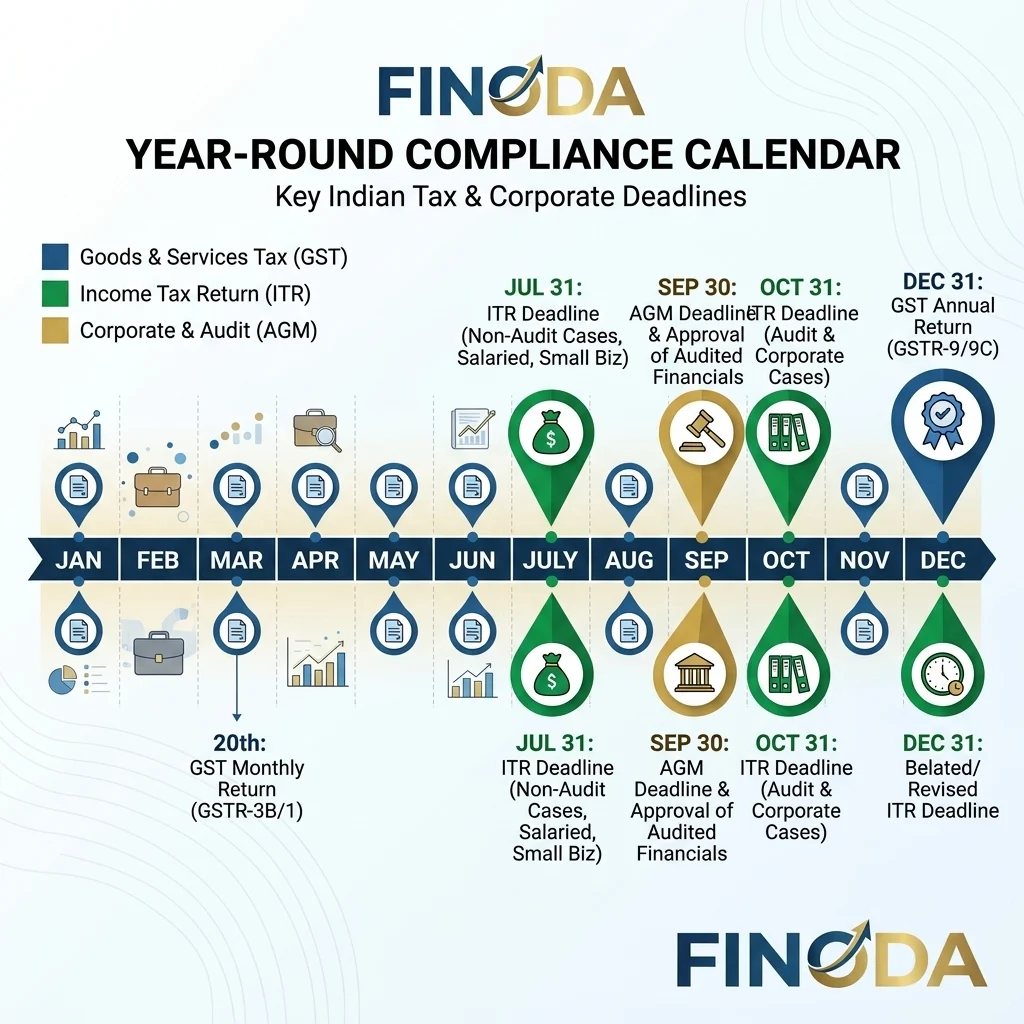
Staying compliant is really about staying ahead. Here's a month-by-month breakdown of what needs to happen for FY 2025–26. We share this with every client we onboard — because missing one date can trigger a cascade of problems.
| Month / Date | Compliance Action |
|---|---|
| April 2025 | New FY begins. Review old vs new income tax regime. Begin advance tax planning. |
| 15 June 2025 | 1st installment of advance tax (15% of estimated annual liability) |
| July 31, 2025 | Last date to file belated/revised ITR for FY 2024–25 (AY 2025–26) |
| 15 September 2025 | 2nd installment of advance tax (45% cumulative) |
| 15 December 2025 | 3rd installment of advance tax (75% cumulative) |
| 31 December 2025 | GSTR-9 + GSTR-9C annual return filing (FY 2024–25) |
| 31 January 2026 | Update investments, 80C proofs, close books for Q3 |
| 15 March 2026 | 4th and final advance tax installment (100% cumulative) |
| 31 March 2026 | FY 2025–26 ends. Last chance for tax-saving investments for this year. |
| 1 April 2026 | New Income Tax Act, 2025 comes into force (applies from Tax Year 2026–27 onwards) |
| 31 July 2026 | ITR filing deadline — salaried individuals, no audit required (ITR-1, ITR-2) |
| 31 August 2026 | ITR deadline — business/profession, non-audit cases (ITR-3, ITR-4) |
| 30 September 2026 | Tax audit report (Form 3CA/3CB/3CD) due for audit cases |
| 31 October 2026 | ITR deadline — audit cases |
| 31 December 2026 | Belated ITR for FY 2025–26. Also last date for GSTR-9 (FY 2025–26). |
| 31 March 2027 | Revised return deadline for AY 2026–27 |
Pro tip from our team: Mark 30 September 2026 as an internal deadline for audit clients, not 31 October. Filing the audit report at the last minute creates unnecessary pressure on accuracy. We book slots early for exactly this reason.
Why Choose Finoda for Tax & Compliance — One Team, All Services
We've been in this long enough to know what frustrates people about tax consultants. Slow responses. Hidden charges. The CA who handles your audit doesn't know your investment portfolio. Advice that changes every year with a new junior handling your file.
We built Finoda to fix all of that.
What makes us different:
One integrated team. The same professionals who advise on your investments also understand your tax position. So when we say "invest ₹1.5 lakh in ELSS before March 31," we're saying it because we've already looked at your return and know it reduces your taxable income by that exact amount — not as generic advice.
Digital-first, pan-India. You don't need to come to our Bangalore office. All document submissions happen online. Consultations are on video call. We file directly on government portals — incometax.gov.in, gst.gov.in, and mca.gov.in. Response time on client queries: within 24 hours on working days.
Transparent pricing. We quote a fixed fee before we start, not after. We've never sent a surprise invoice.
Real track record. Over 10,000 clients served. More than ₹100 crore in assets under advisory. 8+ years of operations. These are real numbers from our team — not marketing copy.
We operate under all applicable regulatory frameworks — ICAI for chartered accountancy services, and SEBI guidelines for investment-side advisory. So every side of your financial life is covered by people who are properly credentialed to handle it.
→ About Our Team
→ Why Finoda
→ Contact Our Tax Team
→ Official Income Tax Portal — incometax.gov.in (external: government ITR filing reference)
Frequently Asked Questions — Tax & Compliance India
Yes, and that's genuinely one of our biggest differentiators. Most firms do one or the other. We do both — our finance advisors handle equity, mutual funds, SIP, IPO, and portfolio management, while our CA team handles ITR filing, GST compliance, and company audits. One relationship covers your full financial life. In our experience, clients who work with an integrated team like ours tend to make better tax-saving investment decisions because both sides talk to each other.
Yes. We offer bundled annual compliance packages for business owners — combining monthly GST return filing, year-end ITR, and statutory audit at a bundled rate. The exact pricing depends on your business structure, turnover, and specific compliance requirements. Reach out to our team for a custom package quote.
For salaried individuals and those without business income (ITR-1, ITR-2), the deadline is 31 July 2026. For business and professional income cases not requiring audit (ITR-3, ITR-4), it's 31 August 2026 — a new extension effective from this assessment year, introduced in Budget 2026. Audit cases must file by 31 October 2026. If you miss the main deadline, you can still file a belated return by 31 December 2026, but a penalty of ₹5,000 applies if your income exceeds ₹5 lakh.
Absolutely. While our registered office is in Bengaluru (100 Feet Ring Rd, Jayanagara 9th Block), we work with clients across India — Mumbai, Delhi, Hyderabad, Chennai, Pune, and smaller cities too. Everything happens digitally. You upload documents via our secure portal, we consult on video call, and filings go directly to the government portals. No physical visit needed.
A Chartered Accountant (CA) is licensed by the Institute of Chartered Accountants of India (ICAI) and is authorised to conduct statutory audits, certify financial statements, and sign off on tax audit reports. A tax consultant may offer advisory services without this formal certification. At Finoda, our compliance team includes ICAI-qualified CAs — so you're getting properly credentialled professionals, not just advisors.
Don't panic — most notices are procedural. Common ones include 143(1)(a) for mismatch in income or TDS, 139(9) for defective return, and 148 for income escaping assessment. Our team reviews the notice, identifies the exact issue, prepares the response, and submits it on your behalf within the required timeline. We've handled hundreds of notices across different sections. The key is not to ignore them — every notice has a response window.
GST registration is the process of enrolling your business on the GSTN (Goods and Services Tax Network) portal and obtaining a GSTIN number. It's mandatory if your turnover exceeds ₹40 lakh (goods) or ₹20 lakh (services) annually. But even if you're below the threshold, voluntary registration is often beneficial — you can claim Input Tax Credit on purchases, and it adds credibility when dealing with larger clients. We complete the registration process in 7–10 working days.
A statutory audit is a legally mandated review of a company's financial statements by an independent CA, required under the Companies Act, 2013. Every private limited company and public limited company — regardless of size or turnover — must get a statutory audit done each financial year. For LLPs, it's required if turnover exceeds ₹40 lakh or capital contribution exceeds ₹25 lakh. The audit report must be submitted before the AGM and filed with the ROC.
GSTR-9 is the annual GST return summarising all monthly/quarterly returns filed during the year. It's mandatory for all GST-registered businesses. GSTR-9C is a reconciliation statement that compares the figures in GSTR-9 with the audited financial statements. It's required only for businesses with annual aggregate turnover exceeding ₹5 crore. Both must be filed by 31 December of the following financial year. Our team handles both.
Yes, and we'd argue tax planning is actually more valuable than filing. Filing is just reporting what happened. Planning is about shaping what will happen — legally reducing your tax liability before the financial year ends. We advise on 80C optimisation (ELSS, PPF, ULIP, life insurance), 80D (health insurance for self and family), NPS contributions under 80CCD(1B), home loan benefits under Section 24, and timing of capital gains booking. The best time to start is April — not March.
Under GST law, a late fee of ₹50 per day (₹25 CGST + ₹25 SGST) applies for each day of delay in filing GSTR-1 and GSTR-3B. For nil returns, the late fee is ₹20 per day. Over months, this adds up fast — we've seen businesses accumulate ₹30,000–₹50,000 in avoidable penalties. Additionally, if ITC is not claimed within the prescribed timelines (generally by November 30 of the next FY), it lapses permanently. Timely filing isn't optional.
Generally no — if your business turnover is below ₹1 crore, a tax audit under Section 44AB is not mandatory. However, if you declare net profit below 8% (or 6% for digital transactions) of turnover and claim it under the presumptive scheme (Section 44AD), you'll need an audit regardless of turnover. Also note: the ₹1 crore threshold rises to ₹10 crore if at least 95% of your business receipts and payments are digital. Our team assesses your specific situation before advising.
After submitting a complete application on the GST portal with all required documents (PAN, Aadhaar, address proof, bank statement, business proof), registration is typically granted within 7 working days. If the GST officer raises a query or asks for additional documents, it can take up to 30 days. We prepare and submit the complete application on Day 1, which minimises back-and-forth delays.
Yes. NRI tax compliance in India is actually more complex than resident filing — there are specific rules around TDS on NRI income, DTAA (Double Taxation Avoidance Agreement) benefits, capital gains from Indian investments, and mandatory ITR filing if Indian income exceeds the basic exemption limit. We handle NRI returns, FEMA compliance questions, and TDS refund claims. Consultation is via video call regardless of which country you're in.
CONTACT
Ready to sort your taxes this year?
We offer a free 30-minute consultation — no commitment, no pressure. Just bring your basic income details and we'll tell you exactly what you need and what it'll cost.
+91 90352 94343
info@finoda.in
VGV Towers, Unit 101, 139/88, 1st Floor, 100 Feet Ring Rd, Jayanagara 9th Block, Bengaluru — 560041