
Commodity Trading India — Trade Gold, Silver & Crude Oil on MCX | Finoda
Commodity trading in India has grown faster than most people expected. From gold touching new highs every few weeks to crude oil moving wildly on global headlines — more and more traders are stepping into this market. And honestly, it's not hard to see why.
At Finoda, we've worked with traders across Bangalore and beyond. In our experience, the biggest barrier isn't knowledge — it's finding a broker who actually explains things. Someone who'll walk you through your first gold trade on MCX just as easily as your tenth. That's what we do.
Whether you're looking to trade gold price MCX live, hedge your portfolio with silver, or explore crude oil futures — we've got you covered.
- What is Commodity Trading in India? — MCX & NCDEX Explained
- Commodities You Can Trade on MCX
- MCX Trading Hours & Sessions
- How to Start Commodity Trading in India — Step by Step
- Commodity Trading vs Equity Trading — Key Differences
- Commodity Trading Charges at Finoda
- Frequently Asked Questions — Commodity Trading
What is Commodity Trading in India? — MCX & NCDEX Explained
Commodity trading simply means buying and selling raw materials through a regulated exchange. In India, two exchanges handle this:
MCX (Multi Commodity Exchange) is India's largest commodity exchange. It handles metals like gold and silver, energy like crude oil and natural gas, and some agri commodities. MCX is where most active traders spend their time.
NCDEX (National Commodity & Derivatives Exchange) is India's go-to platform for agricultural commodities. Think turmeric, pepper, cumin, cotton, and soybean. Farmers, agri businesses, and commodity traders all use NCDEX to manage price risk.
Both exchanges operate under the regulatory framework set by SEBI. That means your trades are legally protected, prices are transparent, and everything runs through a regulated clearing system.
We've found that most new traders don't realise how different commodity trading is from equity trading — and that's okay. The mechanics are similar (buy low, sell high), but the drivers are entirely different. Weather patterns, global supply chains, geopolitical events — these are the forces that move commodity prices. It's a fascinating space once you get into it.
Internal Link: Also explore Equity Trading at Finoda if you prefer stocks over commodities.
Commodities You Can Trade on MCX
There's a wide range of commodities available on MCX. But in practice, most of the volume — and most of the trader interest — is concentrated in a handful of categories.
Gold Trading on MCX — India's Most Traded Commodity
Gold is India's most loved commodity. And on MCX, it's also the most actively traded one. With around 500,000 monthly searches for gold price MCX live and gold price MCX today, it's clear that Indians track gold prices constantly — and many of them trade it actively.
On MCX, gold trades in 1 kg lots (standard) and 100 gram lots (mini). The price you see on MCX is linked to global COMEX gold prices, converted into Rupees and adjusted for import duties and local factors.
We've seen traders use MCX gold for two main reasons — speculation on short-term price moves, and portfolio hedging against inflation and currency weakness. Both are valid strategies. The key is knowing your position size and having a clear exit plan.
Check MCX India Official for live gold price MCX and contract specifications.
Silver Trading on MCX
Silver often gets less attention than gold, but don't let that fool you. The silver India price is one of the most-searched commodity terms in India, and for good reason. Silver moves faster than gold — it's more volatile, which means more opportunity (and more risk).
On MCX, silver trades in 30 kg lots (standard) and 5 kg lots (mini). Silver has both industrial demand (electronics, solar panels) and investment demand, which makes it respond to a wider set of market forces than gold.
For traders who want commodity exposure but find gold a bit slow-moving, silver is worth looking at. But because of that volatility, risk management is especially important here.
Crude Oil Trading
Crude oil on MCX is the go-to instrument for traders who want to ride global energy market moves. Every time there's a news event around OPEC, the US Dollar, or global demand — crude oil reacts. Fast.
MCX crude oil trades in 100-barrel lots, linked to the international WTI (West Texas Intermediate) crude price. It's one of the most actively traded commodities on the exchange and sees heavy participation from both retail and institutional traders.
Moreover, crude oil trades deep into the night — up to 11:30 PM IST — so you can trade it after the US market opens, when the real price action often happens.
Agricultural Commodities on NCDEX
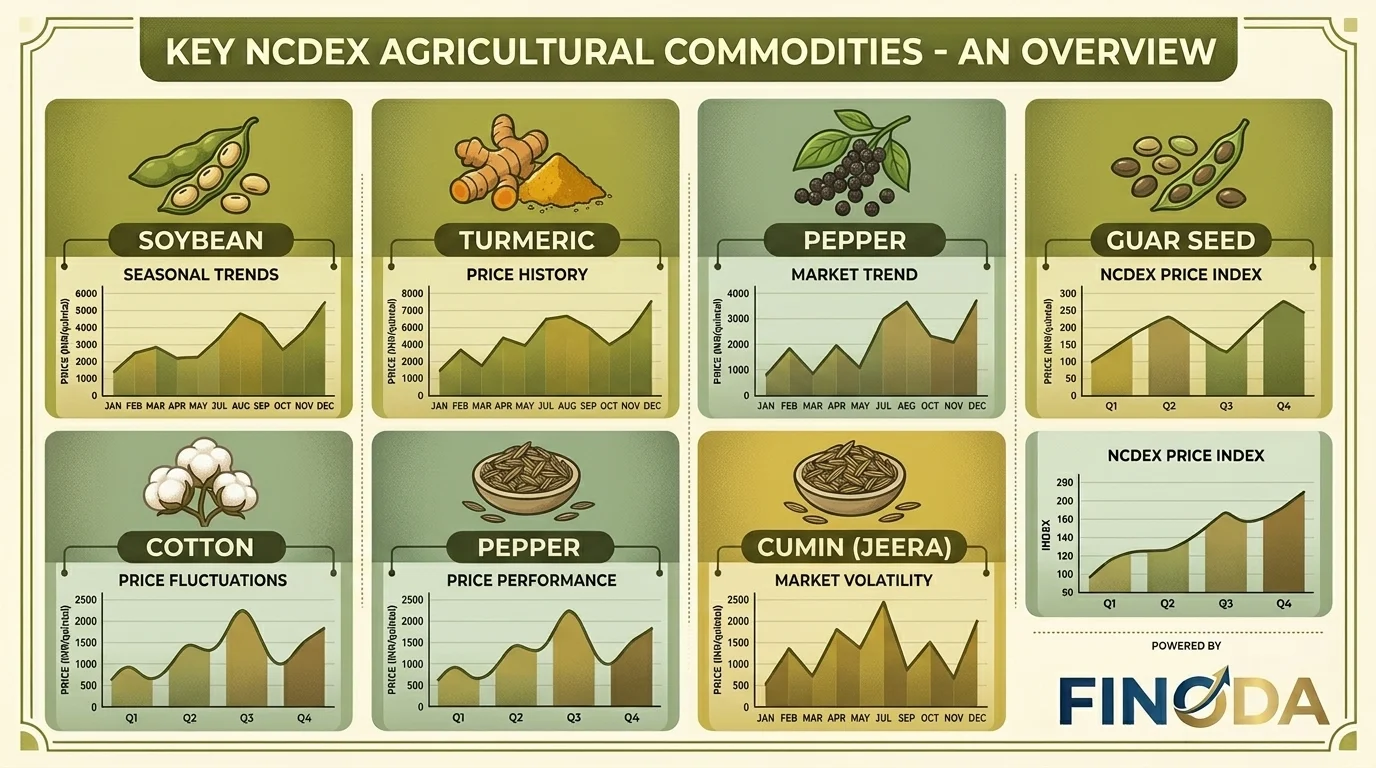
NCDEX is where India's agricultural commodity story plays out. The platform is well-known for NCDEX turmeric futures, which attract significant volume from traders and businesses in Erode, Nizamabad, and other major production hubs.
Beyond turmeric, NCDEX covers:
- Pepper (black and white)
- Cumin (jeera) — one of the most watched agri contracts
- Soybean and soy oil
- Cotton (kapas and seed cotton)
- Guar seed and guar gum
Agricultural commodities are heavily influenced by monsoon forecasts, crop production data, government MSP announcements, and export-import policies. So if you're someone who follows agri news closely, NCDEX gives you a direct way to trade on that understanding.
For live agricultural commodity prices, visit NCDEX Official.
MCX Trading Hours & Sessions
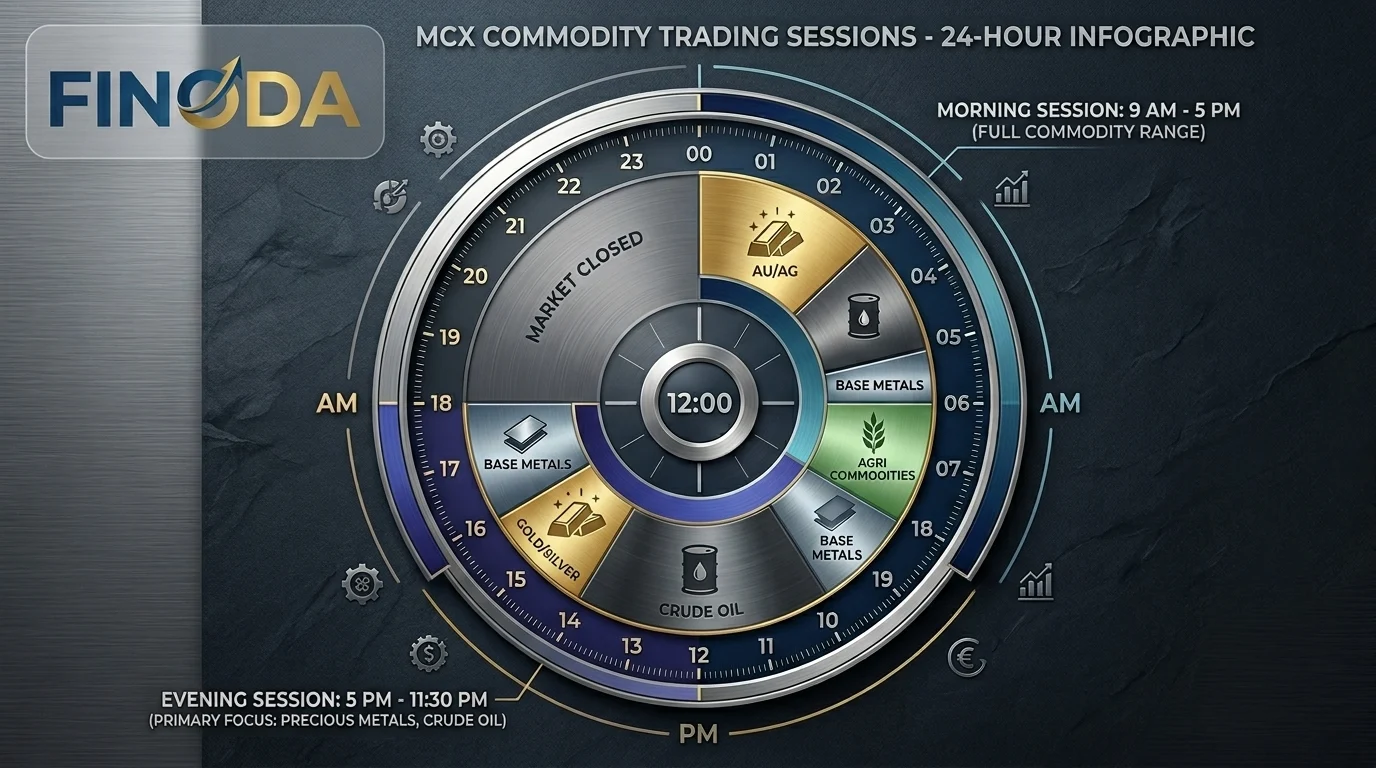
One of the biggest differences between commodity trading and equity trading is the trading window. MCX stays open far longer than the stock market. Here's how it works:
Commodity trading time in India (MCX):
| Session | Time (IST) | Commodities Covered |
|---|---|---|
| Morning Session | 9:00 AM – 5:00 PM | All commodities (metals, energy, agri) |
| Evening Session | 5:00 PM – 11:30 PM | Metals (gold, silver) & Energy (crude oil, natural gas) |
Agricultural commodities like turmeric and cumin only trade in the morning session. But metals and energy continue into the night, which is why commodity trading time comes up so often in search — many traders don't realise they can trade gold at 10 PM.
This extended window is genuinely useful. Global commodity markets move in the evening India time, when the US market opens. So having that 11:30 PM cut-off means you can actually react to overnight developments in real time.
How to Start Commodity Trading in India — Step by Step
Starting commodity trading isn't complicated. But it does require a proper account setup. Here's how we walk our clients through it at Finoda:
-
Step 1 — Open a Trading Account
Visit Finoda and open your demat and trading account. You'll need basic KYC documents — PAN card, Aadhaar, bank details, and a passport-size photo. The process is mostly online and takes a day or two. -
Step 2 — Add the Required Margin
Each commodity contract requires a margin — basically a security deposit. For example, trading 1 lot of gold may need anywhere from ₹25,000 to ₹60,000 depending on current price and volatility. Transfer this to your trading account. -
Step 3 — Choose What to Trade
Decide whether you want to trade metals, energy, or agri commodities. If you're just starting, gold or silver on MCX is usually a good place because there's plenty of liquidity and market information available. -
Step 4 — Place Your First Trade
During MCX trading hours, log into the platform, pick your commodity contract, and place a buy or sell order. Use limit orders to control the price you enter at. -
Step 5 — Manage Your Position
Set a stop-loss to protect yourself from big adverse moves. Track live MCX gold and silver prices, and check in with your Finoda advisor if you need guidance. Risk management isn't optional — it's the whole game.
Contact Us and talk to one of our advisors before placing your first trade.
Commodity Trading vs Equity Trading — Key Differences
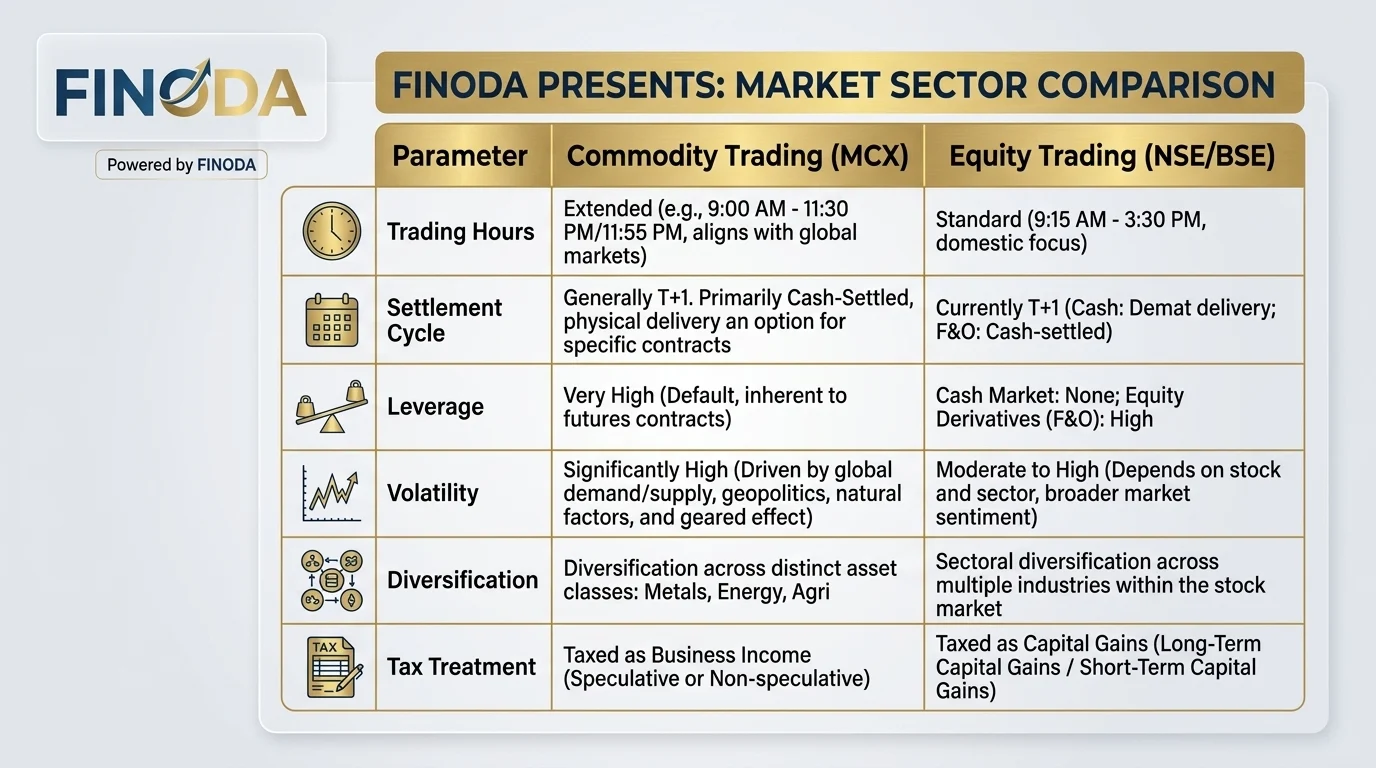
People often ask us: "Should I trade equities or commodities?" Honestly, it's not an either/or question. But the differences matter, and knowing them helps you make a better decision.
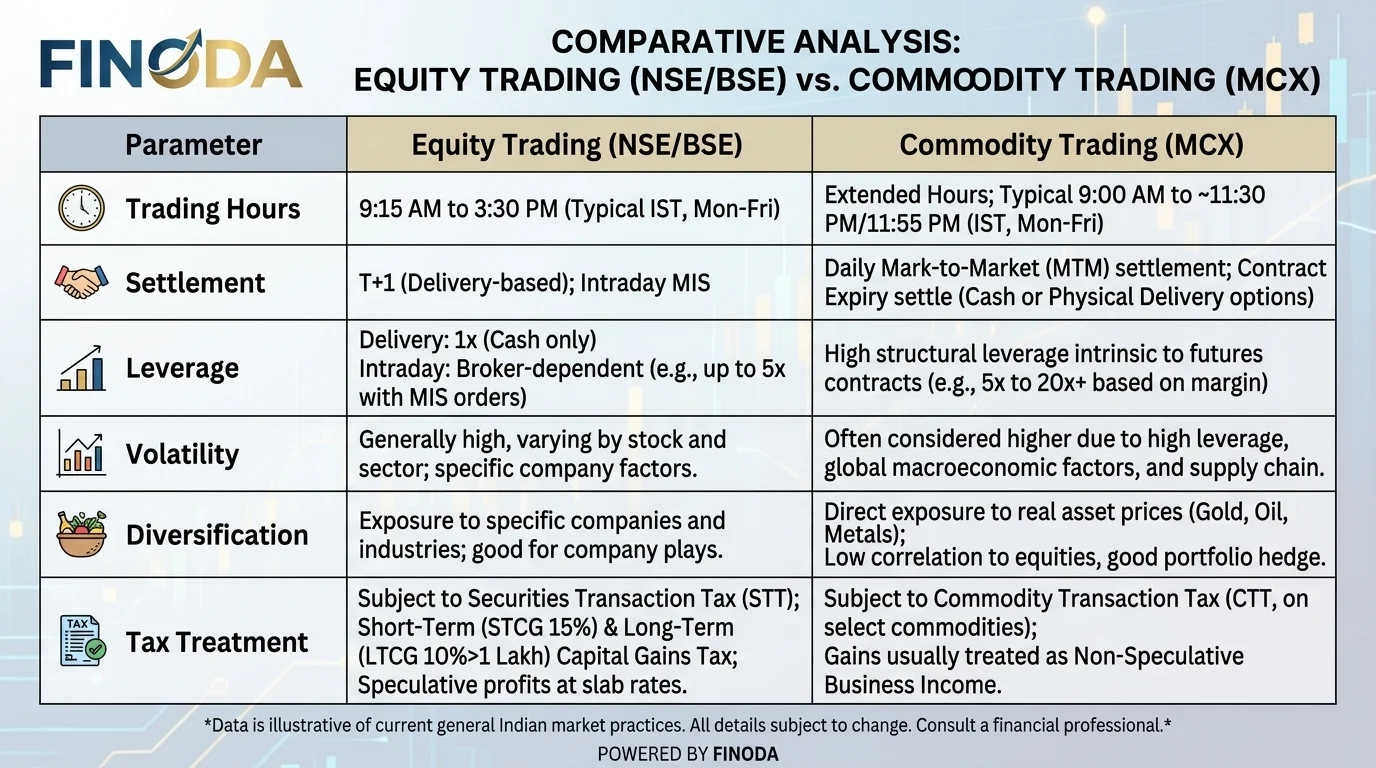
| Parameter | Commodity Trading (MCX) | Equity Trading (NSE/BSE) |
|---|---|---|
| Trading Hours | 9 AM – 11:30 PM IST | 9:15 AM – 3:30 PM IST |
| Asset Type | Physical raw materials (gold, oil, agri) | Company shares and derivatives |
| Leverage | Higher leverage available | Moderate leverage in F&O |
| Market Drivers | Supply-demand, weather, global events | Company earnings, economy |
| Settlement | Mark-to-market daily; delivery optional | T+1 for equity delivery |
| Tax (CTT/STT) | CTT at 0.01% on sell (non-agri) | STT on buy & sell in delivery |
| Diversification | Inflation hedge; uncorrelated to stocks | Correlated to broader market |
So, commodity trading works well for traders who want longer trading hours, inflation protection (especially through gold and silver), and exposure to global economic themes. Equity trading suits those who prefer company-level stories and dividends.
Many of our clients at Finoda run both. That's actually a smart approach — commodities and equities often move in opposite directions during market stress, which smooths out your overall portfolio.
Internal Link: Explore Currency Trading if you're interested in Forex and international markets.
Internal Link: Learn more about Why Choose Finoda for your trading and investment needs.
Commodity Trading Charges at Finoda
Transparency in charges is something we take seriously. Here's a plain-language breakdown of what you'll pay when trading commodities:
Brokerage: Finoda charges competitive brokerage rates. Contact us for current pricing — we'll walk you through the exact numbers before you open your account.
MCX Exchange Transaction Charges: MCX now charges a flat ₹2.10 per lakh of turnover for futures contracts. This replaced the earlier tiered system as per SEBI's transparency directive.
CTT (Commodities Transaction Tax): CTT is 0.01% on the sell side for non-agricultural commodities (gold, silver, crude oil, etc.). Agricultural commodities are exempt from CTT.
SEBI Charges: ₹10 per crore for non-agri commodities. This is a regulatory fee paid to SEBI for market oversight.
GST: 18% is charged on brokerage plus exchange transaction charges combined.
Stamp Duty: Charged on the buy side of the transaction. Rates vary by state.
One thing worth noting — the total effective cost of a commodity trade is often lower than people expect, especially compared to equity F&O. The combination of MCX's flat fee structure and CTT being just 0.01% means a fairly predictable cost per trade.
SEBI publishes updated regulatory charges at sebi.gov.in.
Frequently Asked Questions — Commodity Trading
MCX (Multi Commodity Exchange) is India's largest commodity derivatives exchange where you can trade metals (gold, silver, copper), energy (crude oil, natural gas), and other commodities through a licensed broker operating under SEBI guidelines.
MCX operates in two sessions: Morning session from 9:00 AM to 5:00 PM IST, and Evening session from 5:00 PM to 11:30 PM IST for metals and energy commodities. Agricultural commodities trade only in the morning session.
Yes. Open a commodity trading account with Finoda and trade gold, silver, crude oil, and 30+ commodities on MCX. Our advisors guide you on entry and exit points and help with risk management.
NCDEX (National Commodity & Derivatives Exchange) is India's leading agricultural commodity exchange where traders can buy and sell commodities like turmeric, pepper, cumin, cotton, and soybean.
Yes, commodity trading through MCX and NCDEX is completely legal in India and regulated under SEBI's framework. You must trade through a licensed broker that operates within SEBI guidelines, such as Finoda.
CTT stands for Commodities Transaction Tax. It works like STT in equity markets. Currently, CTT is charged at 0.01% on the sell side for non-agricultural commodities like gold, silver, and crude oil on MCX.
The minimum investment depends on the commodity and lot size. For a gold mini contract (100 grams on MCX), the required margin can be around ₹8,000–₹15,000 depending on current price. For a standard 1 kg gold lot, it can go up to ₹50,000 or more. Finoda advisors help you pick the right contract size for your budget.
On MCX, you can trade precious metals (gold, silver), base metals (copper, aluminium, zinc, lead, nickel), energy commodities (crude oil, natural gas), and some agricultural commodities. NCDEX covers agri commodities like turmeric, cumin, and pepper.
MCX charges ₹2.10 per lakh of turnover for commodity futures. On top of this, SEBI levies ₹10 per crore for non-agri commodities, GST is 18% on brokerage and transaction fees, and CTT is 0.01% on the sell side for non-agri commodities.
It depends on your goals. Commodity trading offers longer trading hours (up to 11:30 PM IST), inflation hedging through gold and silver, and portfolio diversification. Equity trading offers ownership benefits and dividends. Many traders run both alongside each other for a more balanced portfolio.
MCX gold prices are derived from the international COMEX gold price converted into Indian Rupees. The exchange rate, import duties, and local demand all feed into the final MCX gold price. That's why MCX gold and international gold don't always move in the same percentage terms on a given day.
MCX primarily handles metals and energy commodities like gold, silver, and crude oil. NCDEX focuses on agricultural commodities like turmeric, soybean, cumin, and cotton. Both exchanges operate under SEBI's regulatory framework but serve different segments of the commodity market.