
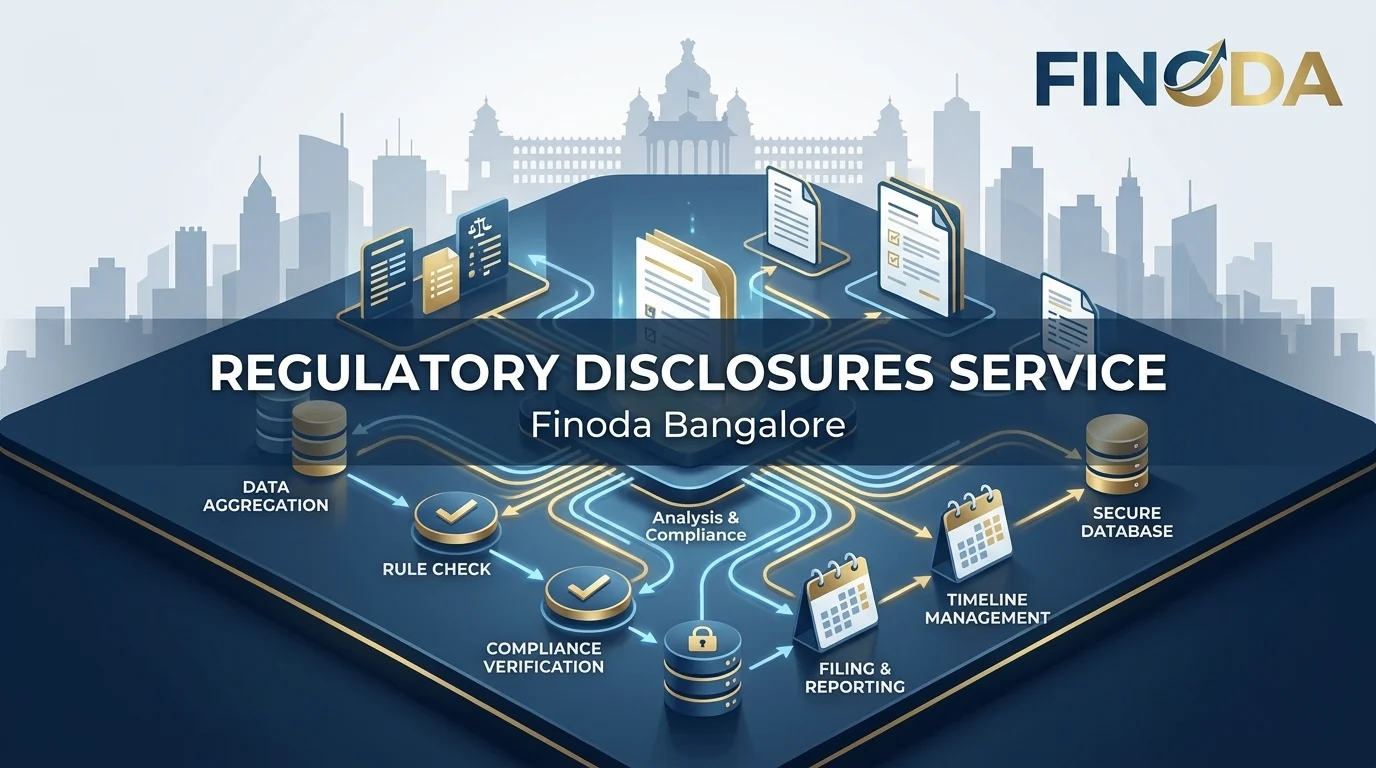
Regulatory Disclosures — SEBI, AMFI, IRDAI Registrations
We believe transparency isn't just a legal box to tick. It's the foundation of real trust. At Finoda, we operate under the full framework of Indian financial regulations — and we make every registration, every compliance document, and every regulatory detail publicly available on this page. No fine print. No buried links. Just clear, honest disclosure of who we are and how we're regulated.
So whether you're a first-time investor wondering if Finoda is legit, or a seasoned market participant doing your due diligence — this page gives you everything you need.
Table of Contents
- Why Regulatory Disclosures Matter for Indian Investors
- SEBI Registration Details
- NSE & BSE Membership
- AMFI ARN Registration
- IRDAI License Disclosure
- Annual Compliance Reports
- Our Compliance Commitment — What We Believe
- Frequently Asked Questions (FAQs)
- Q1. What are regulatory disclosures in the context of a financial services company?
- Q2. How do I check if Finoda is a legitimate financial services company?
- Q3. Does Finoda operate under SEBI guidelines?
- Q4. What is an AMFI ARN and why does it matter?
- Q5. Is it safe to invest in mutual funds through Finoda?
- Q6. What IRDAI license does Finoda hold for insurance products?
- Q7. What is the NSE and BSE membership, and what does it mean for my trades?
- Q8. Can I see Finoda's annual compliance reports?
- Q9. What is SEBI's role in regulating stock brokers in India?
- Q10. What is the difference between SEBI, AMFI, and IRDAI?
- Q11. How does Finoda handle client complaints or grievances?
- Q12. What happens to my money if Finoda shuts down?
- Q13. Does Finoda charge hidden fees or earn commissions?
- Q14. How do I contact Finoda for regulatory or compliance queries?
- Q15. Is investing through a regulated broker in Bangalore safe?
- Ready to Invest with Confidence?
Why Regulatory Disclosures Matter for Indian Investors
In our experience, one of the first questions new clients ask us is: "How do I know you're genuine?" It's a fair question. Indian markets have seen their share of unregulated entities offering dubious advice. Regulatory compliance is what separates a trustworthy firm from the rest.
SEBI, AMFI, IRDAI, NSE, and BSE are not just acronyms. They're India's financial watchdogs — and every legitimate financial service provider must earn registration from them, maintain ongoing compliance, and face regular audits. We do all of that. Moreover, we publish our registration details here so you can verify them yourself directly on the official government portals.
Furthermore, SEBI's 2025 overhaul of the Stock Brokers Regulations has raised the compliance bar across the industry. The new framework demands clearer disclosures, stronger audit trails, and tighter investor protection standards. We welcome those changes — because they align with how we've always operated.
SEBI Registration Details
SEBI — the Securities and Exchange Board of India — is the apex regulator for India's securities markets. All stock brokers, investment advisers, and portfolio managers must register with SEBI and comply with its guidelines.
Finoda operates under SEBI's regulatory framework. Our operations follow the SEBI (Stock Brokers) Regulations, 2025 — the landmark framework that replaced the 1992 rules and brought India's broker compliance into the modern era. This includes clear obligations around client onboarding, fund handling, grievance redressal, and reporting.
Key compliance areas under SEBI guidelines:
- Client KYC and due diligence as mandated by SEBI circular
- Risk disclosure to all clients before onboarding
- Maintaining client fund segregation at all times
- Regular internal audits and compliance reporting
- Grievance redressal within SEBI-prescribed timelines
We encourage every investor to verify the compliance status of any financial service provider before investing. You can check registrations directly at SEBI Official Portal.
Related: Risk Disclosure Policy | Grievance Redressal
NSE & BSE Membership
The National Stock Exchange (NSE) and Bombay Stock Exchange (BSE) are India's two premier stock exchanges. Trading on these exchanges is only permitted through registered members. This membership is a critical quality signal for investors — it means the broker has cleared stringent capital, infrastructure, and governance checks set by the exchanges themselves.
Finoda's clients get direct access to NSE and BSE listed securities, including equities, derivatives (F&O), currency pairs, and commodity instruments. All trade execution happens through a fully regulated and exchange-approved platform.
What NSE & BSE membership means for you:
- Your trades execute on official exchange order books — no dark pools or off-market dealing
- Exchange-level investor protection and dispute resolution mechanisms apply
- Your demat securities are held with CDSL or NSDL depositories — not with us
- All settlement happens through the exchange clearing corporation — T+1 rolling settlement for equities
The exchange membership also gives us access to real-time market data, research feeds, and compliance monitoring tools that we pass on to our advisory clients.
Related: Equity Trading | Derivatives — F&O | Cash Equity
AMFI ARN Registration

AMFI — the Association of Mutual Funds in India — regulates all mutual fund distributors in the country. To legally distribute or advise on mutual funds, a financial advisor must hold a valid AMFI Registration Number (ARN). Getting an ARN isn't a formality — it requires passing NISM certification examinations and ongoing education credits.
Our team at Finoda holds valid AMFI ARN registrations. This means every SIP recommendation, every lumpsum mutual fund suggestion, and every fund comparison we share with you comes from certified, AMFI-compliant advisors.
What our AMFI ARN registration covers:
- Recommending and processing SIP investments across all mutual fund categories
- Distributing equity mutual funds, debt funds, ELSS tax-saving funds, hybrid funds, and liquid funds
- Providing fund performance comparisons and risk-adjusted return analysis
- Processing NFO (New Fund Offer) applications for clients
- Handling mutual fund redemptions, switches, and STP/SWP transactions
So when you invest in a SIP through Finoda, you're not dealing with an unlicensed distributor. You're working with a certified, AMFI-registered advisor who's accountable to the regulator.
Related: Mutual Funds | SIP Investment | ELSS Funds Guide
IRDAI License Disclosure
Insurance in India is regulated by IRDAI — the Insurance Regulatory and Development Authority of India. Any entity that sells, recommends, or distributes insurance products must hold a valid IRDAI corporate agent license or individual agent license. Operating without this license is a criminal offence under the Insurance Act.
Finoda holds the necessary IRDAI corporate agent authorisation to distribute life insurance, health insurance, motor insurance, and investment-linked plans (ULIPs) in India. Our insurance advisors are trained, licensed, and regularly assessed as per IRDAI norms.
Our IRDAI-compliant insurance services include:
- Term life insurance from leading IRDAI-registered insurers
- Health insurance plans — individual, family floater, and senior citizen policies
- Motor insurance — comprehensive and third-party liability cover
- ULIP investment-linked plans with long-term wealth creation potential
We also follow IRDAI's disclosure requirements — which means we tell you exactly what commission (if any) we earn from a policy sale. You'll never find us pushing an unsuitable policy to earn a higher payout. IRDAI guidelines are very clear on mis-selling, and we take those obligations seriously.
Related: Health Insurance | Life Insurance | Motor Insurance | ULIP Plans
Annual Compliance Reports
Regulatory compliance is not a one-time event. It's a continuous process. Every financial year, Finoda's compliance team submits mandatory reports to SEBI, AMFI, IRDAI, and exchange regulators. These include audit reports, KYC compliance statements, client fund segregation confirmations, and grievance resolution data.
In our experience, annual compliance reports are one of the most overlooked but important indicators of a firm's health. A firm that files clean reports year after year — with no disciplinary actions, no client fund deficiencies, and no pending regulatory orders — is a firm you can trust with your money.
We're proud of our compliance track record. And we publish this section not to boast, but to be honest with you about what responsible financial services look like from the inside.
What we report annually:
- Client asset reconciliation and fund segregation confirmation
- AMFI ARN renewal and continuing education compliance
- IRDAI corporate agent annual return
- Exchange member compliance reports (NSE/BSE audit certificates)
- SEBI annual regulatory return for applicable registrations
- Internal audit report by a SEBI-empanelled auditor
- Grievance data — number of complaints received, resolved, and pending
If you have a specific compliance-related query or require documentation for your own due diligence, reach out to us directly at info@finoda.in or call 9035294343.
Related: Privacy Policy | Terms & Conditions | Grievance Redressal
Our Compliance Commitment — What We Believe
We've found that most investors don't actually read compliance pages. But the ones who do — they're the kind of investors who make thoughtful, long-term decisions. And those are exactly the clients we want to work with.
Compliance isn't a burden we resent. It's a framework we respect. Because ultimately, every regulation SEBI, AMFI, and IRDAI puts in place exists for one reason — to protect you, the investor.
So here's our simple promise: We'll always follow the rules. We'll always tell you when we don't know something. And we'll never recommend something that benefits us at your expense.
If you're ready to start investing with a team that takes compliance this seriously, open your free Demat account today. It takes less than 10 minutes.
Frequently Asked Questions (FAQs)
Q1. What are regulatory disclosures in the context of a financial services company?
Regulatory disclosures are mandatory statements a financial firm must publish, covering its registrations, licenses, compliance status, and obligations under law. For a company like Finoda, this means disclosing AMFI ARN numbers, IRDAI license details, exchange memberships, and SEBI-compliant operating norms — so clients can verify legitimacy before investing.
Q2. How do I check if Finoda is a legitimate financial services company?
You can verify our regulatory registrations directly on official government portals. Check our AMFI ARN on the AMFI website (amfiindia.com), insurance credentials on irdai.gov.in, and exchange-related compliance details on nseindia.com or bseindia.com. You can also email us at info@finoda.in for specific registration numbers.
Q3. Does Finoda operate under SEBI guidelines?
Yes. Finoda's operations fully follow SEBI's regulatory framework. This covers client onboarding, KYC verification, risk disclosure, fund handling, grievance redressal, and annual compliance reporting — all aligned with SEBI's guidelines for financial market intermediaries.
Q4. What is an AMFI ARN and why does it matter?
AMFI ARN stands for Association of Mutual Funds in India — Agent Registration Number. It's a mandatory license for anyone who distributes or advises on mutual funds in India. An ARN holder has passed NISM exams and is accountable to AMFI's code of conduct. If your mutual fund advisor doesn't have an ARN, they're operating illegally. Our team holds valid, current ARN registrations.
Q5. Is it safe to invest in mutual funds through Finoda?
Yes, it's safe. When you invest in mutual funds through Finoda, your money goes directly to the AMC (Asset Management Company) — not to us. We're simply a distribution channel. Your investments are reflected in your own folio, held by the AMC and regulated by SEBI. We cannot access or move your mutual fund units without your explicit instruction.
Q6. What IRDAI license does Finoda hold for insurance products?
Finoda holds IRDAI corporate agent authorisation, which allows us to distribute life insurance, health insurance, motor insurance, and ULIP products from IRDAI-registered insurers. This means we can legally recommend and process insurance purchases — but we're required to always act in your best interest, not just sell the policy with the highest commission.
Q7. What is the NSE and BSE membership, and what does it mean for my trades?
NSE (National Stock Exchange) and BSE (Bombay Stock Exchange) are India's two main stock exchanges. Membership means exchange approval to trade on behalf of clients. Your buy and sell orders execute on the official exchange order book, your settlements happen through the exchange clearing house, and your demat securities are held safely with CDSL or NSDL depositories.
Q8. Can I see Finoda's annual compliance reports?
We submit annual compliance reports to relevant regulators every financial year. If you need specific compliance documentation for your own due diligence — for instance, if you're a corporate client, HNI, or institution — you can write to us at info@finoda.in and we'll share relevant verified documents.
Q9. What is SEBI's role in regulating stock brokers in India?
SEBI (Securities and Exchange Board of India) is the primary regulator for India's capital markets. It registers and supervises stock brokers, investment advisers, mutual fund houses, portfolio managers, and other market intermediaries. SEBI sets the rules for how markets operate, how clients must be protected, and how firms must report and behave. In December 2025, SEBI replaced the 1992 Stock Brokers Regulations with a modern, simplified framework that focuses on clear compliance, risk-based supervision, and investor protection.
Q10. What is the difference between SEBI, AMFI, and IRDAI?
SEBI regulates the securities market — stocks, bonds, derivatives, and mutual fund houses. AMFI regulates mutual fund distributors and ensures they're certified and conduct-compliant. IRDAI regulates the insurance sector — both insurers and the agents/corporate agents who sell insurance policies. A full-service financial advisory firm like Finoda operates across all three regulatory frameworks.
Q11. How does Finoda handle client complaints or grievances?
Finoda has a formal grievance redressal process aligned with SEBI and AMFI norms. You can raise a complaint by emailing info@finoda.in or calling 9035294343. We're required to respond within defined timelines. If your complaint is unresolved, you can escalate it to SEBI's SCORES portal (scores.sebi.gov.in) or the respective exchange's investor grievance cell. We take every complaint seriously — that's not a marketing line, it's a regulatory obligation.
Related: Grievance Redressal
Q12. What happens to my money if Finoda shuts down?
Your investments are held in your name — not in Finoda's name. Mutual fund units are in your AMFI folio. Demat shares are in your CDSL or NSDL account. Insurance policies are with the insurer directly. We are simply an advisory and distribution intermediary. Even if Finoda were to stop operations tomorrow, your assets would remain fully intact and accessible to you.
Q13. Does Finoda charge hidden fees or earn commissions?
Finoda earns commission or brokerage for the services it provides — this is standard industry practice and fully SEBI and IRDAI-compliant. We are required to disclose all charges before you invest. There are no hidden fees. For brokerage, you get a contract note for every trade. For mutual funds, the expense ratio includes distributor commission at the AMC level, disclosed in the scheme's fact sheet. For insurance, commissions are disclosed under IRDAI norms.
Q14. How do I contact Finoda for regulatory or compliance queries?
You can reach us at:
- 📞 Phone: 9035294343
- 📧 Email: info@finoda.in
- 🏢 Address: VGV Towers, Unit 101, 139/88, 1st Floor, 100 Feet Ring Rd, Jayanagara 9th Block, Bengaluru Karnataka — 560041
Our compliance team responds to regulatory queries on priority. We're also available on LinkedIn, Facebook, Instagram, and X (Twitter).
Q15. Is investing through a regulated broker in Bangalore safe?
Yes — and choosing a regulated financial firm is the single most important step before investing. A regulated broker must follow SEBI rules on fund segregation, KYC, and risk disclosure. They face audits, must maintain client fund accounts separately, and can be penalised for mis-selling. Unregulated entities have none of these obligations. Always verify registrations before investing.
Ready to Invest with Confidence?
Transparency builds trust. And trust builds long-term wealth. We've told you exactly who we are, what licenses we hold, and how we operate. Now it's your turn.
Open Your Free Demat Account →
Or explore our services: Equity Trading | Mutual Funds | Health Insurance | Income Tax Filing | GST Filing