
Buy Unlisted Shares & Pre-IPO Stocks India | Expert Advisory
Most investors don't know about this. There's a whole market — quietly growing — where you can buy shares of companies before they ever hit the NSE or BSE. These are unlisted shares and pre-IPO stocks. And honestly, we've found that some of the best wealth creation in India has happened here, well before the public even got a chance.
At Finoda, we help HNI investors, startup employees with ESOPs, and serious retail investors access this market the right way — with proper documentation, demat transfers, and guidance rooted in SEBI compliance.
Want to explore current unlisted stock availability? Contact our advisors →
- What Are Unlisted Shares? — Pre-IPO & Unlisted Equity Explained
- Pre-IPO vs Unlisted Shares — Key Differences
- Currently Available Unlisted Shares in India — Finoda's Curated List
- How to Buy Unlisted Shares in India — Step by Step
- IPO GMP Today + Upcoming IPO List 2025 — Finoda's Daily Tracker
- SME IPO India — Small Cap Pre-Listing Opportunities
- Risks of Investing in Unlisted Shares — Important Advisory
- Unlisted Shares FAQs — Everything You Need to Know
- Why Choose Finoda for Unlisted Shares & IPO Advisory?
What Are Unlisted Shares? — Pre-IPO & Unlisted Equity Explained
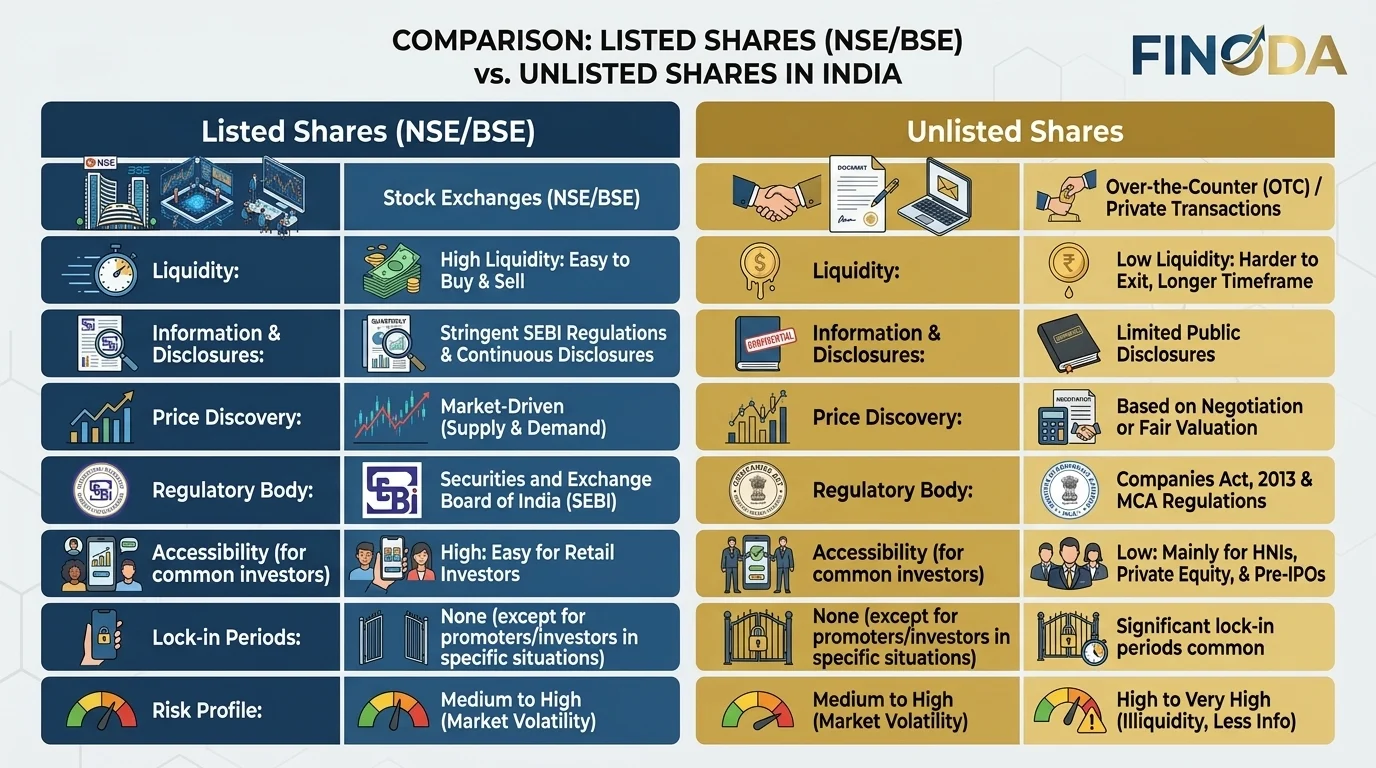
Unlisted shares are equity shares of companies that are not listed on NSE or BSE. They trade privately — between buyers and sellers — at negotiated prices, without an exchange in the middle. So there's no live order book, no price ticker, and no instant liquidity. But also no crowd fighting you for allocation.
Who issues them? Think startups, unicorns, subsidiaries of listed companies, and even well-established private firms that simply prefer staying private. Some well-known examples include NSE shares (before it potentially lists), HDB Financial Services (HDFC's lending arm), and scores of Bangalore-born startups whose employees hold ESOPs.
The big difference from listed stocks? When you buy from NSE or BSE, SEBI directly oversees that exchange. But unlisted shares sit outside that exchange framework — which is why due diligence and choosing the right advisory partner matters so much here. We've seen investors burn money buying unlisted shares from random WhatsApp groups. That's exactly the kind of situation we help people avoid.
Once purchased, unlisted shares are held in your CDSL or NSDL demat account — the same account you use for regular stocks. There's no separate account needed. And if the company eventually lists, your unlisted shares automatically convert to tradeable listed shares.
Pre-IPO vs Unlisted Shares — Key Differences
Not all unlisted stocks are the same. There's an important distinction here.
| Feature | Pre-IPO Shares | Unlisted Shares |
|---|---|---|
| Listing timeline | Company has announced or filed for IPO | No confirmed IPO plans |
| Exit opportunity | Defined — listing date is near | Longer horizon, secondary sale only |
| Grey Market Premium (GMP) | Usually higher, driven by IPO buzz | Lower or absent |
| Risk level | Moderate-high | High |
| Liquidity | Improves near listing | Very limited |
| Typical investor | IPO-focused HNI, retail savvy investors | Long-term HNI, PE-style investors |
| Min investment (approx.) | ₹10,000 – ₹50,000 | ₹25,000 – ₹1,00,000+ |
In simple terms: pre-IPO shares are unlisted shares with a defined exit window. Unlisted shares are a broader category — some will list one day, some may never. The return potential is real in both. But so is the risk. Neither category suits someone looking for quick trades.
Pre-IPO Shares — Invest Before the Listing Boom
Pre-IPO investing means buying into a company before it files for or receives approval for an IPO. You get in at a valuation that public investors never will. In our experience, the best pre-IPO trades in India have come from companies where there was a clear regulatory pathway or investor pressure to list within 12–24 months.
Historical examples? Look at Hyundai India before its 2024 IPO, or NSDL ahead of its listing. Investors who held pre-IPO positions saw meaningful appreciation from their entry price to listing price — though it's important to note that past performance doesn't guarantee anything.
The risk, though, is real. IPOs can be delayed. Companies can pull listings entirely. And if the IPO prices at the low end of the band, your pre-IPO entry might barely break even. That's why we always say: go in with capital you don't need tomorrow.
Unlisted Equity Shares — Long-Term Wealth in Uncovered Markets
Unlisted equity shares include:
- Subsidiary shares — like HDFC Group subsidiaries before they listed separately
- Startup ESOPs — employees of funded startups often want to sell before vesting cliffs
- Employee buyback programs — some companies offer structured buyback windows
- Private unicorns — companies like PhonePe, Lenskart, OYO, and similar names
Prices in the unlisted market are determined by the grey market — essentially, what the last buyer paid. There's no exchange-based price discovery. Valuations also look at funding round multiples, comparable listed companies, and sector trends. Minimum investment is typically between ₹10,000 and ₹1,00,000 depending on the company and lot size.
How to Buy Unlisted Shares in India — Step by Step
Buying unlisted shares isn't like placing a buy order on Zerodha. There's no click-to-buy button. But it doesn't have to be complicated either. Here's exactly how we handle it at Finoda:
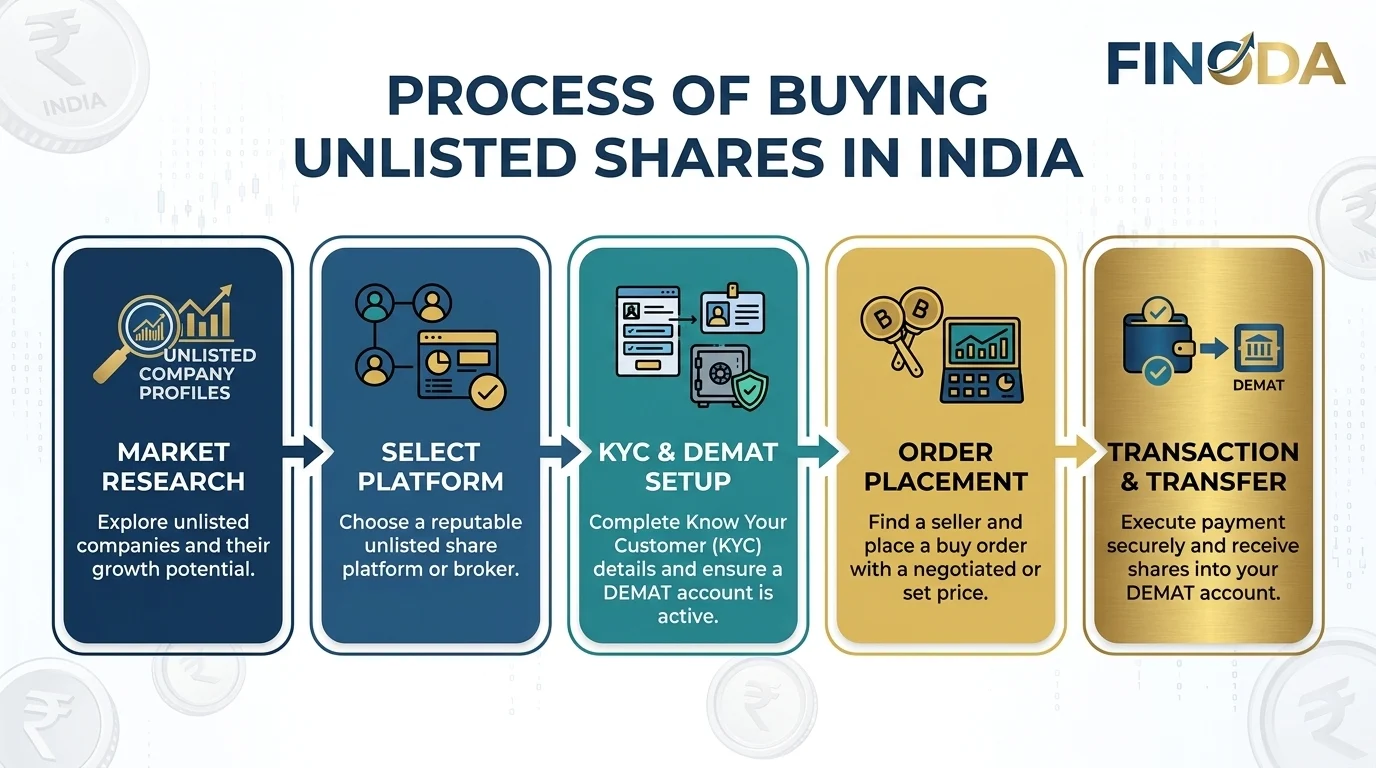
Step 1 — Contact a Finoda Advisor
Reach out via our contact page or call 9035294343. Tell us which company you're interested in, or ask us for current inventory. We'll share available names, indicative prices, and lot sizes.
Step 2 — KYC and Agreement
Once you shortlist a stock, we send you a standard purchase agreement. You complete your KYC (PAN, Aadhaar, demat details). This step typically takes 1–2 business days.
Step 3 — Transfer Payment
You transfer the agreed amount to the designated escrow or company account. We only work with proper payment trails — never cash. Every transaction is documented.
Step 4 — Shares Credited to Your Demat Account
The seller transfers shares to your CDSL or NSDL demat account via an off-market transfer. You'll get a demat statement showing the shares within 1–7 business days.
Step 5 — Hold Until Listing or Secondary Sale
You're now a shareholder. If the company lists on NSE or BSE, your unlisted shares automatically become tradeable after a 6-month lock-in from listing date. Or, if you want to exit early, we can help you find a secondary buyer in the unlisted market.
Don't have a demat account yet? Open yours free in 10 minutes →
IPO GMP Today + Upcoming IPO List 2025 — Finoda's Daily Tracker
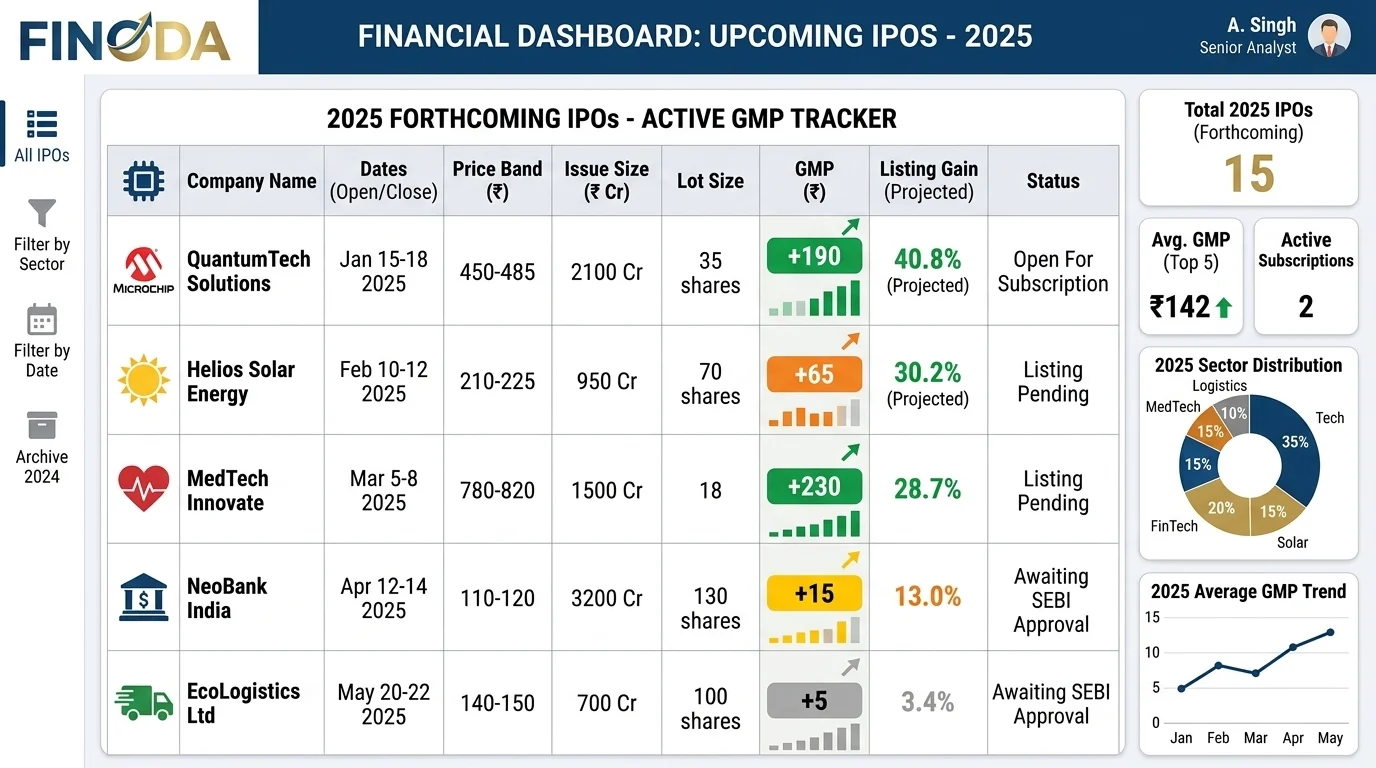
If you've been searching for IPO GMP today or the upcoming IPO list for 2025, you're in the right place. The grey market premium (GMP) is an unofficial indicator — it tells you what investors in the grey market are willing to pay above the IPO issue price. A high GMP usually signals strong demand. But it's not a guarantee of listing gains.
We track GMP data daily and update our clients through our advisory channel. Key things to watch:
- IPO allotment status — check if you've received shares post-subscription
- Listing date — typically 6 business days after subscription closes
- GMP trends — a falling GMP between close and listing can signal weak listing
For the most current upcoming IPO list, open/close dates, issue price, and GMP, visit our main IPO investing page →
Want to apply for IPOs systematically? We help clients apply for IPO online through ASBA → for both mainboard and SME IPOs.
SME IPO India — Small Cap Pre-Listing Opportunities
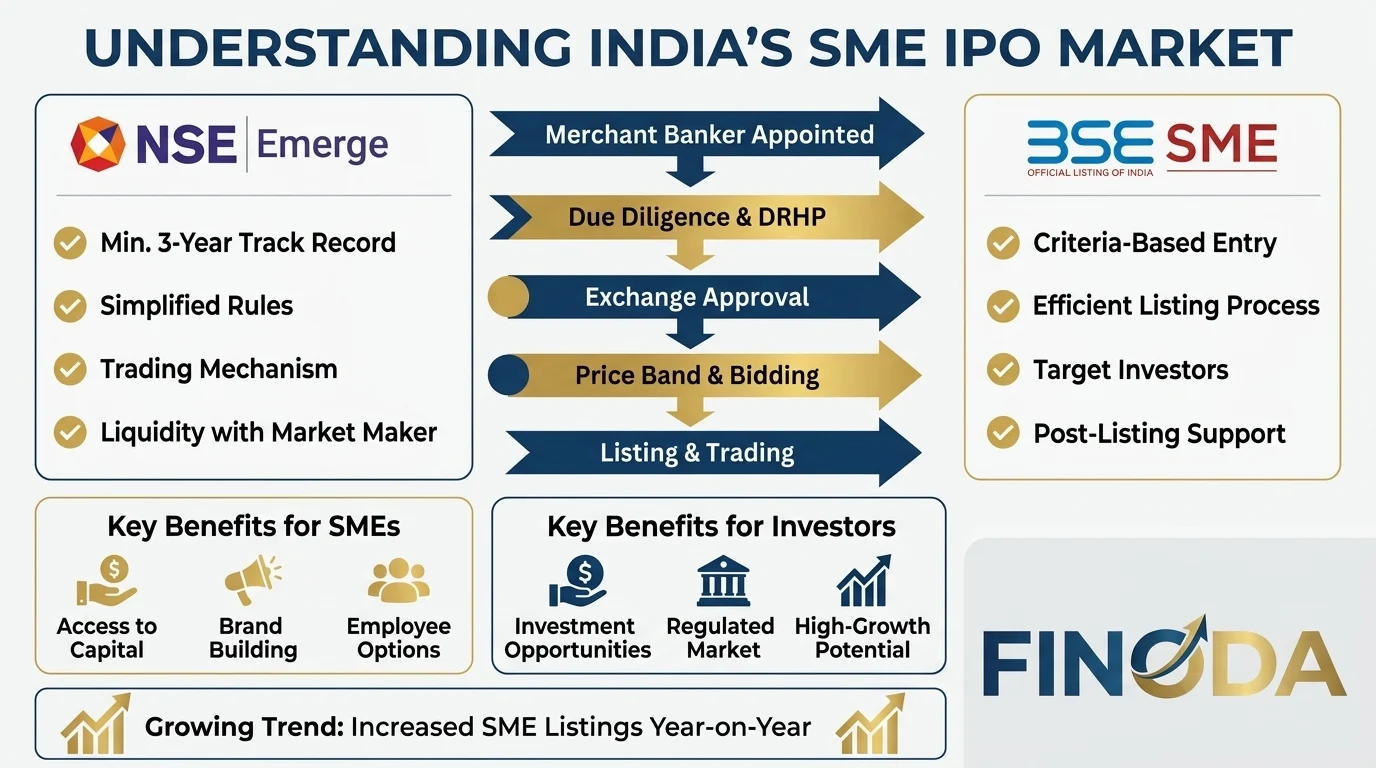
SME IPOs are one of the most underrated segments in Indian investing right now. These are companies listing on NSE Emerge or the BSE SME platform — platforms specifically designed for smaller, growing businesses.
Issue sizes typically range from ₹25 crore to ₹250 crore. The minimum application size is higher than mainboard IPOs, but many SME IPOs have delivered extraordinary listing gains — sometimes 100% and above — though with equally higher risk.
What makes SME IPOs different?
First, they're not picked up by mainstream financial media the way mainboard IPOs are. So the competition for allotment is often lower. Second, the underlying businesses tend to be niche — manufacturers, exporters, regional players — which means their growth story is less familiar to the average investor.
But here's the catch: SME IPOs have also seen failures. Companies that listed at high valuations have corrected sharply. The sector mix, promoter background, and financial track record matter enormously.
At Finoda, we research each SME IPO before recommending it to clients. We look at financials, promoter history, sector tailwinds, and GMP sentiment together — not any one factor in isolation.
For the current SME IPO pipeline, explore our IPO advisory service →
Risks of Investing in Unlisted Shares — Important Advisory
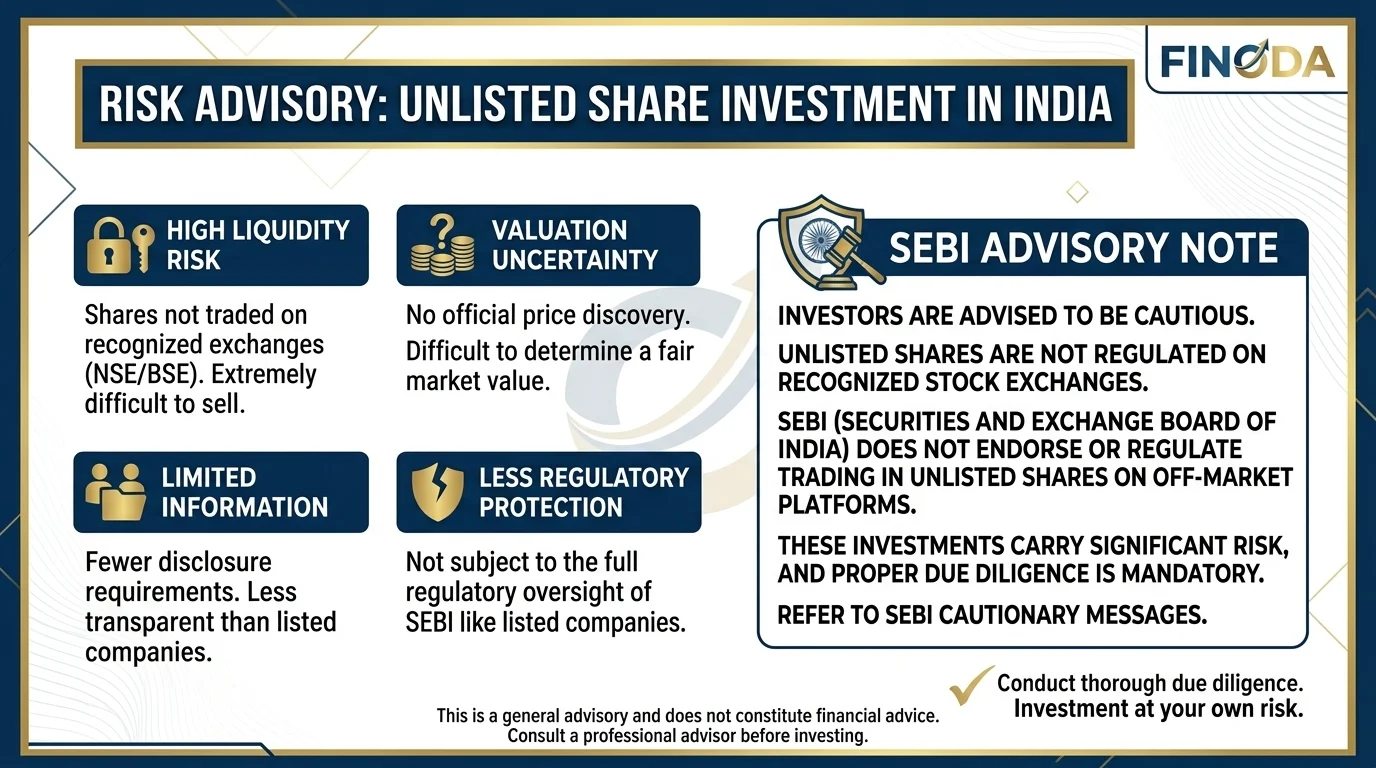
We believe in being honest about this. Unlisted shares carry real risks — and anyone who tells you otherwise isn't being straight with you.
Here are the key risks you must understand before investing:
1. Illiquid market. There's no exchange. If you want to sell, you need to find a buyer. That can take days, weeks, or months. You cannot exit instantly like a listed stock.
2. No exchange-level price discovery. Prices are negotiated. The "grey market price" is based on the last known transaction — not a regulated market mechanism. You could be overpaying.
3. Company may never list. IPO plans can be shelved. Regulators may raise objections. The economy can turn. If the company doesn't list, your exit options narrow significantly.
4. Limited financial disclosure. Private companies don't publish quarterly results like listed ones do. You're often relying on last-known financials, sometimes 6–12 months old.
5. Fraud risk from unregistered sellers. Dozens of WhatsApp-based "dealers" sell unlisted shares with no documentation, no demat transfer, and no accountability. This is where people lose money completely.
How do you manage these risks? Work only with compliant advisories. Insist on a proper purchase agreement. Ensure shares land in your demat account — not a paper certificate. And read our complete risk disclosure before you put a single rupee in.
Unlisted Shares FAQs — Everything You Need to Know
Why Choose Finoda for Unlisted Shares & IPO Advisory?
We're not a pure-play discount broker. We don't just hand you a platform and say "good luck." In our experience, unlisted share investing fails most often not because of the companies chosen, but because of execution — bad documentation, unverified sellers, wrong pricing.
At Finoda:
- Every unlisted share transaction comes with a proper purchase agreement
- Shares always transfer to your demat — we don't hold custody
- We vet the seller and check last known transaction prices before quoting
- Our team is based in Bangalore and available on call — not just over a chatbot
We're transparent about what we don't know too. We can't guarantee any company will list or that any investment will generate returns. But we can guarantee the process is clean, documented, and compliant with SEBI guidelines.
See why investors choose Finoda →
New to stock investing? Start with our stock market basics guide →