
Tax-Saving Investments India 2026 — Complete Section 80C Guide
Every March, millions of salaried Indians scramble to put money somewhere — anywhere — just to show their employer they've "done the tax saving." We've seen it happen every single year. The last-minute rush. The rushed FD. The random endowment plan that nobody really wanted.
It doesn't have to be that way.
Tax-saving investments, done right, are not just about cutting your tax bill. They're about building real wealth while you save. The difference between someone who blindly dumps money into a tax-saving FD every January and someone who smartly allocates across ELSS, PPF, and NPS can be lakhs of rupees over a decade. This guide breaks it all down — clearly, honestly, without jargon.
We've helped 10,000+ investors across India plan their finances. So here's what we've actually learnt on the ground.
Table of Contents
Section 80C Deductions — Full ₹1.5 Lakh Guide India
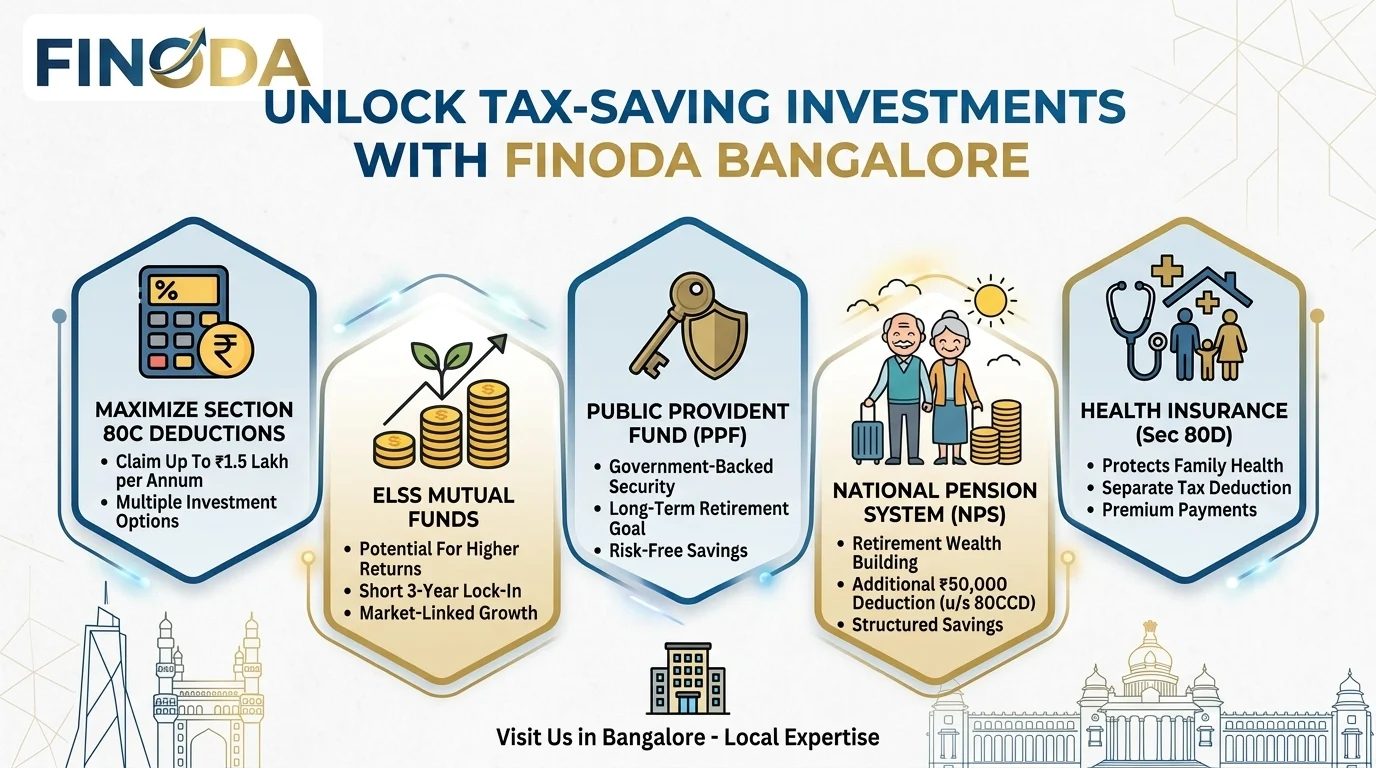
Section 80C is the most popular tax-saving section in the Indian Income Tax Act. It lets you reduce your taxable income by up to ₹1.5 lakh per financial year. That means if you're in the 30% tax bracket, a full ₹1.5 lakh investment under 80C saves you roughly ₹46,800 in taxes. Not small change.
But here's what most people miss — Section 80C has more than a dozen eligible investments, and not all of them are equal. Some give you market-linked growth. Others give you guaranteed, government-backed returns. And some just give you a tax certificate without doing much for your wealth.
The main 80C instruments include:
- ELSS (Equity Linked Saving Scheme) — Market-linked mutual funds with a 3-year lock-in. Highest growth potential.
- PPF (Public Provident Fund) — Government-backed, 15-year tenure, currently earning 7.1% p.a. tax-free.
- EPF (Employee Provident Fund) — Employer and employee both contribute. Auto-deducted for most salaried folks.
- NPS (National Pension System) — Retirement-focused, with an extra ₹50,000 deduction under Section 80CCD(1B).
- NSC (National Savings Certificate) — Post office instrument, 5-year lock-in, fixed returns.
- Tax-Saving FD — 5-year bank fixed deposits. Low risk, but interest is taxable.
- Life Insurance Premiums — Premiums up to ₹1.5 lakh qualify. But don't buy insurance just for tax saving.
- ULIP (Unit Linked Insurance Plan) — Combines insurance and market-linked investment.
- Sukanya Samriddhi Yojana — Exclusively for parents of a girl child.
- Home Loan Principal Repayment — Your principal EMI component also counts under 80C.
- SCSS (Senior Citizens Savings Scheme) — For those aged 60+, currently at 8.2% p.a.
- Tuition Fees — School/college fees for up to two children qualify.
One important thing to remember — the total deduction across all 80C instruments is capped at ₹1.5 lakh. You can't double it by combining multiple instruments. Plan your allocation wisely.
ELSS — Best Tax-Saving Investment with Highest Returns
If you're under 45, earning well, and comfortable with some market ups and downs — ELSS is probably the best 80C option for you. We say that from experience, not just theory.
What is ELSS exactly? It's a category of mutual fund that puts at least 65% of its portfolio into equities. The government allows you to claim up to ₹1.5 lakh invested in ELSS as a deduction under Section 80C. The catch? A 3-year lock-in. The upside? That 3-year lock-in is the shortest of any 80C product.
And the numbers back it up. Some well-known ELSS funds have historically delivered 12–15% annualised returns over long periods, well ahead of PPF's 7.1% or a tax-saving FD's 6.5–7%. Yes, ELSS has market risk. But over a 5–10 year horizon, the equity growth typically compensates for any short-term volatility.
How to invest in ELSS through SIP: Many investors make a simple mistake — they invest the full ₹1.5 lakh in one go in March. But if you invest via a monthly SIP of ₹12,500, you get the benefit of rupee cost averaging. Market dips become opportunities. It's a smoother, smarter approach.
Key things to know before investing in ELSS:
- Each SIP instalment has its own 3-year lock-in from the date of investment
- Long-term capital gains (LTCG) above ₹1 lakh per year are taxed at 10%
- You can't redeem during the lock-in, even in emergencies
- Past performance doesn't guarantee future returns — fund selection matters
For fund selection, look at 5-year and 10-year CAGR, the expense ratio, and how the fund performed during downturns (like 2020 or 2022). We'd suggest going with established fund houses with a strong track record.
PPF vs ELSS vs NPS — Complete Comparison for Tax Saving
This is the question we get asked more than almost anything else. And honestly, it's the wrong framing — you don't have to pick just one.
| Feature | ELSS | PPF | NPS |
|---|---|---|---|
| Section | 80C | 80C | 80C + 80CCD(1B) |
| Max Deduction | ₹1.5 lakh | ₹1.5 lakh | ₹1.5L + ₹50K extra |
| Lock-in Period | 3 years | 15 years | Till retirement (60) |
| Returns | Market-linked (12–15% historically) | 7.1% p.a. (fixed, tax-free) | Market-linked (equity/debt mix) |
| Risk Level | Moderate-High | Very Low | Low-Moderate |
| Tax on Returns | LTCG at 10% above ₹1L | Fully tax-free (EEE) | 60% tax-free at maturity |
| Liquidity | After 3-year lock-in | Partial after 7 years | Restricted till age 60 |
| Best For | Wealth creation, young investors | Safe returns, conservative investors | Retirement planning |
Our honest take: If you're in your 20s or 30s, put the bulk of your 80C allocation into ELSS. Add PPF for stability and long-term compounding. And if retirement planning matters — and it should — start NPS early. The extra ₹50,000 NPS deduction under Section 80CCD(1B) is over and above the ₹1.5 lakh 80C limit. That's a combined maximum deduction of ₹2 lakh for NPS investors.
Moreover, NPS offers flexibility in choosing your asset mix — you can go aggressive on equity (up to 75%) when you're younger, then gradually shift to bonds as you near retirement. It's one of the most underused tools in the Indian tax-planning toolkit.
Section 80D — Health Insurance Tax Deduction
Section 80D sits right next to 80C in importance, but most people forget about it. Here's the deal — health insurance premiums qualify for a separate deduction, over and above your 80C limit.
How much can you claim under 80D?
- Self, spouse, and children: Up to ₹25,000 per year
- If you're a senior citizen (60+): Up to ₹50,000 per year
- For parents' health insurance: Another ₹25,000 (₹50,000 if parents are senior citizens)
- Preventive health check-up: Up to ₹5,000 (within the above limits)
So a 35-year-old who pays health insurance premiums for herself, her family, and her parents could potentially claim up to ₹50,000 under 80D alone. Combined with ₹1.5 lakh under 80C and ₹50,000 under NPS's 80CCD(1B), total deductions can reach ₹2.5 lakh or more.
But honestly, don't buy health insurance just for the 80D benefit. Buy it because medical bills are expensive and a single hospitalisation can derail years of savings. The tax benefit is a bonus.
In our experience, most salaried individuals in Bangalore are either under-insured or rely solely on the group insurance their employer provides. Group covers have limitations — they don't travel with you when you change jobs. A personal health cover is non-negotiable.
Old Tax Regime vs New Tax Regime 2026 — Which Saves More?
This is the defining question for FY 2026-27, and there isn't a single right answer. It depends on your income and how much you actually invest.
Here's the key difference: The new tax regime offers lower slab rates but removes almost all deductions — no 80C, no 80D, no HRA. The old regime keeps all those deductions but has higher base rates.
New regime highlights for FY 2026-27:
- Income up to ₹12 lakh is effectively zero tax (due to Section 87A rebate)
- Standard deduction of ₹75,000 for salaried employees (so zero tax up to ₹12.75 lakh)
- No 80C, 80D, or HRA deductions allowed
Old regime is better when:
- Your total deductions (80C + 80D + HRA + home loan) exceed roughly ₹5.44 lakh
- You're in the 30% bracket and actively investing for tax saving
- You pay significant rent (HRA exemption is only in old regime)
- You have a home loan with large interest outgo
Simple rule of thumb: If you're earning under ₹12–15 lakh and don't have significant investments, the new regime probably saves you more. If you're earning ₹20 lakh+ with a home loan, HRA, and full 80C investments — run the numbers for old regime. It often wins.
The important thing? Don't default to the new regime without checking. And don't stay in the old regime out of habit either. Calculate both every year before filing.
Tax Planning Calendar — When to Act for Maximum Savings
Most people treat tax planning as a March problem. That's a mistake — and we see it cost people real money every year.
Here's a better approach:
April–June: Start ELSS SIPs from April 1. You get 12 months of market exposure instead of buying at a single March price point. Also review your health insurance — renewal and premium payment in this quarter gives you peace of mind.
July–September: Review your EPF contributions. Check if your VPF (Voluntary Provident Fund) top-up is on track. Mid-year is also a good time to open or top up your PPF account.
October–December: NPS contribution check. Submit rent receipts to your employer if you're on old regime. Review your 80D position — are your health insurance premiums paid?
January–March: Final top-up to complete the ₹1.5 lakh 80C limit. Submit all proofs to your employer before the deadline they set (usually late January or February). File your ITR well before July 31.
The point is — tax saving works best when it's planned, not panicked. And the earlier you invest in ELSS, the more SIP instalments benefit from a full year of compounding.
How to Start Tax-Saving Investments with Finoda
We keep this simple. If you're based in Bangalore or anywhere in India, here's how we work:
Step 1: Open a free Demat and investment account — it takes about 10 minutes online.
Step 2: Tell us your income, current investments, and tax-saving goals. We'll map out an 80C plan that actually suits your situation.
Step 3: Start an ELSS SIP, set up PPF contributions, explore NPS — or do all three, based on what makes sense for you.
Step 4: We help you track, rebalance, and make sure everything's documented before your employer's proof submission deadline.
There's no pressure to invest in any specific product. Our job is to help you make the right call for your money, your goals, and your tax bracket.
Open Free Demat Account →Frequently Asked Questions — Tax-Saving Investments India
1. What is the maximum tax deduction under Section 80C?
You can claim up to ₹1.5 lakh per financial year under Section 80C. This applies to eligible investments like ELSS, PPF, EPF, NSC, tax-saving FDs, life insurance premiums, and more. The total deduction across all instruments combined cannot exceed ₹1.5 lakh.
2. Which is the best tax-saving investment in India for 2026?
There's no single "best" — it depends on your goals. ELSS is best for growth potential with a short 3-year lock-in. PPF is best for safe, tax-free returns over 15 years. NPS is best for retirement planning with an extra ₹50,000 deduction. Most experienced investors use a combination of all three.
3. Can I invest in both ELSS and PPF in the same year?
Yes, absolutely. You can invest in multiple 80C instruments in the same financial year. However, the total deduction you can claim is still capped at ₹1.5 lakh. So splitting ₹75,000 into ELSS and ₹75,000 into PPF, for example, still gets you the full ₹1.5 lakh deduction.
4. Is ELSS better than PPF for tax saving?
For younger investors comfortable with market risk, ELSS generally delivers higher long-term returns (historically 12–15% vs PPF's 7.1%). But ELSS carries market risk and returns aren't guaranteed. PPF offers government-backed, completely tax-free returns in the EEE category. The right choice depends on your risk appetite, investment horizon, and financial goals.
5. What is the lock-in period for ELSS funds?
ELSS funds have a 3-year lock-in period — the shortest of any Section 80C investment. Note: if you invest via SIP, each monthly instalment has its own 3-year lock-in from its investment date, not from the date you started the SIP.
6. How much extra tax can I save through NPS over 80C?
NPS gives you an additional ₹50,000 deduction under Section 80CCD(1B), completely separate from your ₹1.5 lakh 80C limit. If you're in the 30% tax bracket, this extra ₹50,000 deduction translates to approximately ₹15,600 in additional tax savings per year.
7. Is Section 80C available under the new tax regime?
No. The new tax regime (default from FY 2026-27) does not allow Section 80C deductions. To claim 80C, 80D, HRA, or home loan benefits, you need to opt for the old tax regime. The new regime offers lower slab rates in exchange for giving up most deductions.
8. What is Section 80D and how is it different from 80C?
Section 80D covers health insurance premiums and is separate from 80C. You can claim up to ₹25,000 for self, spouse, and children (₹50,000 if any is a senior citizen), plus another ₹25,000–₹50,000 for parents' health insurance. This deduction is over and above the ₹1.5 lakh 80C limit.
9. What happens to my ELSS investment if the market falls?
If the market falls during your 3-year lock-in, your ELSS units may show a loss on paper. However, historically, equity markets recover over longer periods. This is why ELSS is recommended for a horizon of at least 5–7 years, not just the minimum 3-year lock-in. SIP investing also reduces the impact of market timing.
10. Can a housewife or self-employed person invest in PPF?
Yes. PPF is open to all Indian residents — salaried, self-employed, freelancers, homemakers, and even minors (through a guardian). You can open a PPF account at a post office or most major banks. The minimum annual deposit is just ₹500, and the maximum is ₹1.5 lakh.
11. Is the interest on PPF taxable?
No. PPF falls under the EEE (Exempt-Exempt-Exempt) category. Your investment qualifies for 80C deduction, the interest earned is completely tax-free, and the maturity amount is also tax-free. It's one of the best tax-free fixed-income instruments available to Indian investors.
12. Should I choose the old or new tax regime for FY 2026-27?
It depends on your deductions. If your total deductions (80C + 80D + HRA + home loan interest) add up to more than roughly ₹5.44 lakh, the old regime typically saves more. If your deductions are lower than that, the new regime's lower slab rates and ₹12 lakh zero-tax threshold usually win. Use a tax calculator or consult Finoda's team to check your specific numbers.
13. When is the last date to invest for tax saving in FY 2026-27?
The last date to make tax-saving investments and claim 80C deductions for FY 2026-27 is March 31, 2026. The ITR filing deadline for most salaried individuals is July 31, 2026. However, most employers require investment proofs by late January or February — check your company's HR deadline.
14. Can I claim ELSS investment made in April–March of the same FY?
Yes. Any ELSS investment made between April 1, 2026 and March 31, 2027 qualifies as a tax-saving investment for FY 2026-27. This is why starting SIPs from April — rather than rushing in March — gives you better cost averaging and the same tax benefit.
15. What is the PPF interest rate in 2026?
The PPF interest rate is currently 7.1% per annum, compounded annually. The government reviews this rate quarterly. The interest is credited at the end of each financial year and is completely tax-free.