
GST Registration & Filing Services India | Expert Consultant
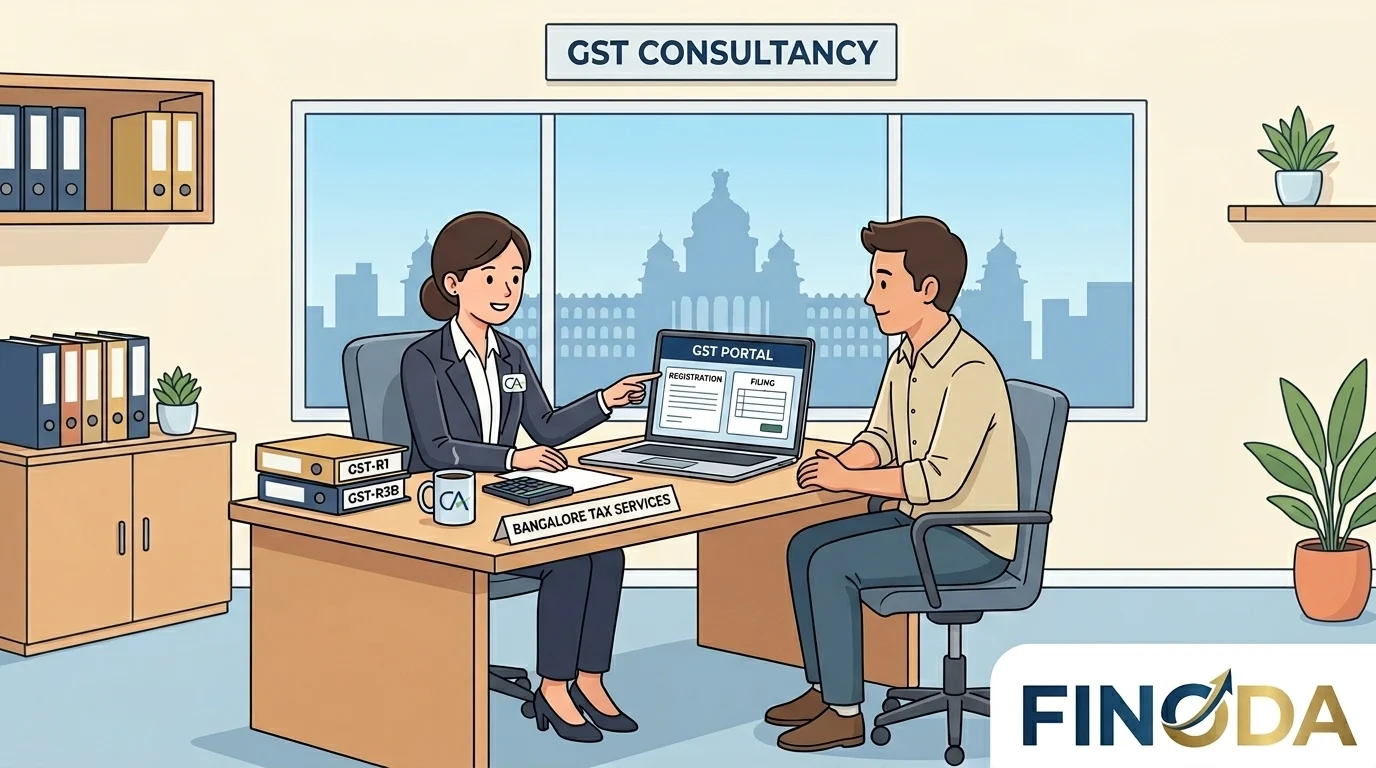
GST compliance used to be complicated. For most business owners, it still is. Missed due dates, ITC mismatches, confusing return types — one small error can trigger a notice or a penalty. At Finoda, our CA team handles every part of your GST compliance — from registration to monthly filing to annual returns. We've helped businesses in Bangalore and across India stay penalty-free, month after month.
Starting a business? We get your GST number in 3 working days. Already registered but struggling with returns? Switch to Finoda and file on time, every time. Contact our GST consultant in Bangalore for a free 30-minute consultation — no pressure, no sales pitch.
GSTR 3B Filing Due Date India — Monthly Compliance Calendar
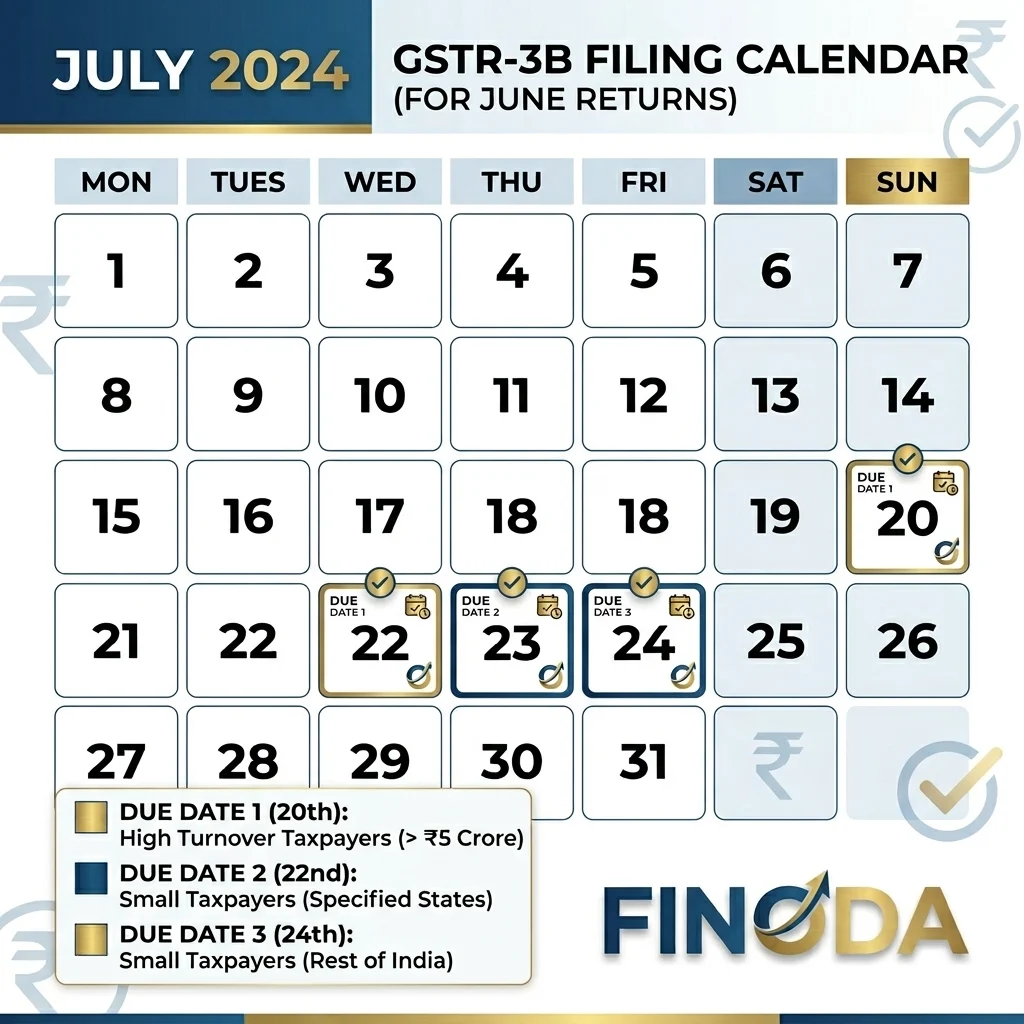
Every month, GSTR 3B search volumes spike around the 15th. That's when business owners start panicking about the deadline. Don't be that person. Here's the exact due date calendar — bookmark it, or better yet, let Finoda handle it.
GSTR 3B Monthly Due Dates (Updated May 2026):
| Taxpayer Category | GSTR 3B Due Date |
|---|---|
| Annual turnover > ₹5 Crore | 20th of every month |
| Annual turnover ≤ ₹5 Crore — Category 1 states | 22nd of every month |
| Annual turnover ≤ ₹5 Crore — Category 2 states | 24th of every month |
Other GST Return Due Dates:
| Return Type | Due Date | Who Files |
|---|---|---|
| GSTR 1 (Monthly) | 11th of every month | Businesses with turnover > ₹5 Crore |
| GSTR 1 (Quarterly) | 13th of month after quarter end | QRMP scheme taxpayers |
| GSTR 4 | 30th April (annual) | Composition dealers |
| GSTR 9 (Annual Return) | 31st December | All regular taxpayers with turnover > ₹2 Crore |
| GSTR 9C (Audit) | 31st December | Turnover > ₹5 Crore |
Important 2025–26 update: From July 2025, GSTR 3B Table 3 is non-editable. It auto-populates from your GSTR 1 filings. So if your GSTR 1 has an error, your GSTR 3B will carry that error too. Use GSTR 1A to correct outward supply details before GSTR 3B is filed. This is exactly why accurate filing matters — and why you need a CA team, not just filing software.
Late GST filing attracts a penalty of ₹50 per day (₹25 CGST + ₹25 SGST). For nil returns, the penalty is ₹20 per day. Finoda files all returns 2–3 days before the deadline. System overload on the GST portal is common on the due date — we never wait that long.
GST Registration in India — Who Needs It and How to Apply
If you've been asking "do I need a GST number?" — you probably do. Here's how to know for sure.
Who must register for GST in India?
You must register if any of the following applies to your business:
- Annual aggregate turnover exceeds ₹40 lakh (for goods) or ₹20 lakh (for services) in normal states
- You sell goods or services inter-state — regardless of turnover
- You sell on e-commerce platforms like Amazon, Flipkart, Meesho, or your own website
- You are a casual taxable person or a non-resident taxable person
- You are required to deduct or collect TDS/TCS under GST
- You supply goods/services under reverse charge
Also, voluntary GST registration is possible even if you're below the threshold. Many small service providers opt in because GST registration builds credibility with large corporate clients who need GST invoices to claim ITC.
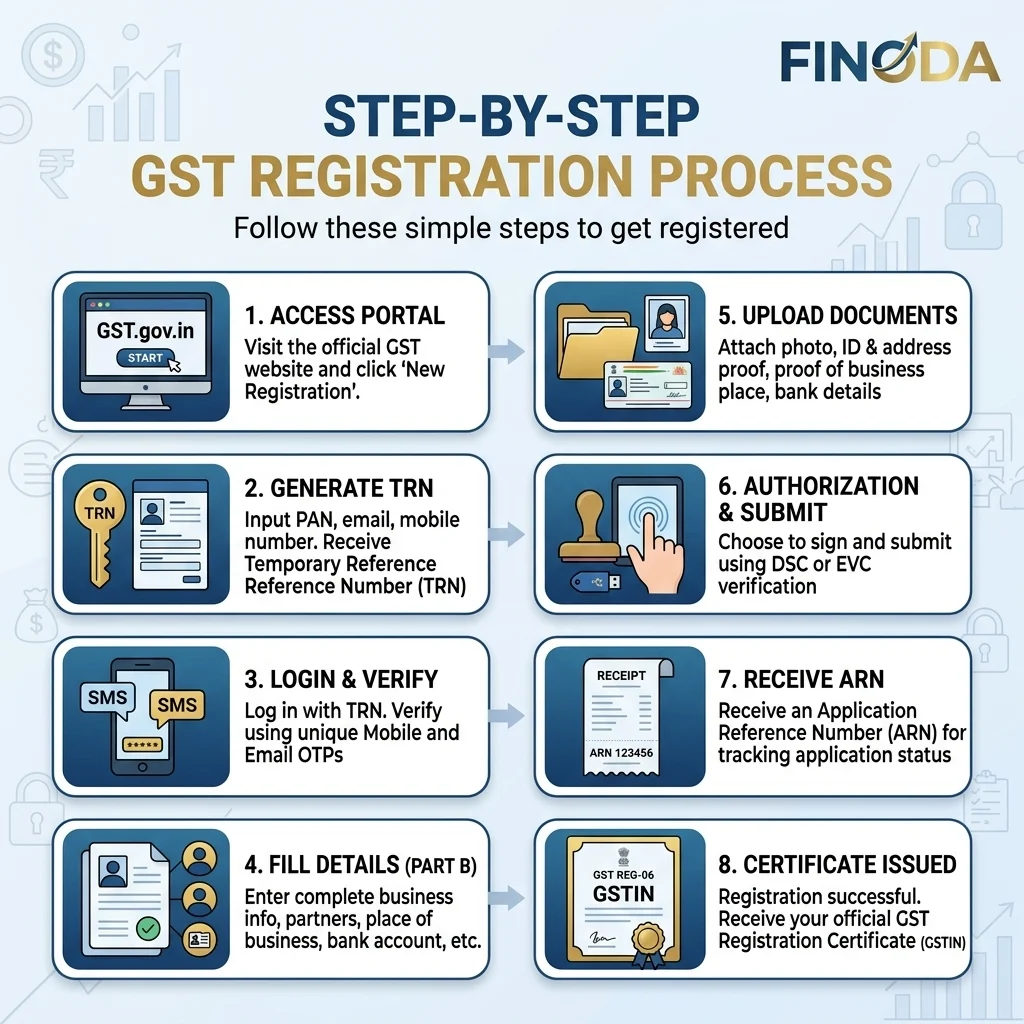
The GST Registration Process — 5 Steps:
Step 1 — Document Collection
Finoda's team collects all required documents digitally. No branch visit required. We handle the checklist.
Step 2 — GST Portal Application
We submit your application on GST Portal India with accurate business details, HSN/SAC codes, and address proof.
Step 3 — ARN Generated
Within minutes of submission, you receive your Application Reference Number (ARN). This confirms the application is submitted and under review.
Step 4 — Biometric or OTP Verification
From November 2025, GST registration includes Aadhaar-based OTP authentication for individuals and biometric authentication for company promoters and directors. Finoda guides you through this step.
Step 5 — GSTIN Issued
For low-risk businesses (monthly output tax liability below ₹2.5 lakh), GST registration is now granted within 3 working days under the new Rule 14A introduced on 1 November 2025. For others, it may take 7–15 working days depending on officer scrutiny.
Documents Required for GST Registration
Here's the exact document checklist. We've found that missing even one document causes delays — so keep all of these ready before you apply.
For Sole Proprietor / Individual:
- PAN card (mandatory)
- Aadhaar card
- Passport-size photograph
- Business address proof (electricity bill / rent agreement / NOC from owner)
- Cancelled cheque or bank statement
- Digital Signature Certificate (DSC) — optional for individuals
For Private Limited Company / LLP:
- PAN card of the company
- Certificate of Incorporation from MCA India
- PAN and Aadhaar of all directors/partners
- Board resolution authorising signatory
- DSC of authorised signatory
- Registered office address proof
- Bank account details
For Partnership Firms:
- Partnership deed
- PAN and photos of all partners
- Address proof of principal place of business
Finoda's team prepares and reviews all documents before submission. We cross-check everything to avoid rejection.
GST Registration Fees and Timeline
Government fee: Zero. The GST Portal charges no government fee for registration.
Finoda professional fee: ₹2,500 — covers document review, application filing, Aadhaar verification assistance, and follow-up with the tax officer until GSTIN is issued.
Timeline:
- ARN generated: Immediately on submission
- GST registration (low-risk businesses under Rule 14A): 3 working days
- GST registration (standard applicants): 7–15 working days
- GSTIN certificate issued: After officer approval
Need GST registration urgently? Contact our team today — we handle same-day submission.
Types of GST Returns — GSTR 1, 3B, 4, 9 Explained
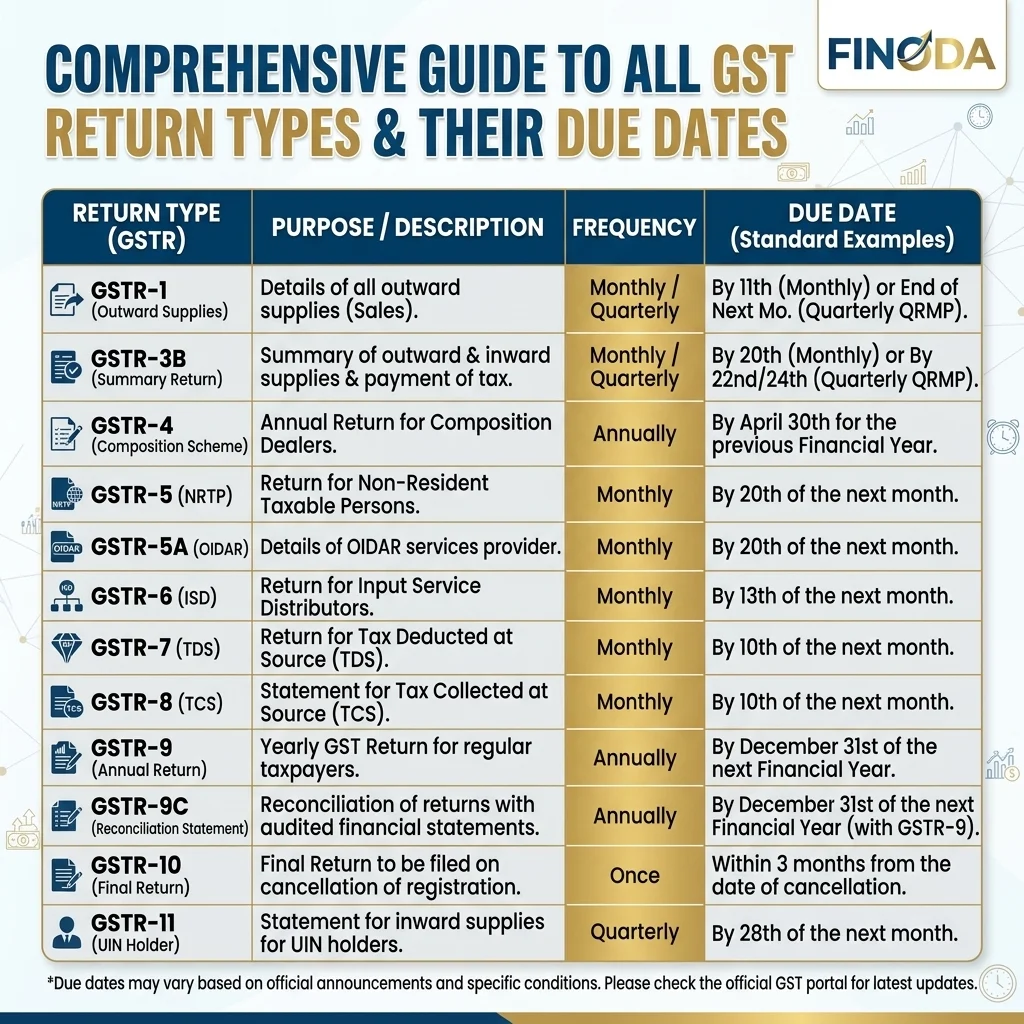
Most business owners only know GSTR 3B. But there are actually four return types you need to know — and filing the wrong one, or missing one, creates a compliance hole.
| Return | What It Covers | Frequency | Due Date | Who Files |
|---|---|---|---|---|
| GSTR 1 | Outward supplies (sales invoices) | Monthly / Quarterly | 11th monthly / 13th quarterly | All regular taxpayers |
| GSTR 3B | Summary of all liabilities and ITC | Monthly | 20th / 22nd / 24th | All regular taxpayers |
| GSTR 4 | Composition dealer annual return | Annual | 30th April | Composition dealers |
| GSTR 9 | Annual consolidated return | Annual | 31st December | Turnover > ₹2 Crore |
| GSTR 9C | Audit reconciliation statement | Annual | 31st December | Turnover > ₹5 Crore |
A common mistake we see is e-commerce sellers missing GSTR 1 because they think GSTR 3B is enough. It's not. GSTR 1 feeds into your buyer's ITC. If you don't file it, your customers can't claim credit — and they'll stop buying from you.
Also, if you're on the QRMP scheme (Quarterly Return Monthly Payment), you file GSTR 1 quarterly but pay tax monthly through PMT-06 challan. Many small businesses qualify for this and save time. We handle QRMP clients too.
Finoda files all GST return types — GSTR 1, 3B, 4, and 9 — for all client categories. Also, we cover income tax filing services and company audit services so your entire annual compliance is managed under one team.
GST Input Tax Credit (ITC) — Claim Back What You've Paid
ITC is one of GST's biggest benefits. And one of its most misunderstood. In our experience, unclaimed or wrongly reversed ITC is the number-one reason businesses overpay GST. Let's fix that.
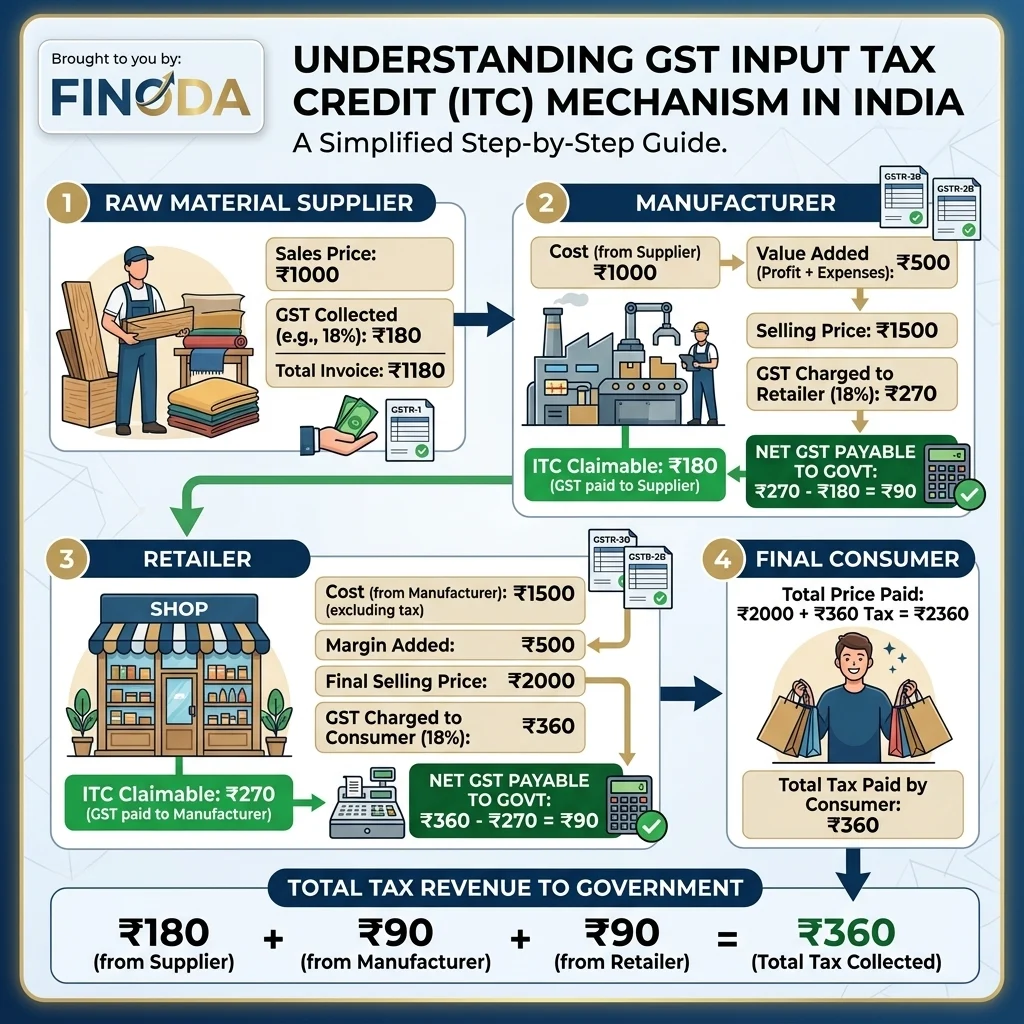
How ITC works — a simple example:
You buy raw materials and pay ₹18,000 as GST. You sell finished goods and collect ₹36,000 as GST from your customers. Instead of paying ₹36,000 to the government, you set off the ₹18,000 you already paid — and pay only ₹18,000 net. That ₹18,000 you saved? That's Input Tax Credit.
Conditions to claim ITC:
- You must hold a valid tax invoice from the supplier
- Your supplier must have filed their GSTR 1 (the credit shows in your GSTR 2B)
- You must have received the goods or services
- You must have paid the supplier within 180 days
- The purchase must be for business use — not for personal use or blocked credits
What blocks ITC?
- Motor vehicles (in most cases)
- Food, beverages, beauty products for personal use
- Works contract services for immovable property construction
- Club memberships and employee benefits (certain items)
ITC reconciliation matters. From July 2025, GSTR 3B Table 3 is auto-filled from GSTR 2B. If your supplier hasn't filed their GSTR 1, their invoices won't appear in your GSTR 2B — and you can't claim ITC. Finoda's team reconciles GSTR 2B with your purchase register monthly, ensuring you never miss eligible credits and never face ITC reversal notices.
For GSTN advisory updates on ITC rules, check the GSTN Official website.
GST Annual Return (GSTR 9) — Complete Filing Guide
GSTR 9 is the one return most businesses are scared of. It's filed once a year and covers everything — all your monthly GSTR 1 and GSTR 3B data for the full financial year. Think of it as the GST equivalent of your annual income tax return.
Who must file GSTR 9?
All regular GST taxpayers with annual aggregate turnover exceeding ₹2 crore. GSTR 9C (audit reconciliation) is mandatory for turnover above ₹5 crore.
GSTR 9 due date: 31st December every year. The GSTR 9 and GSTR 9C for FY 2024–25 are now active on the GST portal — file early, don't wait for December.
What GSTR 9 covers:
- Annual summary of all outward supplies (from GSTR 1)
- Annual summary of all inward supplies and ITC (from GSTR 3B)
- Tax paid vs tax liability reconciliation
- ITC claimed vs ITC available reconciliation (GSTR 2A/2B comparison)
- Any additional tax payable or refund due
Penalty for missing GSTR 9: ₹200 per day (₹100 CGST + ₹100 SGST), capped at 0.25% of your annual turnover. For a business with ₹1 crore turnover, that's a maximum of ₹25,000 — easily avoidable.
Also, if you haven't filed GSTR 9 for earlier years, act now. From December 2025, the GST portal permanently blocks filing of returns that are more than 3 years past their due date. If you have pending returns from 2021–22 or 2022–23, contact Finoda immediately — there's still time.
Our CA team files GSTR 9 and GSTR 9C with zero errors. We cross-check each figure against your monthly returns before submission. Companies above ₹2Cr turnover should also look at our company audit services — the GST audit and statutory audit often run in parallel in December.
For official GST Council policies and updates, see GST Council India.
GST Notice & Assessment — Defend Your Business with Expert CA
Getting a GST notice feels alarming. But most notices are fixable — if you respond within the deadline. The mistake most business owners make is ignoring the notice or responding with incomplete information. That makes things worse.
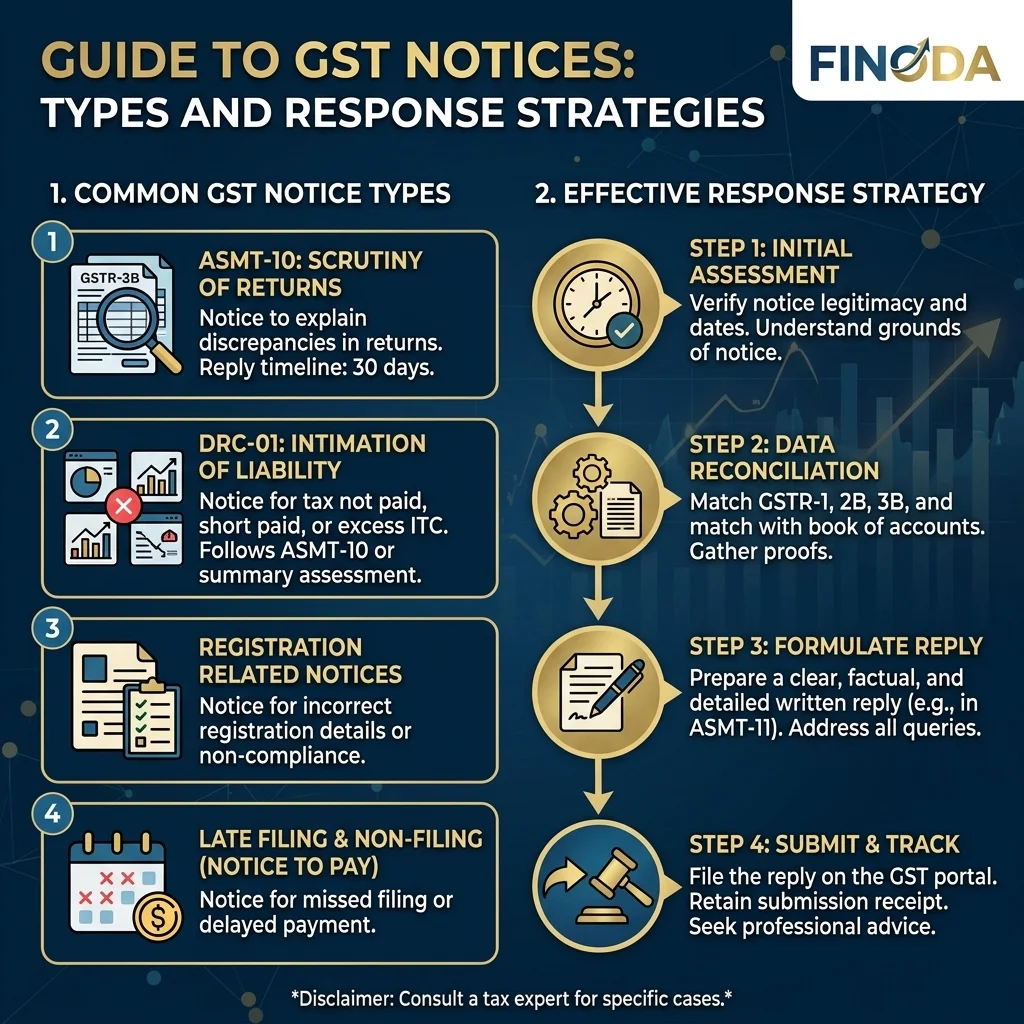
Common types of GST notices:
SCN (Show Cause Notice): Issued when the GST officer believes you've short-paid tax or wrongly claimed ITC. You have a specific time to respond (usually 30 days). If you don't, the officer may confirm the demand ex-parte.
ASMT-10: A scrutiny notice. The officer has spotted discrepancies between your GSTR 3B, GSTR 1, and the department's data. You need to explain the differences.
DRC-01: Demand and Recovery. This is a formal demand for tax + interest + penalty. It can be issued after a failed SCN response or in cases of detected fraud.
Why do notices come?
- ITC mismatch between your GSTR 3B and GSTR 2B
- Turnover mismatch between GST returns and ITR
- Late filing history
- UPI transaction data flagging unregistered turnover (the GST department actively monitors this now)
- Fake registration cancellation proceedings
How Finoda handles your notice:
Step 1 — We analyse the notice type and the specific demand. Step 2 — We review your return history and identify the exact discrepancy. Step 3 — We draft a detailed, factual response with supporting documents. Step 4 — We submit within the deadline and, if required, represent you before the GST authority.
Don't wait if you have a GST notice. Every day of delay reduces your options. Contact our GST consultant today.
Also see our regulatory disclosures to understand how Finoda operates under applicable financial compliance standards.
For ICAI-standard CA advisory practices, we follow guidelines issued by ICAI.
GST Registration & Filing Pricing — Transparent Finoda Packages
We believe in simple, upfront pricing. No hidden charges. No "call us for a quote" games. Here's exactly what we charge.
| Service | Finoda Fee |
|---|---|
| GST Registration (new) | ₹2,500 one-time |
| Monthly Filing — GSTR 1 + GSTR 3B | ₹1,500/month |
| Quarterly Filing (QRMP scheme) | ₹750/month |
| GSTR 9 Annual Return | ₹3,500 |
| GSTR 9C Audit Reconciliation | ₹5,000 |
| GST Notice Response | From ₹2,000 per notice |
| Comprehensive Package (Reg + Monthly + Annual) | ₹1,999/month |
All packages include: filing, ITC reconciliation, deadline alerts, and response to routine GST portal queries. Monthly clients get unlimited WhatsApp support for GST questions.
Also, bundling GST with income tax filing services saves you money — ask about our combined compliance package when you book a consultation.
Frequently Asked Questions — GST India
GSTR 3B must be filed by the 20th of every month for taxpayers with annual aggregate turnover above ₹5 crore. For others, the due dates are the 22nd (Category 1 states) or 24th (Category 2 states) of every month. Finoda files GSTR 3B 2–3 days before the deadline to avoid last-minute portal overload and late penalties.
GST registration is mandatory if:
- Your annual aggregate turnover exceeds ₹40 lakh (goods) or ₹20 lakh (services) in normal states
- You supply goods or services inter-state, regardless of turnover
- You sell on e-commerce platforms like Amazon, Flipkart, or Meesho
- You are a non-resident taxable person
- You are liable to deduct TDS or TCS under GST
Voluntary registration is also available below these limits — useful for businesses dealing with GST-registered corporate clients.
Documents required for GST registration: PAN card, Aadhaar card, passport-size photograph, business address proof (utility bill or rent agreement), bank account details with cancelled cheque, business registration certificate (for companies and LLPs), and digital signature certificate (for companies). Finoda collects all documents digitally — no branch visit needed.
Late GST filing attracts a penalty of ₹50 per day (₹25 CGST + ₹25 SGST). For nil returns, the penalty is ₹20 per day. Additionally, you cannot claim ITC if GSTR 3B is not filed. Interest at 18% per annum applies on unpaid tax. From December 2025, returns older than 3 years cannot be filed at all — so pending returns must be cleared urgently.
Input Tax Credit allows you to reduce your GST liability by the GST you have already paid on purchases. For example, if you paid ₹18,000 GST on purchases and collected ₹36,000 GST on sales, you pay only ₹18,000 net to the government. ITC can only be claimed if your supplier has filed their GSTR 1 and the credit appears in your GSTR 2B.
Yes. GST registration on the government portal (gst.gov.in) is completely free. The professional fee charged by consultants like Finoda — for document preparation, application filing, and follow-up — ranges from ₹2,000 to ₹5,000 depending on complexity. The government itself imposes no registration fee.
GSTR 9 is the annual GST return that summarises all your monthly or quarterly returns for a financial year. It is mandatory for all regular GST taxpayers with annual aggregate turnover exceeding ₹2 crore. The due date is 31st December each year. It reconciles data from GSTR 1, GSTR 3B, and GSTR 2B, and covers all outward supplies, inward supplies, ITC claimed, and taxes paid.
Yes. You can apply for voluntary GST cancellation if your turnover falls below the registration threshold, or if you close or transfer your business. Apply through the GST portal with reasons for cancellation. All pending returns must be cleared before cancellation is approved. Also, any outstanding tax dues must be settled. Finoda handles GST cancellation applications with all clearances completed.
GSTR 2A is a dynamic, real-time statement of your purchase invoices as uploaded by your suppliers. It changes every time a supplier files or amends their GSTR 1. GSTR 2B is a static, monthly auto-drafted statement — generated once a month and does not change after generation. For accurate ITC reconciliation, always use GSTR 2B, not GSTR 2A. Finoda uses GSTR 2B as the basis for all ITC reconciliation.
QRMP stands for Quarterly Return Monthly Payment. Under this scheme, taxpayers with annual aggregate turnover up to ₹5 crore can file GSTR 1 and GSTR 3B quarterly instead of monthly — but still pay tax monthly via PMT-06 challan. This significantly reduces the compliance burden. Moreover, you can use the Invoice Furnishing Facility (IFF) to upload key invoices in months 1 and 2 of the quarter, so your B2B buyers can claim ITC without waiting for the quarterly GSTR 1.
In September 2025, India implemented GST 2.0 — a significant simplification. The earlier 4-slab structure (5%, 12%, 18%, 28%) is being consolidated into a 2-slab structure of 5% and 18%, with a special 40% cess on luxury goods like tobacco, aerated drinks, and high-end vehicles. Rates on household essentials like soaps and Indian breads have been reduced to 5%. Also, the registration process has been simplified — low-risk businesses now get GSTIN in 3 working days. As these rate changes take full effect, Finoda will update all clients proactively.
Technically yes — the GST portal is open to everyone. But in practice, e-commerce GST registration has specific complexities: HSN code selection, marketplace TCS deduction reconciliation, multi-state supply rules, and e-invoice compliance. We've seen many self-filed registrations come back for correction. For e-commerce sellers, using a professional consultant like Finoda ensures your registration is done right the first time — and your monthly TCS credit from Amazon/Flipkart reconciles correctly in your GSTR 3B.
E-invoicing is mandatory for businesses with annual turnover exceeding ₹10 crore (from January 2026). Under e-invoicing, every B2B invoice must be registered on the Invoice Registration Portal (IRP) before it is issued. The IRP generates an IRN (Invoice Reference Number) and QR code that must appear on the invoice. If e-invoicing applies to your business, Finoda's team sets up the integration with your accounting software and ensures full compliance.
The composition scheme is available to small businesses with annual turnover up to ₹1.5 crore (goods) or ₹50 lakh (services). Under this scheme, you pay a flat tax rate (1% for manufacturers, 5% for restaurants, 6% for service providers) instead of the regular GST rates. However, composition dealers cannot collect GST from customers or claim ITC. They file GSTR 4 annually. If you're not sure whether the composition scheme benefits you, talk to our CA team — it depends heavily on your margins and client types.
Why Bangalore Businesses Trust Finoda for GST
We handle compliance for startups, freelancers, service businesses, manufacturers, traders, and e-commerce sellers across Bangalore and across India. In our experience, most compliance problems come from last-minute filing and untrained software users — not from complex tax laws. The rules are actually quite straightforward once you understand them.
What makes Finoda different: a dedicated CA handles your account. Not software, not a junior executive — a qualified CA who knows GST inside out. Furthermore, all our clients get WhatsApp-based deadline reminders, monthly reconciliation reports, and a single point of contact for all tax queries.
We also offer a full compliance bundle that covers GST, income tax filing, and company audit under one monthly retainer. For businesses that want one team handling everything — this is the smart way to do it.
And if you're building a business from scratch, consider pairing your compliance setup with opening a free demat account to manage your business investments too.
Learn more about our team and approach on the why choose Finoda page.
For income tax compliance that works alongside GST, refer to Income Tax India.
Ready to get your GST sorted?
Book a free 30-minute consultation with our CA team in Bangalore. We'll review your current compliance status, identify any gaps, and give you a clear action plan — no charge, no obligation.
Contact our GST consultant →VGV Towers, Unit 101, 139/88, 1st Floor, 100 Feet Ring Rd, Jayanagara 9th Block, Bengaluru – 560041