

Pre-IPO Investment India — Buy Pre-Listing Shares Before the Boom
⚠️ **Risk Disclaimer:** Pre-IPO investing involves significant risk. Shares may be illiquid for 6 months to 3 years. The company may delay or cancel its IPO. Only invest surplus capital you can afford to lock in. Please read our Risk Disclosure before investing.
So here's the thing — by the time an IPO opens on NSE or BSE, most of the early gains are already gone. The HNI investors, the startup insiders, the people who got in at ₹200 when the issue price became ₹800 — they didn't find that opportunity through an IPO form. They got in before the listing. That's exactly what pre-IPO investing is about.
At Finoda, we work with serious investors who want access to these pre-listing opportunities — the kind that aren't available through your regular trading app. We help you identify, evaluate, and invest in curated pre-IPO shares through a structured, transparent process. No grey market guesswork. No cold calls. Just honest advisory built around your goals.
Ready to explore current opportunities? Request a free pre-IPO consultation →
- What is Pre-IPO Investing? — Invest Before the Stock Exchange Listing
- How Pre-IPO Investing Works — From Purchase to Listing
- Current Pre-IPO Opportunities — Finoda's Curated Selection
- Pre-IPO Investment Risks — What You Must Know Before Investing
- Why Finoda for Pre-IPO Advisory?
-
Pre-IPO FAQs — Expert Answers
- What is the difference between pre-IPO shares and an IPO?
- How long should I hold pre-IPO shares?
- What is the minimum investment in pre-IPO shares at Finoda?
- Are pre-IPO share transactions legal in India?
- Are pre-IPO shares regulated by SEBI?
- What happens to my pre-IPO shares if the company cancels its IPO?
- How are pre-IPO shares transferred to my demat account?
- Can NRIs invest in pre-IPO shares in India?
- What taxes apply to pre-IPO investment gains in India?
- How is pre-IPO share price determined?
- What is the lock-in period for pre-IPO shares after listing?
- How do I evaluate if a pre-IPO company is worth investing in?
- Can I invest in PhonePe pre-IPO shares through Finoda?
- Related Financial Services at Finoda
- Video: What is Pre-IPO Investing in India?
- External Resources & References
What is Pre-IPO Investing? — Invest Before the Stock Exchange Listing
Pre-IPO investing means buying equity shares of a private company before it lists on NSE or BSE through an Initial Public Offering. In simple terms, you own a slice of the business while it's still private — and if everything goes well, you benefit from both the valuation jump and the listing premium.
Think of how early investors in companies like Zomato, Nykaa, or Paytm entered long before the IPO. Some came in at valuations a fraction of what the public market eventually paid. That gap between early entry price and IPO price — that's the pre-IPO opportunity.
But it's not just about buying low. The bigger picture is this: the Indian IPO market has seen over 850 public listings in the last five years, and 2026–27 is shaping up to be one of the busiest cycles yet. Companies like PhonePe, Tata Capital, Lenskart, and others are in various stages of IPO preparation. Smart investors are already building positions.
Who can invest in pre-IPO shares in India?
Any resident Indian with a valid demat account can technically invest in pre-IPO shares. That said, this space is best suited for:
- HNI investors (₹5 lakh+ investment capacity)
- Startup employees with ESOPs they want to complement or offset
- Long-term investors comfortable with a 1–3 year holding horizon
- Portfolio diversifiers who want early-stage equity exposure
Typical holding period ranges from 6 months to 3 years, depending on when the company files for its IPO and eventually lists. Minimum investment at Finoda usually starts from ₹50,000 — though this varies by company and deal structure.
For a complete background on what unlisted shares are and how they differ from listed stocks, visit our Unlisted Stocks & IPO Guide →
How Pre-IPO Investing Works — From Purchase to Listing
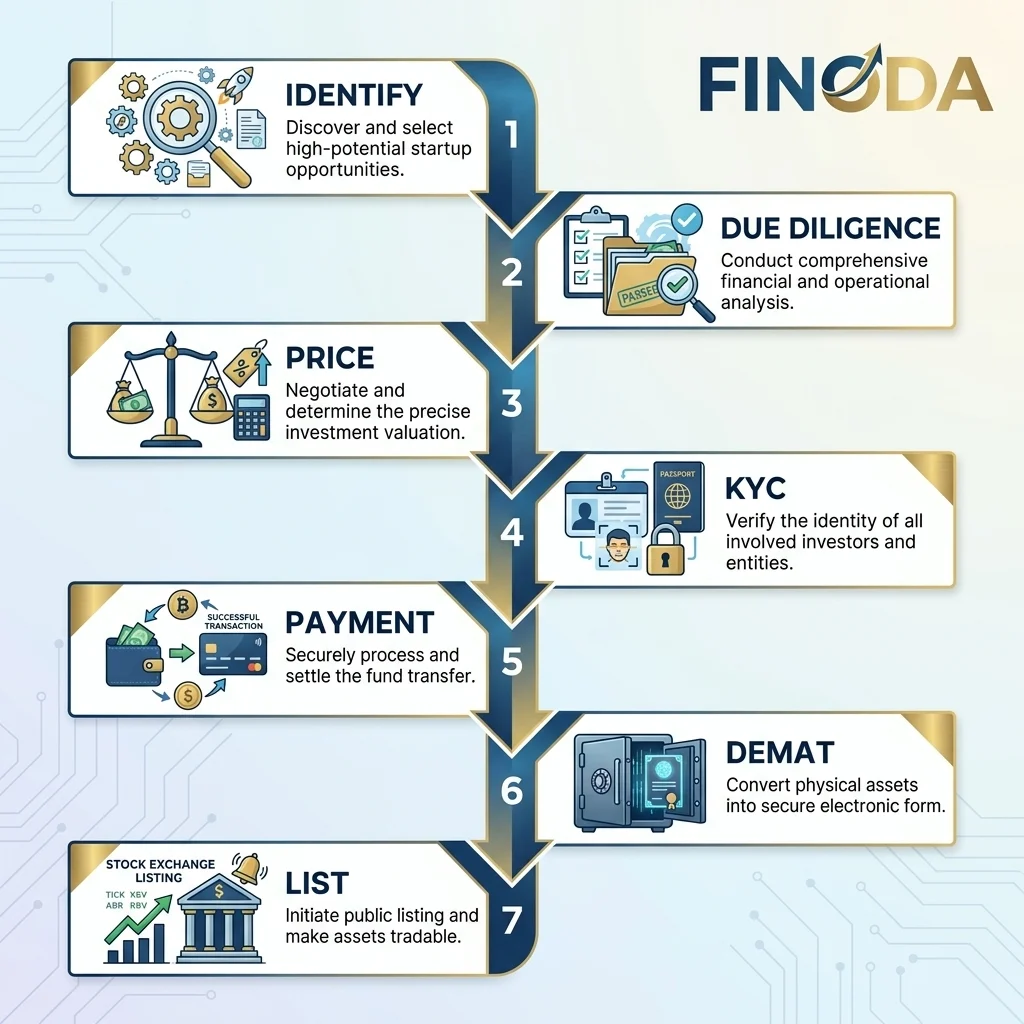
In our experience, most people understand what pre-IPO investing is — but not how the actual transaction happens. So here's how we do it at Finoda, step by step.
Step 1 — Opportunity Identification
We track companies across sectors that are actively preparing for an IPO — through DRHP filings, SEBI observations, and our network of corporate advisors. Not every company with buzz makes our list. We filter hard.
Step 2 — Due Diligence
Before we recommend anything to a client, our team reviews the company's financials, promoter background, sector outlook, and IPO intent. We look at revenue trajectory, debt levels, and whether the business model actually works.
Step 3 — Price Negotiation
Unlike IPOs, pre-IPO share prices are negotiable. We secure deals at prices that reflect current fundamentals — not inflated grey market speculation.
Step 4 — KYC & Agreement
You complete your KYC with us, and a formal share purchase agreement is signed between buyer and seller. Everything is documented.
Step 5 — Payment & Share Transfer
Payment goes through banking channels. Shares get transferred to your demat account directly — you can verify this with CDSL or NSDL after the transfer.
Step 6 — Hold Period
You hold the shares until the company lists. Depending on the deal, this could be 6 months to 3 years. We keep you updated on any IPO developments during this time.
Step 7 — Post-Listing & Exit
After IPO listing, a SEBI-mandated lock-in period of 6 months typically applies to pre-IPO shareholders. Once that expires, shares are freely tradable on NSE or BSE like any other stock.
For a broader look at IPO investing and GMP tracking, explore our IPO Investing page →
Current Pre-IPO Opportunities — Finoda's Curated Selection
The Indian IPO pipeline for 2026–27 is exceptionally active. Below are some of the companies that investors are currently watching. This list is updated periodically. Contact our advisory team for exact availability, current pricing, and minimum investment details.
⚠️ **Disclaimer:** Pre-IPO transactions are not directly regulated as exchange transactions. All investments carry risk. Please consult a financial advisor before proceeding. Finoda operates under applicable financial market guidelines.
| Company | Sector | IPO Stage | Expected Timeline | Min. Investment | Risk Level |
|---|---|---|---|---|---|
| PhonePe | Fintech / Payments | Pre-DRHP | 2026–27 | Contact us | High |
| Tata Capital | NBFC / Finance | DRHP filed | 2026 | Contact us | Medium–High |
| Lenskart | Consumer / Eyewear | Pre-DRHP | 2026–27 | Contact us | High |
| Vikram Solar | Renewable Energy | SEBI approved | 2026 | Contact us | High |
| Reliance Jio | Telecom / Digital | Pre-filing | 2026 | Contact us | Medium |
Note: IPO timelines are indicative and subject to SEBI approvals and market conditions. We recommend speaking directly with our advisors for updated information.
Also explore our IPO GMP tracker and upcoming IPO calendar → to stay ahead of listing dates.
If you're an HNI investor looking to combine pre-IPO exposure with managed portfolio returns, our Portfolio Management Services → may be a strong fit alongside.
Pre-IPO Investment Risks — What You Must Know Before Investing
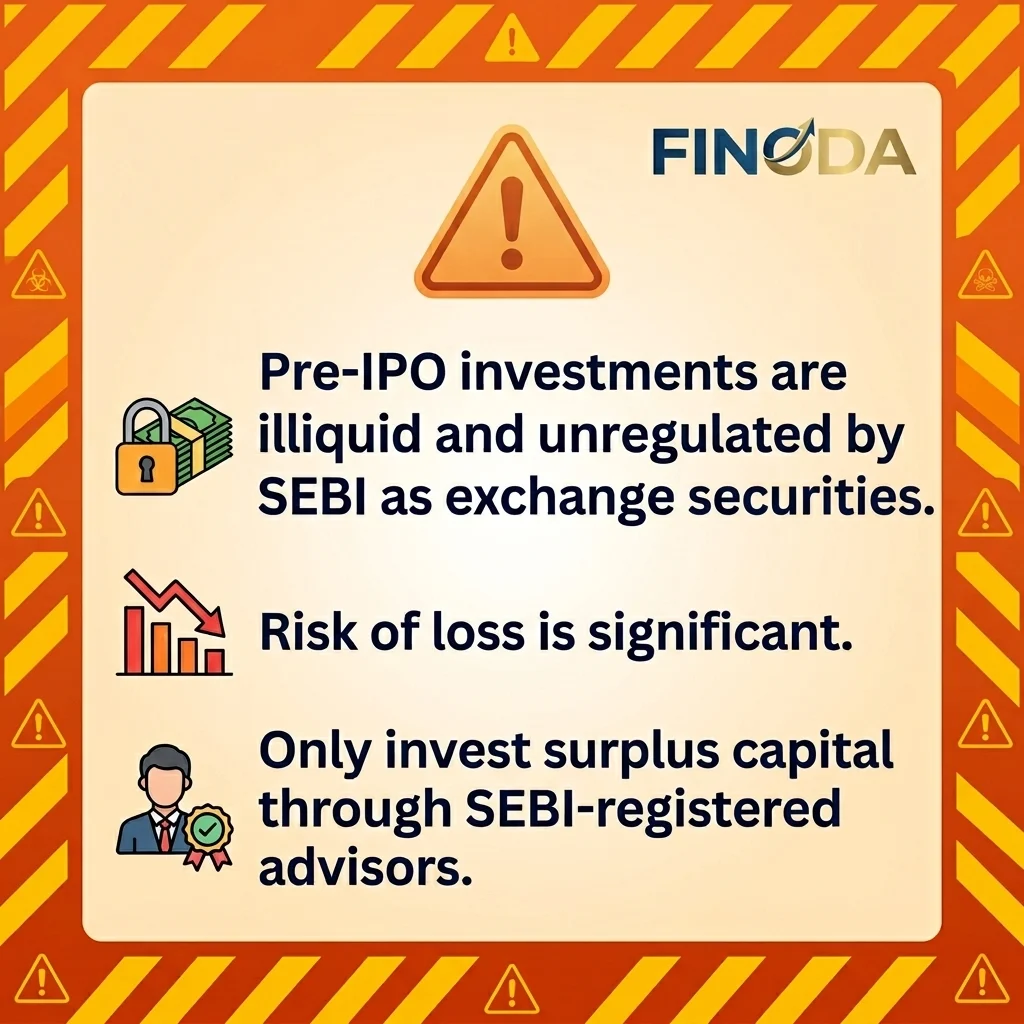
We'll be direct here. Pre-IPO investing is not for everyone. And we'd rather tell you the hard truths upfront than have you discover them after you've committed capital.
Risk 1 — IPO May Be Delayed or Cancelled
A company can withdraw its DRHP, fail to get SEBI approval, or simply decide the market conditions aren't right. There's no guarantee a planned IPO will happen on the expected timeline. We've seen this happen with well-known names.
Risk 2 — Illiquidity
Unlike listed shares, you can't sell pre-IPO shares at the click of a button. There's no live market. Exiting before listing depends on finding a willing buyer — which isn't always easy, especially in a down market.
Risk 3 — Valuation Uncertainty
Grey market prices can be speculative and misleading. A company trading at ₹1,200 in the unlisted market may list at ₹900, or it may not list at all. Pre-IPO pricing is not a scientific process.
Risk 4 — Lock-in After Listing
Even after the IPO, SEBI regulations typically require pre-IPO shareholders to hold for 6 months post-listing before they can sell. So even if the stock lists at a premium, you can't exit immediately.
Risk 5 — Promoter and Governance Risk
Private companies are not subject to the same disclosure standards as listed entities. Audited financials, related-party transactions, and promoter conduct all require independent verification.
What to do: Never put more than 5–10% of your portfolio into pre-IPO investments. Always transact through intermediaries who operate under applicable regulatory guidelines. And always read the Risk Disclosure document → before committing.
Why Finoda for Pre-IPO Advisory?
Most platforms in this space are order-takers. Someone calls, they send a payment link, shares arrive in your demat — end of conversation.
We don't work that way.
At Finoda, we've built relationships with deal originators across Bangalore's startup corridor — Koramangala, HSR Layout, Whitefield — and beyond. That means we see opportunities before they hit the broad market. We've found that startup employees looking to sell their ESOPs, and HNI investors looking to buy early-stage equity, both benefit from a trusted middle layer who understands both sides.
Moreover, we pair pre-IPO advisory with broader wealth management. If you're serious about building a portfolio — one that includes listed equities, SIPs, and early-stage exposure — that's the kind of end-to-end conversation we want to have with you.
We operate under SEBI guidelines, and our processes are aligned with applicable financial market regulations. You're protected by proper documentation, transparent pricing, and genuine after-sale support.
10,000+ investors trust Finoda. ₹100 crore+ in assets under advisory. 8+ years of market experience. See why investors choose us →
📞 Request Your Free Pre-IPO Consultation →
WhatsApp us directly: 9035294343
Pre-IPO FAQs — Expert Answers
Pre-IPO shares are purchased before a company files for or receives SEBI approval for a public listing. An IPO is the formal public offering where shares are sold through NSE or BSE to retail and institutional investors. Pre-IPO typically offers lower entry prices but comes with higher risk — no exchange regulation, no guaranteed liquidity, and no fixed timeline. The IPO, on the other hand, is regulated and transparent but the easy gains are often already priced in by the time retail investors can apply.
Plan for a holding horizon of 1 to 3 years, realistically. After the company lists, SEBI mandates a 6-month lock-in for shareholders who acquired shares within 6 months before the IPO filing date. Beyond the lock-in, how long you hold is a function of valuation, your financial goals, and market conditions. We generally advise clients not to enter pre-IPO with a short-term mindset — this isn't a 3-month trade.
Minimum investment varies by deal structure and company. At Finoda, starting investments typically range from ₹50,000 to ₹5,00,000 depending on the company's valuation, lot size, and current demand. Some high-demand names may have higher minimums. Contact our advisory team for current availability and exact deal terms.
Yes, buying and selling pre-IPO or unlisted shares is entirely legal in India. It happens through private, off-exchange transactions between buyers and sellers, facilitated by intermediaries. Companies involved are incorporated under the Companies Act and subject to applicable regulations. However, these transactions are not directly regulated as exchange trades — so it's important to work with credible advisors who follow proper documentation and KYC processes.
Pre-IPO share transactions in the secondary/grey market are not directly regulated by SEBI as exchange-listed transactions. However, the companies issuing shares are subject to the Companies Act, and SEBI regulations apply fully once the company goes public. Always ensure any pre-IPO transaction is done through properly registered and compliant intermediaries, with full documentation and demat-based share transfers.
Your shares remain with you in your demat account. You still own equity in the company — it just stays private. You have a few options: wait and see if the company relists its IPO plans at a later stage, find a private buyer through the grey market, or hold long-term as the business grows. The value of your investment depends entirely on the company's performance and future decisions. This is why Finoda emphasises due diligence before any pre-IPO recommendation.
Pre-IPO shares are transferred off-market directly from the seller's demat account to yours. This happens through a standard off-market transfer instruction — the process is the same mechanism used for gift transfers or court-ordered transfers on CDSL/NSDL. Once transferred, they appear in your demat holdings under unlisted/pre-IPO securities. You can verify the credit with your depository participant (DP).
NRI investment in unlisted Indian companies is permitted under specific RBI/FEMA provisions — broadly under the Foreign Direct Investment (FDI) route. However, the rules can be complex depending on the sector, ownership caps, and the company's own articles of association. We recommend NRIs get specific guidance before transacting. Contact our team and we'll walk you through the applicable requirements for your situation.
Taxation depends on when you sell. If you sell within 24 months of buying unlisted shares, gains are treated as Short-Term Capital Gains (STCG) and taxed at your applicable income tax slab rate. If you hold for more than 24 months before selling in the unlisted market, it's treated as Long-Term Capital Gains (LTCG) at 20% with indexation benefit. However, if you sell on the exchange after listing, the listed equity rules apply — LTCG at 12.5% above ₹1.25 lakh (for holding > 12 months post-listing), and STCG at 20% if sold within 12 months. Tax laws can change — always consult a tax advisor for your specific case.
There's no formal price discovery mechanism for unlisted shares — no exchange, no live order book. Prices are determined by supply and demand in the grey market, the company's most recent fundraising valuation, comparable public market multiples, and individual negotiations between buyers and sellers. This is why prices can vary significantly across platforms. At Finoda, we negotiate based on fundamentals — not on grey market speculation.
As per SEBI's Issue of Capital and Disclosure Requirements (ICDR) Regulations, shares acquired within six months prior to the IPO filing date are subject to a mandatory lock-in of six months from the date of allotment in the IPO. Shares held for longer than six months before the IPO filing have different lock-in rules. This means your exit window doesn't open the day the stock lists — plan accordingly.
We look at several factors: revenue growth trajectory, EBITDA margins, debt levels, sector tailwinds, promoter track record, competitive landscape, and whether the company actually needs to list (i.e., has credible IPO intent). We also look at comparable public market valuations — because a good private company at an overpriced valuation is still a bad investment. Our team publishes brief thesis notes for each pre-IPO opportunity we recommend to clients. Ask us for one.
PhonePe is one of the most watched pre-IPO names in India right now. While the company has not yet filed a DRHP, it continues to be traded in unlisted markets. Availability, pricing, and lot sizes change frequently. Contact our team directly to find out the current status and whether an investment makes sense at current valuations. We'll give you a straight answer — including if we think it's overpriced.
Resources & References
- SEBI IPO Regulations & Guidelines → (Regulatory authority for IPO filings in India)
- NSE Emerge — SME Listing Platform → (Post-listing platform for SME companies)